





.jpg)

According to the UN Women, over 15% of women in Gaza have experienced violence from their husbands over the past year, while over half of these women have experienced it more than three times.
A 38-year-old woman in Gaza, after spending massive amounts of time searching for food and scraping together what she had left, felt that she had found the solution to her problems. A friend had referred her to a man who she was informed could help with aid, food, and potentially even a job. After meeting with him, she was promised exactly those things, including a six-month contract.
When it came to the date that she was told she would sign her contract, she was led to an apartment where the man told her to remove her headscarf after complimenting her. He said he wouldn’t force her to do anything, but later wouldn’t let her leave the apartment until they eventually had a sexual encounter. The women in the interview chose not to go into detail regarding the encounter, out of shame and fear. Before she left, she was given what translates to approximately thirty American dollars, and weeks later, she was given some medicine and food.
According to PBS News, the woman stated, “I had to play along because I was scared, I wanted out of that place.”
Image Credit: Becker1999 from Wikimedia Commons
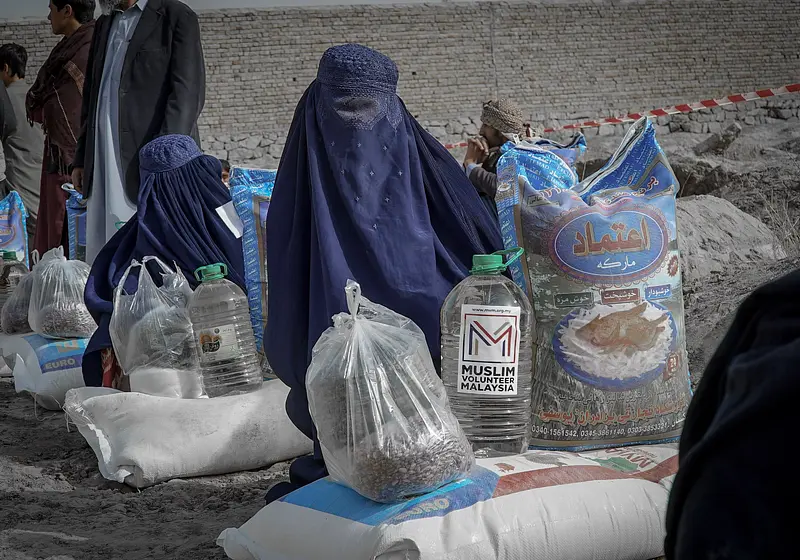
As the Humanitarian Crisis in Gaza continues to grow, many women have reported incidents similar to this one, where they have been promised access to resources in exchange for sexual encounters with local men. According to the Associated Press, many women have encountered verbally direct men, while others have been culturally resonant, suggesting marriage and manipulation.
The growing desperation that women have to face out of fear has particularly driven women to make these unthinkable decisions. Additionally, as stated in the AP’s report, this desperation has also stemmed from many women being left to be single mothers and unable to support their families.
Although most who spoke to the reporters denied giving in to the men’s requests, it was also stated that many men would act as aid workers, noting their phone numbers to exploit the women later. Many of the women have also stated that they are unaware of which aid groups these men are associated with.
This exploitation has further taken a toll on many of these women, with psychologists working closely with humanitarian and care organizations stating that many vulnerable women have been taken advantage of, leaving some even impregnated.
This form of exploitation against women has also been quickly emerging in Palestine, Haiti, Sudan, Congo, Chad, and many more countries.
Image Credit: Muhammad Sabah from Wikimedia Commons
A few months ago, the violence against young women and girls in Palestine inflicted by Israeli forces was so extreme in its existing legal and criminal atmosphere, to the point where Reem Alsalem had called for a halt on what she called “Femi-[censored]”. She uses this term to express how Israeli forces are making attempts to destroy all Palestinian women, and with that, the entirety of the population.
According to the United Nations Human Rights Organization, “What is happening to Palestinian women and girls is not collateral damage of war,” Alsalem said. “It is the intentional destruction of their lives and bodies, for being Palestinian and for being women.”
As of July 9th, 2025, around 67% of the 57,680 Palestinians had been murdered.
Image Credit: John Englart from Wikimedia Commons
Many instances of sexual violence throughout Gaza have been underreported, with many women in Gaza living in fear of social stigmas and condemnation from their own communities if they speak out. There has also been a rising potential for retaliation from perpetrators. The institutional and fragile legal systems in Gaza often fail most women who attempt to report incidents.
Many legal individuals and systems, such as the police and courts, experience a lack of capacity in investigating sexual crimes. As a result, most perpetrators often act with impunity.
Additionally, many NGO institutions and aid agencies report that most survivors don’t report incidents due to the belief that nothing will be done, distrust in institutions, and the fear of disruption to their safety.
Many girls and women in Gaza have also been further displaced from their homes, forced into overcrowded shelters, temporary camps, and damaged buildings, especially due to the intensification of the war and blockade. In many of these settings, protection is minimal, meaning that women are more likely to be exposed to unsafe situations.
Damaged infrastructure further presents difficulties for women who must travel at odd hours to acquire resources, thereby weakening their protective mechanisms. There is also a further increase in the number of women who left as the sole breadwinners of their families due to the many imprisoned, murdered, and unstable men.
Image Credit: Becker1999 from Wikimedia Commons
As the war has progressed, many manipulative tactics have been in play regarding attempts to exploit women. Many men promise long-term marriages and support, pressuring women, while others resort to threats and blackmail. After a woman has participated in a sexual act, they can be blackmailed through threats to expose her shame to her family or use her as a [censored] slave, depriving her of promised aid.
Some survivors receive minor compensation for non-consensual sexual exploitation. Several of these tactics allow for repeated abuse, as some women have even reported that the same men reappear, contacting them, demanding further sexual favors, and using threats if they refuse.
Even after the sexual exploitation has taken place, many women are left with physical injuries, such as sexually transmitted infections and unwanted pregnancy; psychological trauma such as PTSD, anxiety, and depression; social shame in conservative or patriarchal communities where victims are blamed and silenced; economic instability where survivors can also lose social standing or marital prospects; and disruptions in family life where young children may suffer if a mother is traumatized, forced to relocate or unable to care for them.
In many of these instances, women have resorted to survival [censored], where women engage in sexual interactions in exchange for necessities. Various aid agencies have reported men offering assistance in exchange for sexual assistance in countries such as Syria, Congo, and more.
Legal redress in Gaza has remained elusive as Gaza’s legal systems have remained strained. Prosecution of sexual violence has become a low priority due to resources being diverted to reconstruction. Although international law prohibits sexual exploitation and violence in war scenes, it has become further challenging to enforce these rules in war-driven environments.
Many activists have encouraged and urged international donors to tie assistance to human rights conditions, including zero tolerance for sexual exploitation. International agencies, such as the UN and various NGOs, have been calling for documentation of survivors and independent investigations.
Sexual violence against women in Gaza is a systemic coercion stemming from the downfall of humanitarianism. As efforts are made internationally to provide aid to Gaza and various other war-stricken countries, justice and protection should also be noted.
Through this exploitation, women are constantly being oppressed, as their bodies are objectified in exchange for valuable resources. They are only seen for their physical attributes and are disregarded in relation to their status as mothers and overall human beings. Many occurrences, such as these, have further contributed to the violence in Gaza, which has developed into a humanitarian crisis.
Many local men seem like they are be able to capitalize on the religious and culturally conservative social environment that persists in Gaza, as a Muslim-populated country, allowing them to oppress and manipulate women for their own personal gain. These men tantalize vulnerable women, using threats of public humiliation and violence. This psychologically abusive tactic leaves several women in Gaza feeling despair.
The psychological toll that these women have to face after the sexual violence is passed down to their children, who also have to experience the aftermath of the encounters. With the current hardships that are already present for those in Gaza, this form of psychological harassment towards mothers can often lead to inconsistencies in development, paired with the lack of resources for these children.
These sexual encounters can be classified as forced labour, and the growth of the extremity of the conflict has only worsened the possibility for sexual violence, increasing it due to the lack of legal supervision and the deterioration of the justice system.
Along with the oppression that women endure from opposition forces, they continue to experience oppression locally, contributing to the unsafe environment that has been growing in Gaza.
The stories of women represent the erasure of dignity and humanity in Gaza. Under exploitation, these women carry on the psychological implications of raising the next generation. In order to end this cycle, their voices must be amplified, their safety must be prioritized, and their humanity recognized. In Gaza and beyond, justice for them is justice for all!




.jpg)

.jpg)