





Facilities are being burned. Legislators have fled.
Indonesian citizens now face skyrocketing taxes and a collapsing job market, while lawmakers enjoy housing allowances of up to USD 3,000 a month and dance in parliament instead of working. Protests have spiraled into violence, homes of officials have been looted, and a Gojek driver, who was NOT involved in the protest whatsoever, was killed in the chaos.
This is the country's most serious crisis since 1998, when mass protests toppled Suharto's 32-year dictatorship. But unlike 1998, today's unrest comes in the middle of an economy burdened by colossal debt, an ambitious yet unpopular capital city project, and a government that seems more concerned with self-preservation than public welfare.
Let us slide into your dms 🥰
Get notified of top trending articles like this one every week! (we won't spam you)Debt, Nusantara, and the Tax Squeeze
Announced in 2019 by the then-President Joko Widodo, Nusantara is the government's ambitious plan to move the capital from Jakarta to East Kalimantan. By early 2025, he had already spent IDR 75.8 trillion (nearly USD 5 billion) on the project, with the current President Prabowo committing an additional IDR 48.8 trillion (around USD 3 billion) for 2025-2029 to continue development.
The government now faces IDR 800 trillion in maturing debt, and to cover these mounting debts, the government has resorted to steep tax hikes. However, the burden isn't falling on the wealthy or politically connected. Instead, everyday Indonesians are paying the price. Property tax has risen by 250%, and other goods are also facing sharp price increases.
The symbolism could not be more damning. Families struggling to afford basics like cooking oil or transportation are being asked to "sacrifice" for a futuristic capital that few believe will benefit them. Meanwhile, those with connections in the political elite continue to enjoy tax loopholes and lavish subsidies.
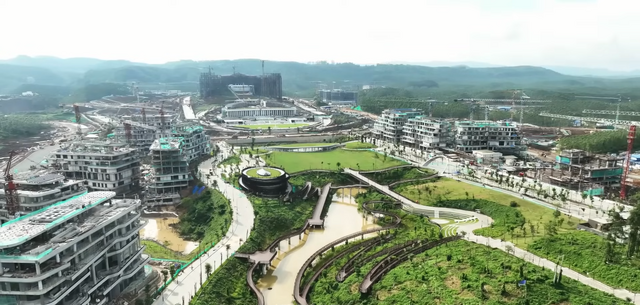
Image Credit: PUPR Permukiman Kaltim (East Kalimantan Public Works and Public Housing Office) from Wikimedia Commons


Take the Quiz: Religion, Schools, and Equality
Religion in Schools: Teaching Respect, Not Bias.
Lawmakers Sleep While the Nation Burns
Nusantara may represent the government's misplaced priorities, but the perks enjoyed by lawmakers are the clearest example of Indonesia's broken political culture. Members of parliament were found to be receiving up to USD 3,000 per month in housing allowances, in addition to a USD 150 "rice allowance" (when rice costs less than a dollar per pound), proving to be a euphemism for funds that have little to do with food and everything to do with luxury living.
These perks became even more insulting in the context of viral footage showing lawmakers sleeping during parliamentary sessions or even dancing inside the chamber. It's gotten as far as a running joke in Jakarta's Model United Nations circle that if you've been allocated to the House of Representatives council, you don't need to worry about accurate representation. All you need to do is wear pajamas and bring pillows to sleep in committee sessions!
For ordinary Indonesians who are being asked to shoulder crushing taxes and cope with rising unemployment, this was proof that their representatives had abandoned their duty.
To make things worse, several lawmakers were caught fleeing the country. An official boarded Singapore Airlines in business class to Frankfurt, Germany, while others quietly slipped away to Singapore, amongst other places. These lawmakers have also mocked the protesters, with one legislator explicitly calling the public "tolol," a degradatory term to insult one's intelligence.
Asset Confiscation Bill
One of the most powerful demands of student protesters has been the passage of the long-stalled Asset Confiscation Bill (RUU Perampasan Aset). This piece of legislation would give the state authority to seize wealth proven to stem from corruption without letting cases drag on indefinitely through the courts. This bill has been pending since 2008, with successive administrations unable or unwilling to move it forward.
President Prabowo publicly endorsed the bill on May Day, saying, "They steal and then don't want to return the assets, but they don't want to return the assets. I'll just seize them." Still, the bill didn’t make it onto the 2025 legislative agenda, a choice interpreted by many as blatant obstruction by lawmakers whose own wealth could be at risk.
When the protests erupted in August, one of the clearest rallying cries was for the confiscation law to finally pass. Some lawmakers were found to own multiple luxury properties, one reportedly with as many as 19 assets. During the chaos, looters stumbled upon absurd spoils: bathtubs, Iron Man figurines, labubu dolls, a watch worth nearly IDR 12 billion (nearly USD 800,000), and even Maine Coones.
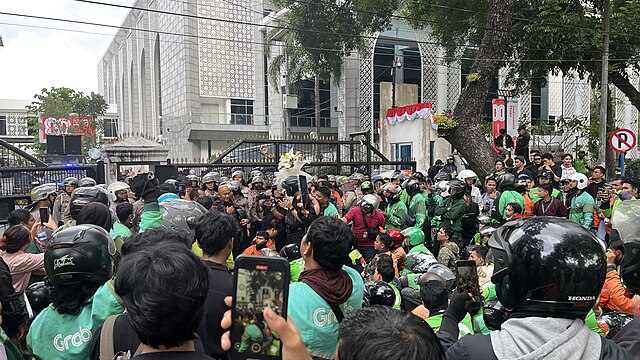
Image Credit: Nafisathallah from Wikimedia Commons
Unemployment & Broken Economic Promises
Amid sweeping protests and rising unrest, the government continues to tout lofty economic targets: an 8% annual growth by 2029 and the creation of 18 million new jobs. Yet, growth remains stuck at around 5%, while youth unemployment and underemployment continue to rise.
I was invited to an energy conference event hosted by the Purnomo Yusgiantoro Center on August 22-23, where officials proudly announced plans to retrain 3,000 specialists for green industry jobs by the end of this year. It wasn't a mistake; they clearly meant specialists. In a country with so many low-income youth struggling to find basic employment, this felt less like economic stimulus and more like symbolic theater.
What makes this especially infuriating is that while grand job numbers are being broadcast, massive structural unemployment remains unaddressed. Ojek (motorbike) drivers, gig workers, and local factory laborers, unorganized and unpaid, have watched the elite bask in wealth while promises to "lift everyone up" have stayed hollow.
NasDem Party and the Corruption Legacy
To those unfamiliar with Indonesian politics, Partai Nasional Demokratis (National Democrats) might sound like a reform-oriented party, yet you couldn’t be more wrong. NasDem's credibility has taken major hits, most notably when Johnny G.
Plate, who served as Communications Minister and was also NasDem’s secretary-general, was arrested in 2023 for corruption linked to a 4G infrastructure project that allegedly cost the state IDR 8 trillion (about USD 540 million). He was eventually sentenced to 15 years in prison, a decision that sent shockwaves through the ruling coalition and cast a harsh spotlight on NasDem's role in governance.
For many Indonesians now protesting in August 2025, NasDem isn't part of the solution, but it is part of the problem. The party's tarnished image, linked with high-level corruption and stalled reform bills like the Asset Confiscation Bill, reinforces the narrative that Indonesia's political elite, regardless of party banner, is self-serving.
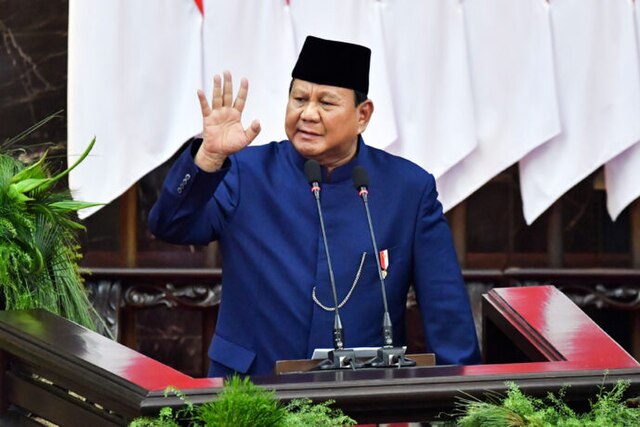
Image Credit: Rahmat, Public Relations of the Cabinet Secretariat of the Republic of Indonesia from Wikimedia Commons
The Poisoned Free Lunch Program
This may seem unrelated, but the Free Nutritious Meal (MBG) initiative was supposed to be a cornerstone of Prabowo Subianto’s campaign, a bold strategy to slash child malnutrition and boost school attendance by delivering one meal a day to around 19.5 million children and pregnant women. Budgeted at IDR 71 trillion (approximately USD $4.5 billion) in 2025 and projected to cost $28 billion by 2029, MBG was framed as a path to a "Golden Indonesia."
However, within months, in Sukoharjo, over 40 students were food-poisoned after eating marinated chicken. In West Java, over 200 students were hospitalized with confirmed cases of E. coli and Salmonella contamination. In Sragen, Central Java, 365 people fell ill after consuming the state-provided lunch. Authorities immediately shut down one kitchen and suspended services for 13 schools.
Multiple outbreaks in Cianjur, Bogor, and Kupang have added up to over 1,300 cases across 10 provinces. Universitas Gadjah Mada food safety experts warned that such an expansive program needs tight controls, from food sourcing and kitchen hygiene to cold-chain logistics. Without that, the risk of contamination increases exponentially.
President Prabowo may have big dreams for Indonesia, but at this point, one can only wonder if the money was efficiently allocated for this program…
Media Blackout
If you want to know how grave the situation has become, let's look at what didn't make it onto screens. Across Indonesia, mainstream media outlets, radio, TV, and major newspapers have delivered minimal coverage of the protests. Many citizens first learned about the scale of the protest, the looted mansions, and the police killings through shaky TikTok clips and WhatsApp forwards, not through professional reporting.
Then, on August 30, TikTok suspended its Live feature in Indonesia. Telegram and X (formerly Twitter) users complained of upload throttling and missing posts. Meanwhile, the government's Digital Affairs Ministry denied any official blocks or restrictions, claiming unconstrained media coverage and urging platforms to fight disinformation instead.
Given Indonesia's historical habits with censorship, silence now speaks volumes. Independent organizations like Human Rights Watch and Reporters Without Borders have documented mounting threats against journalists: intimidations disguised as requests, DDoS cyberattacks, confiscated cameras, and physical assaults, including journalists being forced to delete footage from protests.
A theory has also spread quickly on social media about the fires throughout the nation: that police disguised themselves as protesters to provoke violence. Students, who make up the majority of protestors, rely almost entirely on public transportation to commute to university and their workplaces.
For them to be the perpetrators of the Transjakarta bus shelters, toll gates, and MRT entrances being burnt would simply be absurd, caging them to their own areas and interfering with their lives. This might as well have been portrayed by the media as staged to delegitimize the movement.
Now, protesters in Bandung, Jakarta, and Yogyakarta are met with water cannons, tear gas, and rubber bullets, deepening public anger.
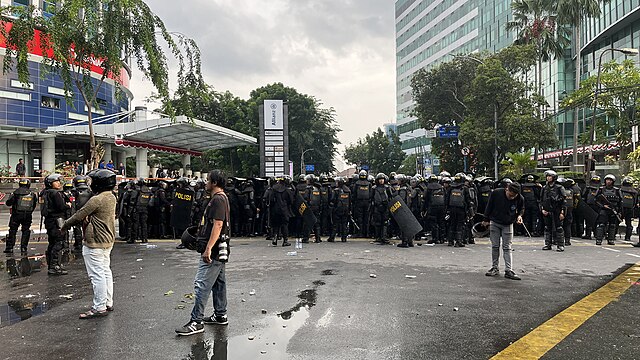
Image Credit: Nafisathallah from Wikimedia Commons
Fear in Classrooms
Perhaps the clearest sign of how deep this conflict is is not in parliament or at police barricades, but in the classroom. On August 31, 2025, the Jakarta Education Office issued a statement allowing schools near protest sites to shift to online learning (PJJ). Unfortunately, this is an admission that the city can no longer guarantee safety for its students.
Last Friday, at my campus, where school usually runs until 3 p.m., all students in grades 9-12 had rushed out by 1:30 p.m. Some teachers left even earlier, a few already out of school grounds before lunch. In the lower grades, half the students were gone before school ended. Parents aren't willing to gamble on safety when videos of clashes and burning highway gates circulate just a scroll away.
Echoes of 1998
For Indonesians over the age of 40, today's turmoil carries a haunting familiarity. Burning infrastructure, furious student rallies, and government paralysis immediately recall the 1998 Reformasi movement, when mass protests caused the downfall of President Suharto after 32 years of authoritarian rule.
In the past, the crisis was triggered by the Asian Financial Crisis, which caused the Rupiah to collapse, food prices to soar, and economic trust to evaporate. Total deaths from the unrest are estimated at over 1,000, with many perishing in burning buildings or violent clashes. The chaos finally subsided when President Suharto resigned on May 21, 1998.
Today's unrest is fortunately not at such a scale, but the parallels are impossible to ignore. Once again, students are at the forefront, organizing marches and rallies. Once again, the economy is under strain; this time from ballooning debt and unpopular taxes rather than currency collapse. And once again, corruption is the rallying cry.
TikTok livestreams of protests have been taken down, lawmakers are fleeing abroad, and parents are pulling their children out of school early. Reformasi was supposed to end the cycle of authoritarianism and corruption. And now, a generation later, Indonesians are asking: did it ever really end?