





Why Lines On A Map Decide More Than You Think
Most people learn that in a democracy every vote counts the same. Then you see a district shaped like a snake and realize something is off. The way voting maps are drawn can make some voices louder and others quieter, even when the total number of votes is similar.
That practice has a name: gerrymandering. It sounds technical, yet it reaches into daily life by shaping who writes the laws that guide schools, climate policy, public safety, and the budget for your community. This article explains what gerrymandering is, how it works, and what teens should watch for when they hear that a state is “redrawing the lines.”
Let us slide into your dms 🥰
Get notified of top trending articles like this one every week! (we won't spam you)What Gerrymandering Is
Every ten years, after the national census, states redraw the boundaries for legislative and congressional districts so that each has roughly the same population. In theory, this is a routine update. In reality, it is a chance for the party in power to draw lines that make it easier for its candidates to win and harder for opponents to compete. That deliberate shaping of districts to favor a side is gerrymandering. The term dates to 1812, when Massachusetts governor Elbridge Gerry approved a district so contorted that a newspaper cartoon likened it to a salamander, dubbing it a ‘Gerry-mander,’ which later became ‘gerrymander.’

Image Credit: Cornell University Library from Wikimedia Commons

Image Credit: Elkanah Tisdale (1771-1835) from Wikimedia Commons

Take the Quiz: Religion, Schools, and Equality
Religion in Schools: Teaching Respect, Not Bias.
How The Trick Works
There are two classic techniques. The first is called packing. Voters who tend to support one party are crowded into a small number of districts where they win by huge margins.
Those extra votes are “wasted” because you only need a simple majority to win a seat. The second is called cracking. That same group of voters is split across many districts so that they never form a majority anywhere, even if they are a large minority overall. Sometimes mapmakers also create comfortable districts for both parties to protect current officeholders, which weakens competition and accountability.
You can get a lopsided result this way. One party might win a slight majority of all votes statewide, yet the other party ends up with most of the seats because the lines were drawn to maximize their advantage. The shapes may look odd, but the real giveaway is the outcome: many safe seats, very few competitive races, and a legislature that does not reflect the overall balance of voters.
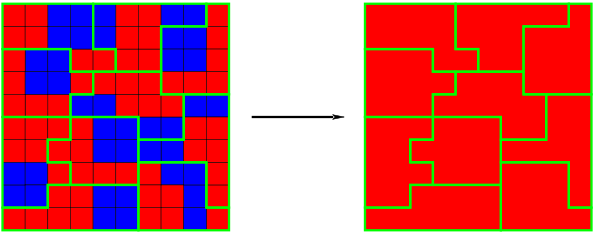
Image Credit: Levochik from Wikimedia Commons

Image Credit: Umbert' from Wikimedia Commons

Image Credit: Jeremykemp from Wikimedia Commons
Why It Matters For How Government Behaves
When most seats are safe, the real contest happens in party primaries, which tend to attract fewer voters who are more ideologically committed. Candidates then have strong incentives to please the most active part of their base rather than the center of the district. That dynamic can push policy toward the extremes and make compromise harder.
For teens, that translates into stalled action on issues that need broad coalitions, including climate adaptation projects, school funding formulas, technology and privacy rules, and public transportation plans. If your representative is shielded from competition by the map, it becomes easier to ignore concerns from students and first-time voters.
Why Strange Shapes Are Not The Whole Story
Unusual outlines get attention, but a pretty shape can still hide an unfair map. Some communities are naturally irregular, especially around rivers, highways, or neighborhoods with different populations. The key questions are different.
Are cohesive communities split apart for no good reason. Do statewide votes regularly translate into unbalanced seat totals. Are most races decided long before Election Day. These clues show more than any outline can.
What Fairer Mapping Can Look Like
Several approaches can reduce manipulation. Independent or bipartisan redistricting commissions remove direct control from politicians and place it in the hands of panels that must follow public rules. Transparent criteria help too.
For example, keeping cities or counties together where possible, respecting communities of interest such as school zones or cultural neighborhoods, and avoiding the protection of incumbents. Open hearings and public mapping software allow residents to submit their own proposals and point out when a draft divides their community. Courts and state constitutions can also set standards against excessive partisan bias or discrimination. None of these steps ends politics, but they narrow the space for abuse and increase public trust.

Image Credit: Slowking4 from Wikimedia Commons
What Teens Can Do
You do not need to be eighteen to pay attention. Many states hold public meetings during redistricting and accept written comments from anyone. Students who organize neighbors to explain how a proposed line divides a school feeder pattern or a transit corridor can make a real impact.
Local newspapers and school publications often welcome explainers that show how a district map would change your area. If you are close to voting age, check whether your state allows pre-registration. When you do vote, do not skip state legislative races. They often control redistricting and state laws that affect daily life more directly than national politics.
Why This Matters To Gen Z
Gerrymandering is not only a math problem or a battle between parties. It is a representation problem. When maps distort who gets a seat at the table, the laws that emerge do not match the lived reality of young people who will be most affected by them.
Gen Z will inherit rising tuition costs, climate risks, digital privacy challenges, and complex job markets. Fair maps do not guarantee outcomes, but they do guarantee that your voice and your neighbors’ voices have a fair chance to shape those outcomes. Understanding how districts are drawn, speaking up when a draft divides your community, and voting in state and local elections are practical steps that keep the promise of equal representation alive. That is why this topic belongs on every teen reader’s radar.

Image Credit: Rob Kall from Wikimedia Commons





.jpg)





.jpg)