


SPOILER ALERT: This article contains major spoilers from the newly released first four episodes of Stranger Things. If you haven’t watched them yet, consider this your gentle warning to pause reading, binge the episodes, and come back when you’re ready.
After three whole years of anticipation for Netflix’s most viewed series’ fifth and concluding season, the first part of the new season has been released with a bang! Stranger Things does an outstanding job at re-creating the memorable friendship and feeling of being at home that Hawkins has to offer as well as reconnecting the audience with the nostalgia that makes the horrendously frightening scenes more palatable. Finally, Stranger Things has managed to perfectly combine horror and grief by recreating the intensity and emotional scars left behind from the trauma faced by Hawkins.
These initial four episodes are working towards building something larger than that of a simple horror show; they contain elements of complicated relationships between characters within the storyline, psychological elements to combine with the horror aspect of the show, and also they have an ability to become increasingly aware of its own mythology.
While the ambitious level of these four episodes is tremendous, they do present a challenge for the producers and writers to maintain a very fine balance between delivering a great product and falling short of the expectations of the audience. The four-part episodes hold a significantly higher level of momentum, excitement and emotional gravity than you might expect; however, at certain times during these episodes, viewers will find that the full significance of these critical events is not clear to them.
Here are my thoughts.

Image Credit: Stranger Things Comic-Con 2017 from Wikimedia Commons
Episode 1: A New Hawkins, an Old Fear
Episode one sets the stage with a visual boldness the show hasn’t attempted before. Hawkins as a military colony feels both dystopian and disturbingly plausible. The quarantine doesn’t just change the town; it sterilizes it. The once-soft edges of suburban midwestern life are replaced by checkpoints, flashing lights, and the constant hum of surveillance.
The gate tearing open in Holly Wheeler’s room is the season’s first true jolt: intimate, unexpected, and eerily domestic in a way the show does well when it remembers to. Will’s telepathic flashback-vision is equally chilling, a reminder that the mind remains a battleground, even when the world outside is burning.
But what the episode gains in scale, it loses in tension. When Dustin is brutalized at Eddie’s grave, we feel outrage and sorrow, but not fear. And that is the show’s most dangerous flaw.
The main characters feel narratively untouchable. We’ve been conditioned to expect survival, redemption, miraculous escape. The stakes don’t raise your heartbeat; they simply mark time.

Image Credit: Alicia Quan from Unsplash
Episode 2: Holly, Henry, and the Uneasy Return of Vecna
Episode two taps into the series’ earlier horror sensibilities. Holly’s disappearance is unsettling on its own, but the reveal that “Mr Whatsit” is Henry adds a cold, almost mythic dread to the story. It’s a reminder that innocence has always been Vecna’s favorite canvas.
Eleven and Hopper navigating the Upside Down carries a quieter emotional weight. Lucas’s devotion to Max is heartbreaking; he moves through the story like someone carrying a ghost on his back. Will’s realization that his visions are actually Vecna’s point of view is one of the season’s sharpest twists.
But once again, the power scaling fractures the story. Eleven’s powers have been used to create a narrative “dimmer switch,” becoming brighter or duller based on what the scene requires. This has begun to be very jarring. How are we meant to fear for someone when even the writers seem unsure of her limits?
Episode 3: A Morally Grey Mission and a Beautiful Mess
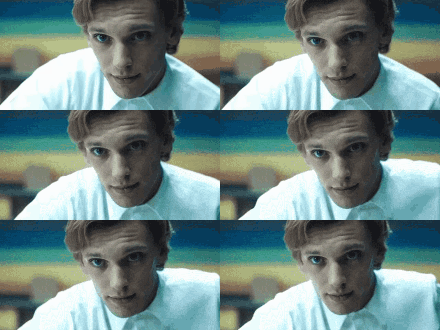
Episode three takes a rare leap into moral ambiguity. Using Derek Turnbow as bait is an adult moral grey area and a real narrative gamble (it’s refreshingly human); you realize that desperation alters people; that survival is not always a heroic act.
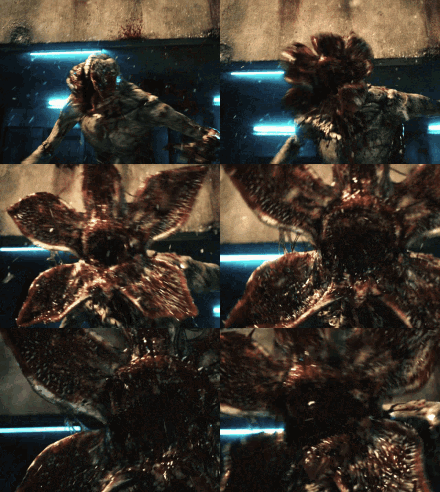
But the monsters continue to suffer from the show’s most persistent flaw: selective threat levels. Demogorgons are terrifying only when the plot needs them to be. Additionally, they are portrayed as bafflingly inept creatures that can withstand military-grade weaponry, but somehow succumb to household weaponry that has been cobbled together.
The episode may be uneven, but the atmosphere is beautiful. Holly’s journey through Henry’s childhood home is like walking into a fairy tale cursed, and her meeting with Max in the woods is one of the most heart-wrenching scenes of the series so far; it’s both haunting and beautiful at the same time.
Episode 4: A Reveal, a Rescue, and a Lot of Narrative Convenience
Episode four storms forward with momentum. Hopper and Eleven infiltrating the military base is gripping, and the reveal that the “captive Vecna” is actually Kali could have been fascinating—if the show had committed to its own darkness.
But instead, we get a safer route. Vecna’s motivations become increasingly inscrutable. Sparing Will makes no tactical sense.
Pivoting suddenly to “collect twelve children and rebuild the world” feels like the writers reinventing his arc rather than expanding it. His behavior no longer tracks with his carefully constructed psychology in Season 4.
Will’s psychic breakout is emotionally powerful, but once again, the logic feels off. It’s hard to suspend disbelief when the story bends physics and psychology just enough to protect its protagonists.

Image Credit: Matt and Ross Duffer from Wikimedia Commons
Where the Season Falters: The Problems No One Can Ignore
These first four episodes shine in atmosphere and character intention, but the cracks are becoming harder to ignore.
1. No real stakes for the main cast, and the show knows it.
We aren’t afraid for anyone. We’re waiting for the scheduled escapes, the timely interventions, the convenient bursts of power.
2. Eleven’s fluctuating power levels weaken tension.
She’s as strong or as weak as the script needs her to be. It breaks immersion.
3. Vecna’s motivations are collapsing under narrative pressure.
His moves no longer feel strategic or psychologically rooted; just convenient.
4. The military storyline is undercooked.
Hawkins is under martial law, yet the plot progression around it feels strangely casual.
5. Internal logic is unstable.
Max’s mother never visiting even though she's been in the hospital for over a year. Machinery appearing unnoticed. Demogorgons changing threat level scene-to-scene. Emotional fallout evaporating in minutes.
Let us slide into your dms 🥰
Get notified of top trending articles like this one every week! (we won't spam you)Characters to Watch
There is a strange bittersweetness in watching characters you once understood so clearly drift into versions of themselves that feel slightly out of tune. Dustin and Steve, for instance, were once the emotional backbone of the show—the unexpected duo who found family in each other when the world was falling apart. But now their dynamic feels hollowed-out, stripped of its warmth.
Steve watches Dustin grieve Eddie, something Steve witnessed, something he shared, and yet the tenderness that once defined them has thinned into something unrecognisable. The writers seem to have forgotten how grief travels between people, how it reshapes them, how it should have reshaped both of them.
Eleven is another character caught in this gravitational pull. The show cannot decide who she is: a god, a girl, or an ever-shifting plot device. Her power levels rise and fall depending on convenience, not consequence.
She can snap necks with a blink in the early seasons, yet now she struggles to open a weird fleshy wall. And that inconsistency doesn’t just hurt her arc; it fractures the stakes of the entire story. Her success and failure does not feel like hers, based on the idea that her powers exist solely based on the needs of the story.
Max is not at very active within the story; her mother been shown as almost entirely useless and/or as a one-dimensional character that does not visit her daughter after being in a coma for nearly two years, lying in an empty room in a hospital where only Lucas ever visits her. It is not only unrealistic, but also very cruel.
And Will, the heart of the first two seasons, is once again positioned as a narrative tool rather than a person. Vecna had every reason to eliminate him, every reason to fear the insight Will’s connection gives him… yet the show sidesteps that logic entirely. Keeping Will alive should mean something. Instead, it feels like another loose thread the writers haven’t decided what to do with.
These characters are worth watching because their arcs are at a crossroads. They could return to emotional depth. Or they could continue sliding into the uncanny space where plot trumps humanity.

Take the Quiz: Which KPop Demon Hunters' Huntrix Member Are You?
Are you the chaos on stage or the calm in the storm? Let’s find your Huntrix twin.
What’s Working Well
Despite the narrative chaos, the show still shines in moments where atmosphere takes the lead. The world-building of Hawkins-as-military-base is visually compelling, even if the logistics fall apart when you think too hard about them (the giant radar on top of the car, the tunnels somehow still unnoticed after 18 months, the military behaving like it has never met the concept of civilian needs). Still, there is a mood the show captures that remains uniquely Stranger Things: that nearness of danger, that electric hum of something cosmic pressing against the edges of ordinary life.
Some of the aesthetic choices still land beautifully. The monsters may no longer make narrative sense, but their presence on screen still feels threatening enough to pull you back into the world, even if they’re somehow deadly only to nameless background characters and weirdly allergic to wine bottles. The show knows how to craft tension, even when it doesn’t know what to do with it.
The emotional potential is there. It’s just waiting for the scripts to catch up.

Image Credit: Stranger Things at Megacon 2024 from Wikimedia Commons
What the Fandom Is Getting Right (and Wrong)
The fandom has been sharp in recognising how stakes have evaporated. When viewers finish an episode already predicting that no real harm will come to the main cast, something vital has been lost. People are right to demand permanence, consequence, risk.
The monsters feel redundant; survival feels guaranteed. And the Wheelers, let’s be honest, don’t really count.
Fans are also right about Vecna’s plan feeling increasingly convoluted. The idea that he needed to recruit twelve kids retroactively undermines the elegance of his Season 4 arc. Was this always the master plan?
A backup plan? A narrative patch? It’s fair for viewers to ask why the writing inflates complexity instead of clarifying intention. And yes, the army harbouring a recovering Vecna would have been infinitely more interesting.
But here’s where some parts of the fandom miss the mark: they blame the characters instead of the writing. They critique El for inconsistency, Max for being “useless,” Steve for being insensitive, Dustin for being emotional. But none of that is rooted in character, it’s rooted in structural decisions. These aren’t failures of personality; they’re failures of storytelling.
Fandom discourse often swings between hyper-defensiveness and scorched-earth criticism. The truth lies somewhere quieter, more human: these characters still have the capacity to be whole. The writing just needs to remember who they were, what they’ve carried, and why audiences cared in the first place.
My Predictions: Where the Season Might Be Heading
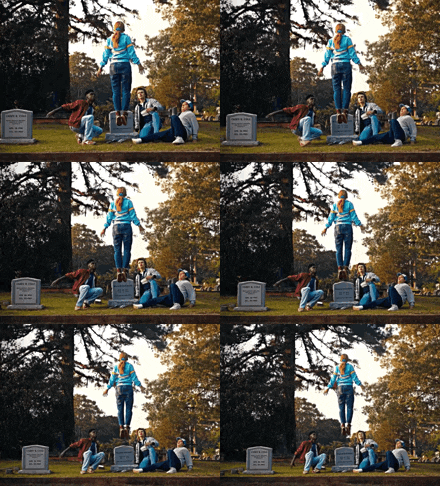
With four episodes behind us, the season has set up several threads, some compelling, some unstable. Here’s what I feel is most likely, based on the narrative trajectories so far.
1. Will’s Powers Will become the True Key to Defeating Vecna
The show is positioning him as a mirror to Henry; another psychic prodigy shaped by trauma. His visions and his connection to the hive mind make him dangerous, both to Vecna and possibly to the people around him. The real question: will he control this power, or will the final battle be as much internal as external?
2. Vecna’s Motives Will Shift Again—Possibly Toward Revenge
The child-harvesting subplot doesn’t feel permanent. It feels like a placeholder, a misdirection, or a late-season twist waiting to happen. The more coherent motive for Vecna is still emotional: resentment, abandonment, superiority. Expect a pivot.
3. Eleven Will Face a Crisis of Identity, Not Just Power
The fluctuating abilities are not just inconsistency, they’re setting up a theme. Eleven is losing control not because she’s weak but because she’s fractured. Her arc will return to identity: what she is without the powers, and who she becomes when she’s more than them.
4. Steve and Dustin Will Have a Major Confrontation
Their dynamic is too iconic to fracture gently. The writing is setting up a breaking point like some moment where Dustin’s grief forces Steve to confront his own avoidance. Whether they reconcile or rupture further will shape the emotional core of the final episodes.
5. Someone We're EXPECTING to Die Will Almost Die—But Still Not Actually Die
The show has trained us: dramatic injuries, emotional sacrifices, miraculous revivals. Expect a major fake-out in episodes 7 or 8.
6. The Military Will Become a Secondary Villain
Not the ultimate threat, but an obstacle that complicates the climax—possibly even interfering with the plan to defeat Vecna.
7. Holly and Max Are Going to Play an Unexpectedly Large Role
Their encounters with Henry aren’t incidental. Holly is being positioned as a symbolic bridge between innocence and corruption; Max as the living wound through which Vecna still operates. Their stories are on a collision course.
8. The Finale Will Try to Be Tragic—But May Hold Back
Stranger Things wants a gut punch. It wants a legacy. It wants emotional devastation. They've been hyping up that the season will break us and leave us devastated, but the real question is whether the show will actually commit, or fold at the last minute to protect its remaining icons.
Image Credit: Cottonbro Studio from Pexels
Fan Theories That Might Shape the Endgame
1. The “Dead” Aren’t Gone—They’re Suspended Somewhere Else
For years, the show has hinted that Vecna’s victims aren’t truly dead, and his line in Season 4: "They're still with me. In here.", feels less metaphorical and more literal. It suggests a shadow-Hawkins where the lost are held in psychic stasis, waiting for the story to finally acknowledge what it set up.
2. Max’s Absence Isn’t a Mystery... It’s a Location
Eleven couldn’t find Max at the end of Season 4, not because she vanished, but because she slipped into that alternate Hawkins. Max feels destined to become the quiet heartbeat of the Upside Down, fighting her way through its mirror streets long before the audience realises where she’s been.
3. The Clock Will Sync Two Worlds for the Final Collision
The grandfather clock wasn’t just horror imagery; it was a mechanism. The Upside Down is frozen in time, and the clock may be the device that accelerates it to match the real world. When both timelines lock into sync, the final battle will begin — two Hawkinses converging into one.
4. Emotional Reunions Will Hit Hard; Then Hurt More
If the suspended-souls theory is right, the reunions will be brutal: Bob and Joyce, Barb and Nancy, Eddie and Dustin, Billy and Max. Short, luminous moments that give the characters (and the fans) everything they ever wanted, just long enough to take it all away again.
5. Robin and Nancy’s Conversation Will Reshape Nancy’s Heart
The season feels poised for a quiet, grounding talk between Robin and Nancy, one that gently pushes Nancy toward clarity about Jonathan and Steve. In the end, she’ll choose Jonathan, and he’ll offer something startlingly sincere, like a promise of marriage if they survive.
6. Steve Will Try to Die a Hero, Nancy Won’t Let Him
Steve has reached the stage of his arc where self-sacrifice feels inevitable, but Nancy fully in her “Walk-’Em-Down Wheeler” mode will refuse to let history repeat itself. She’ll save him, scold him, and remind him he doesn’t get to choose martyrdom.
7. The Final Eleven–Vecna Clash Will Cost Her Everything
The showdown will be massive, messy, and nearly fatal. Eleven will survive, but the effort will burn the last ember of her powers. It’ll be framed as both tragedy and release—the end of the weapon she never wanted to be.
8. Destroying the Upside Down Will End the Ones Trapped Inside
If the Upside Down collapses, the suspended souls will collapse with it. Their brief reunions will be their farewells, not gruesome, not violent, just quietly inevitable. A soft closing of a door that has been open for too long.
9. The Ending Will Circle Back to Where It All Began
The show will reach for symmetry. A basement. A table.
Dice rolling across wood. Maybe they’ll play a final D&D game. Maybe Dustin will ask, “Anyone wanna play?” and everyone will shout, “NO!” Either way, the finale will fold the story back onto its origin point.
10. Karen Wheeler’s Storyline Is a Chekhov’s Gun Waiting to Fire
The series’ fixation on Karen’s romantic subplots either means absolutely nothing, or everything. Her past feels like unresolved narrative weight. Whether she once knew Henry Creel or carries some hidden link, Season 5 seems poised to finally expose it.
11. The Characters Who Feel Truly Safe
Some characters are narratively insulated: Eleven, Mike, Will, Max, Dustin, Hopper, Joyce, and Robin. Their arcs still have future written into them.
12. The Ones Standing on the Edge of the Coin Flip
Steve, Nancy, Jonathan, and Lucas sit in the uncertain middle. Lucas especially feels primed for a heroic death... saving Erica or Max in a moment that mirrors his growth and loyalty.
13. And the Ones Who Won’t Make It
Vecna’s death feels guaranteed. Karen’s feels like the tragic twist the writers have been quietly arranging since Season 1, a story thread finally snapping.
Final Thoughts: A Season That Thrills, But Doesn’t Always Convince
These first four episodes are rich, eerie, and full of potential. They offer mythology, emotional depth, and a sense of scale the show has been building toward for years. Although Stranger Things continues to be showy, entertaining, and occasionally has moments that feel truly epic, for an ending to create a lot of cultural momentum behind it requires a willingness to actually take risks.
Stranger Things isn't without its unevenness in tone, as well as its lack of resolution, so instead of taking the bold pathway forward into creating this culmination point of cultural importance, it has been more of a protector's path than an opportunity for risk-taking.
It needs to let the story hurt.
Until then, the terror will remain beautiful, cinematic, and haunting, but ultimately safe.

.jpg)


.jpg)