





I've wondered about the universe's true nature, its origin, and its existence my entire life.
I'm sure many of you have wondered the same - it's the million-dollar question, really; what caused all of this to exist? Hundreds of theories globally all aim to answer this question, and one subject is entirely dedicated to its answer:
Physics.
Forget the scary equations for a moment - trust me, as someone who takes the subject, it blows. Let’s take a guided tour through some of the most famous, strangest, and most important theories in physics - explained in a way that makes sense, beginning with the infamous genius himself, Albert Einstein.
Image Credit: Aldebaran S from Unsplash
Let us slide into your dms 🥰
Get notified of top trending articles like this one every week! (we won't spam you)Special Relativity (1905): The Speed Limit of the Universe
Imagine you’re on a train going near the speed of light (not possible yet, but imagine how fun F1 in space would be). A friend on the ground watches you zoom by. Special relativity says:
The laws of physics are the same for everyone, no matter how fast they’re moving.
The speed of light (300,000 km/s) is absolute. Nothing can go faster.
Now this may sound like common sense, but it leads to some wild consequences:
- Time slows down when you move close to light speed (time dilation). Imagine you are moving through space, and you are watching a ball of light next to you. This light emits photons, which travel at the speed of light toward you. When you are still, they have a short distance to travel. But when you move faster and faster, they have to travel further and further, but cannot speed up. Therefore, to reach you at the same time as they would have when you were still, time has to slow down while motion stays at the same rate, as if you pressed pause on the universe.
- Lengths shrink in the direction of motion (length contraction). For example, if a train were approaching near the speed of light, it would appear to be squashed horizontally. Imagine you are on this train, and it is travelling at the speed of light (c). You move forward at a speed of 2 km/h. This would suggest your speed is c+2. But this is impossible, because c is the speed limit of the universe. So in turn, the universe decides that the train will become much, much smaller so that your speed is equivalent to nothing - you are moving no kilometres per hour.
- Mass increases as you approach light speed. This is due to the famous equation E=mc^2. When you approach light speed, your energy increases. As your energy increases, your mass must too, according to this equation.


Take the Quiz: Where should you go during Summer break?
Discover your perfect summer escape—whether it’s sun-soaked beaches, vibrant cities, or hidden nature retreats waiting just for you.
General Relativity (1915): Gravity is Geometry
A decade later, Einstein went even bigger. Newton thought of gravity as a force pulling objects together. Einstein said: Nope, gravity is the curvature of spacetime itself.
Spacetime is the idea that instead of living in a 3D world, we live in a 4D world, where time is also a dimension, which basically means that when we move through the world, we also move through time. Now this sounds pretty insane and impossible to picture. But imagine this:
Spacetime is a trampoline. Place a heavy bowling ball (the Sun) in the middle - it makes a dip. Smaller marbles (planets) roll around the dip, not because the Sun is “pulling” them, but because the surface is curved.
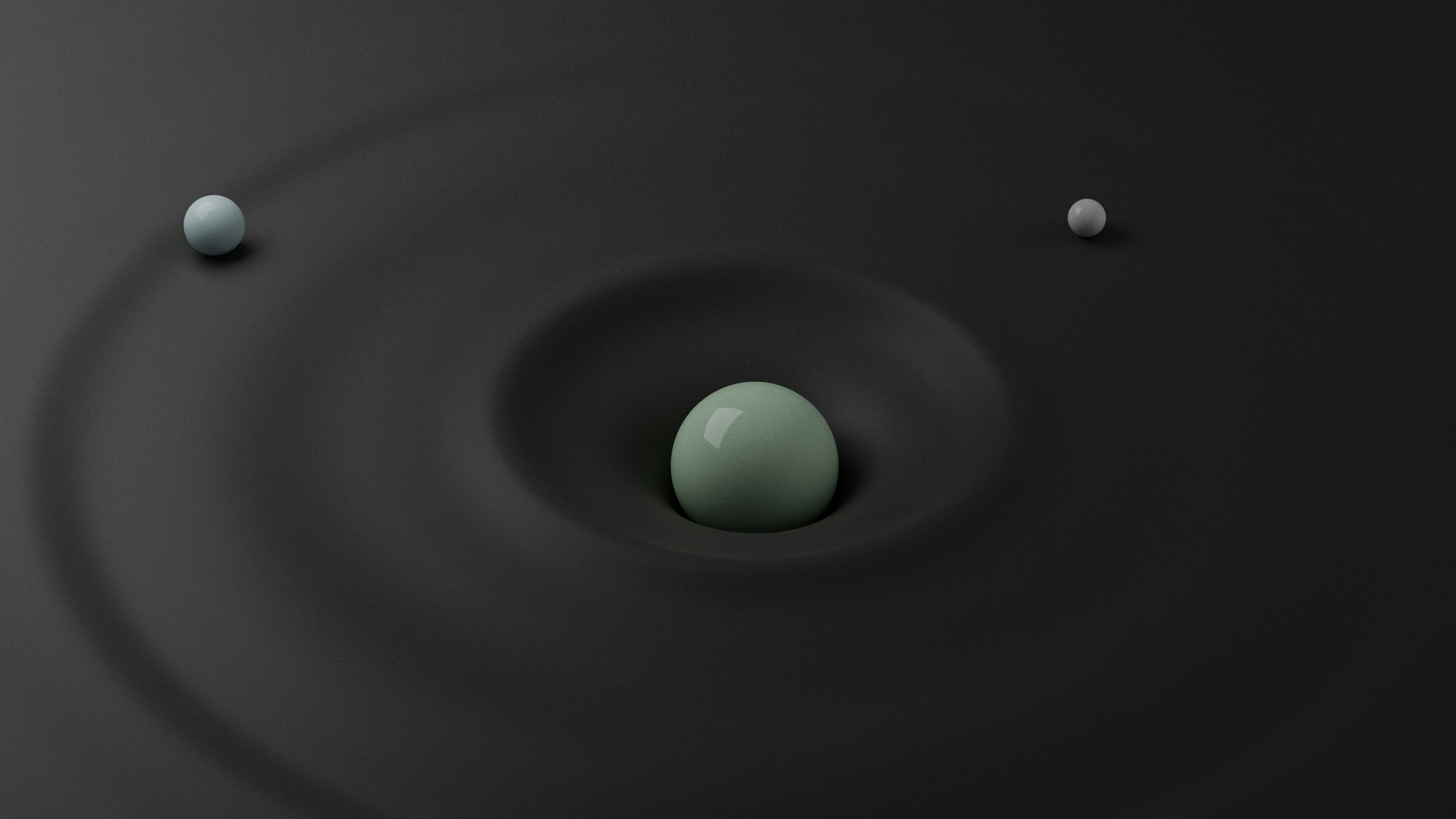
Image Credit: Hassan Here from Unsplash
This explains:
- Why do planets orbit stars.
- Why light bends around massive objects (gravitational lensing). Photons (the particles light shoots out) act the same as planets - they get caught in the dips of mass-heavy objects and bend around the curvature.
- Why time runs slower near stronger gravity (gravitational time dilation). This is because instead of living in a 3D world, these dips in space also affect time - the heavier an object is, the more gravity it has. After all, it dips the fabric further, which in turn decreases time.
General relativity is the reason your GPS works - without correcting for time differences caused by Earth’s gravity, your maps would be way off.
But the problem with general relativity is that it doesn't work on the tiniest, smallest, most elementary level.
So what does?
Quantum Mechanics: The Weird, Wonderful Rules of the Tiny World
Quantum mechanics is the branch of physics that studies the universe on the tiniest scales - atoms, subatomic particles, and the forces that hold them together. At this level, reality gets really strange. Particles don’t always behave like solid objects - they can act like waves, exist in multiple states at once, and even affect each other across vast distances.
Elementary Particles: Building Blocks of Everything
Your teachers have been lying to you your entire life. No, atoms are not the indivisible building blocks of matter. In fact, we know they're not indivisible because atomic bombs exist.
But everything you see, touch, or even think about is made of tiny particles called elementary particles - including atoms. So what are they?
- Quarks, which combine to form protons and neutrons.
- Leptons, like the electron, which buzz around atoms and make electricity possible.
- Bosons, the “force carriers,” like photons (light), gluons (which hold quarks together), and even the hypothetical graviton, which is gravity's own 'particle'.
Without them, nothing in the universe would exist as we know it.
Spin: Particles’ Internal Twist
Particles also have a property called spin. Don’t imagine it like a spinning top - it’s an intrinsic quality that affects how particles interact. It's actually quite silly that it's called spin - the particles don't rotate at all, they just look like it. They have angular momentum, which gives them all the properties they have, but they don't physically spin.
Spin determines things like magnetism, the structure of atoms, and even why matter is stable.
It’s one of the reasons superconductors exist, which allows maglev trains to float above tracks without friction.
Spin is a quantum personality trait - it tells each particle how to behave in the microscopic world.
Entanglement: Cosmic Best Friends
Quantum entanglement is one of the most mind-bending phenomena in the universe. Two particles can become entangled, meaning they’re linked no matter the distance. Think of it like you have one coin, split in two, so that one part shows heads and the other shows tails.
These coins are entangled, meaning the outcome of one affects the other. You place one coin on Earth, and another on Mars, and then you flip the one on Earth. You get tails. Instantly, the one on Mars shows heads, and you know it has to, because the two parts are entangled.
If you change the state of one particle, the other responds instantly, even if it’s light-years away.
Einstein called it “spooky action at a distance,” but experiments confirm it’s real.
Entanglement isn’t just weird, though, as it is actually useful. It could power quantum computers, which might solve problems beyond the reach of today’s technology, or enable unhackable quantum communication.
String Theory: The Universe’s Tiny Vibrating Strings
String theory is a mind-bending idea that tries to explain everything in the universe - all particles and forces - as tiny, vibrating strings of energy. Imagine every particle as a mini guitar string: the way it vibrates determines whether it’s an electron, a quark, or a photon. According to string theory, the universe isn’t just made of points or particles, but also of these tiny, vibrating loops of energy in multiple hidden dimensions we can’t see - which is absolutely crazy.
While it’s still theoretical, string theory could unify gravity, quantum mechanics, and all fundamental forces into one “theory of everything,” giving us a deeper understanding of how reality really works.
Real-World Applications
Quantum mechanics isn't some theoretical nonsense that is useful only in unreadable scientific papers, though - it has real-world applications that are helping to save lives and make technology far more efficient.
- MRI machines use quantum principles to create detailed images of the human body.
- Magnetic levitation (maglev) trains float and glide thanks to superconductors governed by quantum rules.
- Quantum computers are being developed to tackle problems from climate modelling to drug discovery.
Even though quantum mechanics seems abstract and bizarre, it’s the foundation for modern technology - and it’s only getting bigger. So what are some other bizarre phenomena going on in our universe?
Image Credit: Hal Gatewood from Unsplash
Dark Energy: The Cosmic Accelerator
In the late 1990s, astronomers made a shocking discovery: the universe isn’t just expanding, but it's doing so at an ever-increasing rate. This expansion of the universe's boundaries means that all the objects in it are being spread apart - galaxies are flying away from us faster and faster. Something invisible is pushing everything outward. Scientists call this dark energy, and it’s thought to make up about 70% of the universe.
We don’t know exactly what dark energy is, but it’s the reason the cosmos keeps growing - kind of like anti-gravity, pushing instead of pulling.
Without it, the universe might have slowed down or even collapsed back on itself.
Imagine the universe as a balloon. Dark energy is like the air expanding and expanding the balloon further and further out. So what happens if the universe pops? There are three different theories on how the universe could end:
- The Big Freeze. Dark energy remains constant, but the universe keeps expanding and expanding into eternity, until everything is so far apart that there is not enough energy and by extension heat in the universe to keep bodies going. Stars burn out, black holes collapse, and the universe becomes so cold and vast that no matter and energy can interact.
- The Big Crunch. Dark energy weakens, allowing for gravity to overpower its pushing force and contract inwards, basically imploding the universe in on itself - kind of like the reverse of the Big Bang.
- The Big Rip. Dark energy becomes so strong that it overpowers gravity completely, ripping apart all matter and splitting everything, starting with larger objects like galaxies, until eventually even our electrons are ripped.
Clearly, physicists are great namers.
Dark Matter: The Invisible Glue
While dark energy pushes things apart, dark matter holds them together. Galaxies spin so fast that, without extra mass, they should fly apart - but they don’t. Something invisible is keeping them intact: dark matter. So what is it - or rather, what does it do?
Makes up about 27% of the universe.
Doesn’t emit, absorb, or reflect light, so we can’t see it directly.
Its presence is inferred from gravity - the way galaxies move and bend light.
Think of dark matter as the universe’s invisible scaffolding. All the stars and galaxies we see are like decorations hanging on this unseen framework. Without it, galaxies - and life itself - wouldn’t exist.
Dark matter may even be the cause of the hottest physics topic of all.
Black Holes: The Universe’s Ultimate Reality-Benders
Black holes are some of the most extreme - and mind-bending - objects in the universe. They are formed when a massive star collapses under its own gravity, compressing all its mass into an incredibly tiny space. Imagine them as a puncture in the fabric of spacetime, where time and space break down.
The result? A region where gravity is so strong that not even light can escape.
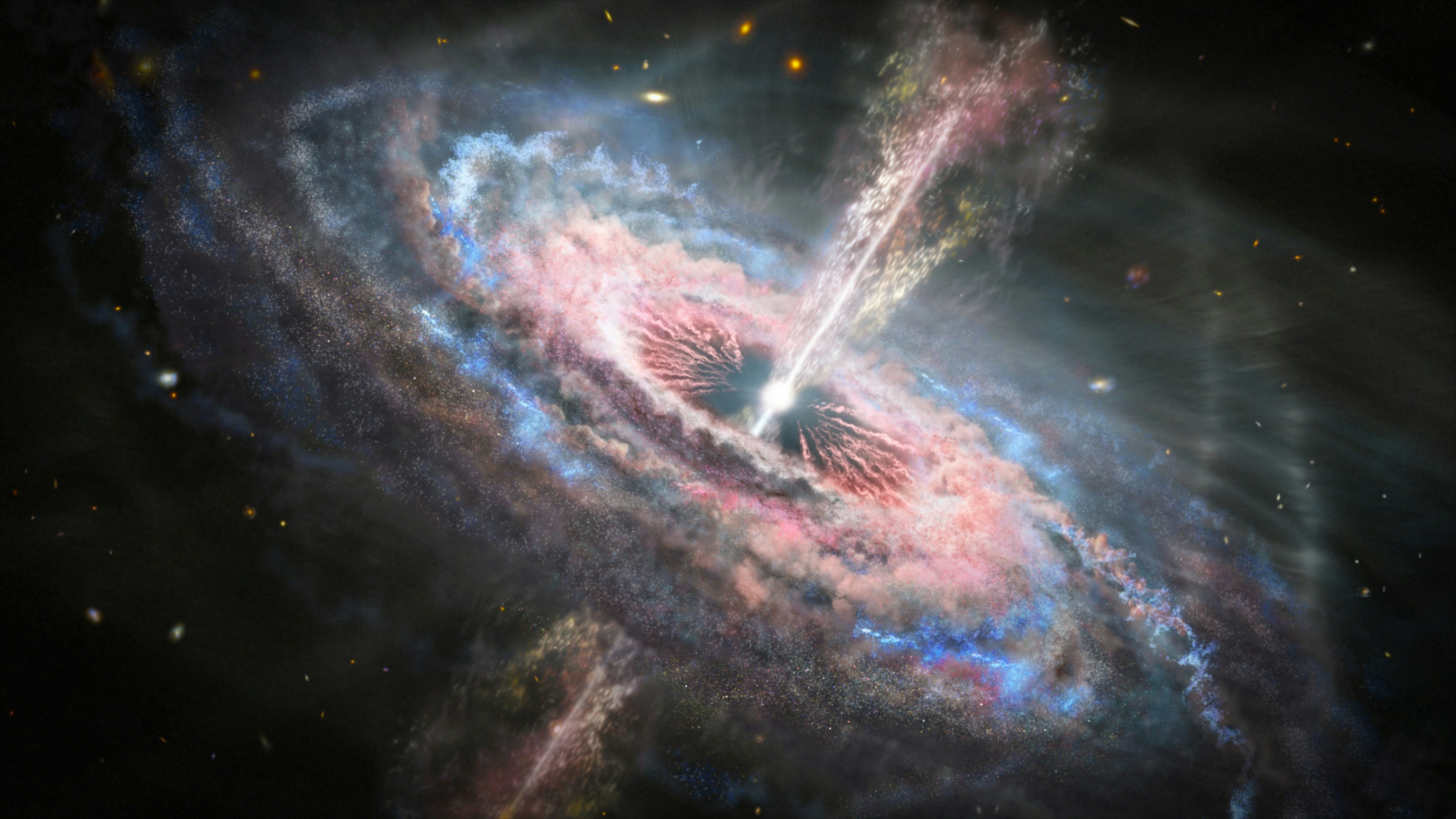
Image Credit: NASA Hubble Space Telescope from Unsplash
Time Dilation: Time Slows Near a Black Hole
Near a black hole, gravity is so strong due to the incredibly high mass of black holes (basically the amount of stuff packed into a space) that its effect on spacetime causes time to slow down until it is almost zero. This is called gravitational time dilation.
Imagine watching a friend fall toward a black hole (don’t actually do this!). From your view, they appear to slow down and almost freeze at the edge, the so-called event horizon.
From their perspective, time feels normal - they experience nothing unusual as they fall in.
This extreme warping of time is a direct consequence of Einstein’s general relativity, showing how gravity can stretch both space and time.
Singularity: Where Physics Breaks Down
At the very centre of a black hole lies the singularity - a point of infinite density where the laws of physics as we know them stop working. This is the hole in spacetime.
All the mass of the original star is crushed into a single point.
Space and time themselves break down here, and predictions become impossible. Time reaches zero, space stops, and it is impossible to move. You're basically trapped in time here.
The singularity is the ultimate unknown, a place where reality itself seems to vanish.
Spaghettification
Spaghettification (yes, that's the actual scientific term) is what happens when something gets too close to a black hole. The gravity near a black hole is so insanely strong and uneven that it stretches objects lengthwise and squeezes them sideways - like turning a person into a cosmic spaghetti noodle.
Scientists call this effect tidal forces, and it happens because the pull on the part of the object closer to the black hole is much stronger than the pull on the part farther away. While it sounds horrifying, spaghettification shows just how extreme gravity can get and why black holes are some of the most extreme - and fascinating - places in the universe.
But they're definitely not the most interesting of the hypotheticals.
Wormholes: Cosmic Shortcuts Through Space
Imagine you’re on a road trip across the galaxy. Normally, even light takes millions of years to travel from one star to another. But what if there were shortcuts through spacetime? That’s the idea behind wormholes - theoretical tunnels that connect two distant points in the universe.
A wormhole is a solution predicted by Einstein’s general relativity. Think of spacetime as a sheet of paper:
On the paper, you name opposite corners A and B. Normally, to go from point A to point B, you have to travel across the surface.
Fold the paper and poke a hole through it. Suddenly, the two points are connected by a tiny tunnel.
That tunnel is a wormhole - a bridge through space and possibly time.
The Universe: Stranger Than You Think
From Einstein bending time and space, to quantum particles acting like cosmic party-goers, to invisible dark matter and energy shaping everything, the universe is far weirder and more fascinating than it looks.
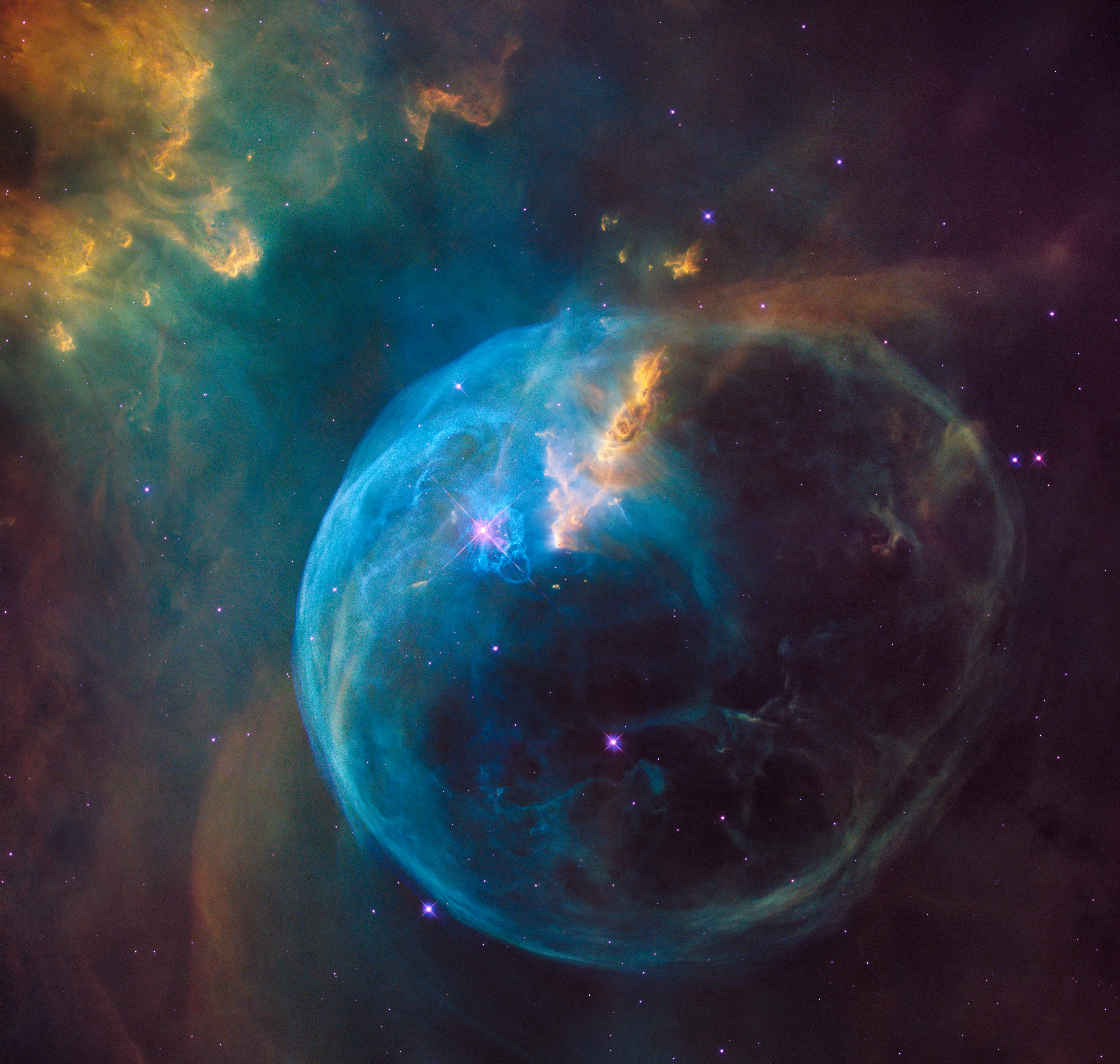
Image Credit: NASA from Unsplash
Even though classroom Physics is all about levers, motion equations, and boring maths, real-life physics is some of the most interesting knowledge you can learn. And the more we learn, the more we realise how much we don’t know. Every discovery opens new questions, new mysteries, and new ways to imagine the universe.
So the next time you look up at the night sky, remember: what you see is only a tiny fraction of what exists. The universe is stranger, deeper, and more incredible than we can ever fully grasp - and that’s what makes exploring it so exciting.


