

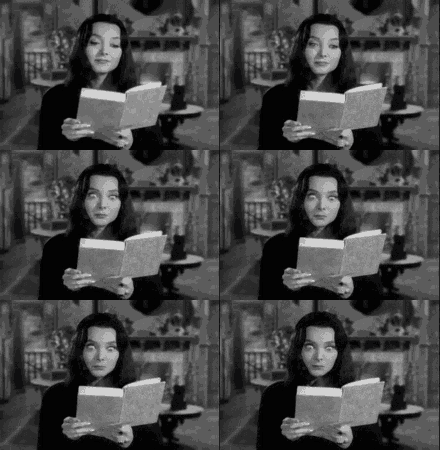
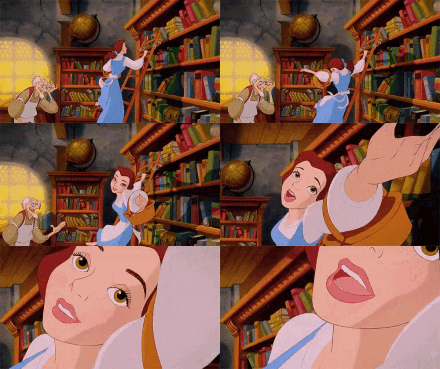


There is an ironic strangeness that accompanies BookTok's alterations to contemporary culture surrounding reading. For the first time in years, publishing houses are thriving, backlist novels are topping charts, and teenagers are bringing around paperbacks everywhere they go. It appears to be a sort of renaissance.
Revival. It seems to be a new golden age for books, but beneath the sheen of glittery edges and limited editions, something quieter is beginning to change. It feels less like passion and something like performance as reading has changed from the private conveyance of an internal world, onto a stage, to be performed.
We are reading so much more than ever, yet so many of us feel like we are reading less deeply. The ritual is there, but the relationship has shifted. Reading has gone from a safe space, to now being curated, displayed and consumed by others.

Image Credit: Katharina Bill on Unsplash
Let us slide into your dms 🥰
Get notified of top trending articles like this one every week! (we won't spam you)When Reading Becomes Aesthetic
BookTok made books into luxurious objects. Not by story or language, but through imagery. A stack of pastel-coloured fantasy romances set out on a white duvet.
Fingers tracing the embossed title of a special edition book. Highlighted margins filmed in gooey lighting, all the highlights placed to appear like they were styled. A slow-motion video of someone closing a book with shaky hands, matched perfectly to music that swelled with the closing of the book.
The aesthetic turned the hook, the marketing strategy, and the cultural script.
In this new script, the books are props. The reader becomes a central character to their own aesthetic universe. The novel becomes a background to a feeling or worse... a performance of a feeling.
We started to cultivate a culture of treating novels like an accessory and reading like a mood board. Even the private act of annotation transgresses, once a quiet and intimate conversation with the text, and now becomes something to be shared and beautified on civilian social networks.
Before long, tropes become stand-ins for quality. Whether or not the story mattered barely compared against the expectation of feeling all the feelings. Slow burn.
Enemies to lovers. Found family. Trauma that crescendos into catharsis. Each trope, replayed hundreds of times over hundreds of TikToks, became banal abstract, narrative currencies of TikTok's platforms.
At some point along the way, reading become a habit of aesthetic measure as opposed to subjective reflection; an externalized way to signal identity instead of working through it.

Image Credit: BookTok Books on Wikimedia Commons


Take the Quiz: Which Harry Potter Character Are You?
Find out which character matches your personality!
The Algorithm Decides What We Love
Consider a title like A Court of Thorns and Roses, Fourth Wing, or any of the romantasy novels that orbit around that gravitational pull. Their success is indisputable. They helped revive sales in a brick-and-mortar bookstore.
They helped create lively online communities. They provided a gateway for new readers.
But concomitantly, its viral nature is revealing about the way BookTok is influencing our decision-making process.
The Algorithm has already made the decision for us well before we hit “add to cart.” The Algorithm doesn't just show us books; it prescribes the emotional experience we are having with it. It primes us to cry, to annotate, to feel devastated in all the right parts of the text. It distills our reading diet down to consuming derivatives of the same story: "hot," "anticipated," varied only in comfort but striking the same predictable emotional beats.

Image Credit: BookTok Stop on Wikimedia Commons
Often these stories draw upon the same emotional architecture: the morally grey love interest, the traumatized heroine cliched by the trauma, a fantasy world created from romance and affectionate tension rather than lore or worldbuilding, a past that becomes a personality trait. These stories work, but they homogenize our reading experiences.
BookTok amplifies the emotional drama of reading, as opposed to the cognitive work of reading. It lends platform to the books that cause visceral reaction—gasps, tears, breathless disbelief—because those experiences go viral. They can happen in thirty seconds, and there is a performance involved.
But uncertainty does not go viral. Subtlety chokes under pressure. Books that take time, contemplation, or effort are generally settled on the shelf.
And if we lean into reading as a search for another viral feeling, slumps are inevitable. We binge and then we flop, not because we don't like reading, but because we become bored of passion wrapped in predictability.
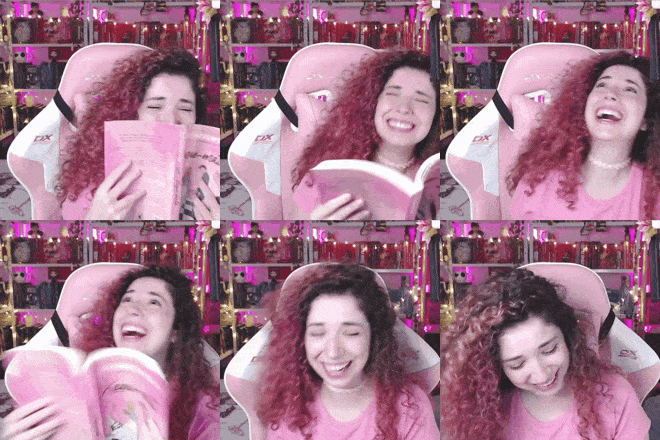
The Rise of the Reading Slump
A reading slump often occurs not because people do not care about reading books, but rather because they have been consuming only what the algorithm tells them to. When every novel is promoted as "life-changing," few actually are. Other than when every protagonist seems like a duplicate of the previous, the excitement decreases. When every love interest is the same "dark-and-broody" character, the flame goes out.
Thus, this slump becomes an emotional hangover.
Readers are not bored; they are overstimulated. They have become exhausted because they expect transcendence from books that were only ever created to be compulsive.
BookTok gives us abundance but not variation; it gives us excitement but never longevity; it creates hype cycles; intense, short-lived, and explosive, but lacks sustained participation. Perhaps most notably, it creates a culture of reading that is outward-facing rather than inward-facing. We read to join the conversation, to keep up, and to belong. We do not always read to think, to question, or to evolve.
The end result is a generation of readers who love books, truly and wholeheartedly, but feel removed from the deeper relationship they once had with literature. Reading becomes something we "show" instead of "live."

Image Credit: Vitaly Gariev on Unsplash
Has BookTok Helped or Hurt? It’s More Complicated Than Either
BookTok revitalized the industry in a way no one predicted. It brought life back to independent bookstores, introduced new readers to stories they might have otherwise ignored, made reading social and joyful and accessible. It stripped away the elitism that often gatekeeps literature.
But it also changed the cultural definition of a “good book.”
Depth has been replaced by intensity. Craft by relatability. Rereadability by virality.
The platform struggles to reward nuance because nuance cannot be translated into a short video. It punishes experimentation because experimentation risks confusion, and confusion does not engage.
Books become content. Characters become archetypes. Literature becomes digestible entertainment. And readers become consumers of feelings rather than seekers of ideas.
The emotional arc matters more than the craftsmanship that holds it together. Sensation matters more than subtlety. Impact matters more than introspection.

Image Credit: Tim Gouw on Unsplash
The Gifts BookTok Has Given Us
Despite its numerous problems, it would be disingenuous to deny that BookTok has opened channels for exploration in remarkable ways. BookTok has provided whole generations with an experience of discovery, not only giving fully forgotten books new life but also elevating authors who may never cross the gates erected by traditional readers. I’ll admit it—more than a few of the books I obsess over today reached my desk because someone somewhere filmed an authentic thirty-second video about how one sentence broke them at two in the morning.
BookTok gave us the privilege of probing into books that you may not have ever read on your own. It brought back The Song of Achilles, We Were Liars, The Seven Husbands of Evelyn Hugo, A Good Girl's Guide to Murder, and about half a dozen other stories that quietly passed behind the scenes when they were released. It reminded readers, (readers!!), that poetry still exists.
It shared memoirs that should have been read, and it provided thrillers that demanded a bit more noise. It gave us romances that felt like mini resurrections. And in its best moments, it wasn't vacuous at all; it was a community of readers softly saying, “I loved this. Maybe you will too."
I've found books on BookTok that I genuinely love. Stories I'm shoving at friends. Lines that I underlined not for a picture, but for me.
There is something deeply generous about a platform that can take an unloved book and turn it into a glorious experience across two countries. There is something tender about the way strangers suggest books simply because those books made them feel less alone.

Image Credit: Annie Spratt on Unsplash
This is the part of BookTok that feels like a gift instead of a distraction—the part that reminds readers that reading, at its core, is communal. That to share an experience with a book is an act of vulnerability. That sometimes the algorithm works, because it simply amplifies what readers are already softly whispering to one other: this moved me, this healed me, this made the world feel a little easier to breathe in.
BookTok can be loud, chaotic, and repetitive, sure. But it can be a lamp of light in the dark; a space that lets readers find one another, and in the process, discover books they may not have ever realized they needed.
And recognizing that the truth does not negate the critiques. It complements them. It reminds us the platform is neither nefarious nor vacuous; it merely mirrors the behaviors we invite. Ultimately, its capacity is in how we decide to use it—to mindlessly curate or to meaningfully discover, to mindlessly consume or to read deeply, and to follow trends or to follow our curiosity.
BookTok has introduced us to good books. The obstacle is remembering it does not tell us which will become significant. That piece is, and always will be, up to us to decide.

Image Credit: Mediamodifier on Unsplash
So, What Does Our Generation Truly Want From Reading?
It could be that we are caught between two wishes.
We want the excitement of community and the closeness of solitude. We want the short jolt of the surprise in a story, and the slow heat of a story that hangs on for years. We want reading that is easy to get into, yes, but also reading that is difficult and expansive and full of twist and turns.
BookTok does not have to be the enemy of depth—it simply cannot be the replacement for it.
This era of reading culture asks us to become more intentional. To choose books not because they trend, but because they call to us. To allow a story to move us quietly instead of theatrically. To remember that literature is not a performance but an interior journey—one that requires time, patience, and attention.
The real question is not whether BookTok caused our reading slumps. It is whether we handed over our literary instincts to the algorithm, trading curiosity for convenience and exploration for comfort.
And maybe now, as the noise grows louder and the hype cycles grow shorter, it is time to reclaim the act of reading; not as content, but as communion. Not as performance, but as pleasure. Not as trend, but as truth.
Maybe it is time we choose differently.


