




In today's literary climate, it is nearly impossible to begin a bestselling young adult novel without being thrust into a terrain of grief, heartbreak, generational scars, or some form of emotional wreckage.
On BookTok, the algorithm has legitimized an entire industry of writing: books that ruin you, and that will make you cry in public, leaving you with that familiar, hollowed-out feeling that readers now boast about wearing like a badge of honor. At one point along the continuum of these texts, pain became not just a theme, but also a marketing angle—a kind of aesthetic currency that capitalizes on an emotional breakdown.
However, beneath the quotes meant to make us cry and the pages meant to be underlined lies a much more complex and troubling question: Is our title actually expanding our capacity for empathy, or are we just romanticizing trauma into the next product to purchase?

Image Credit: Alisa Anton from Unsplash
Let us slide into your dms 🥰
Get notified of top trending articles like this one every week! (we won't spam you)The Rise of Trauma as a Narrative Aesthetic
In the past, trauma within fiction felt like a fragile burden that the story had to bear with care. These stories often also had horrifying twists, however.
Now, trauma is often the hook itself. Many of the trending titles across BookTok: The Song of Achilles, They Both Die at the End, A Little Life, It Ends With Us, The Invisible Life of Addie LaRue, rely on suffering to become the central engine of a complex narrative. The marketing leans into it.
The discourse celebrates it. And at least partially jokingly, the reader text asks, "Will this destroy me emotionally?" as if emotional devastation is not an emotional state but a literary genre.
This is not to say this is automatically a bad thing. Pain exists as part of being human. Fiction itself has always been a mirror for things we're usually more uncomfortable saying out loud. It is not that trauma exists in fiction.

Image Credit: BookTok from Wikimedia Commons
It is how trauma has become so easily reducible to entertainment.
On BookTok, crying has come to be a marker of appropriate engagement in a fandom. Emotional turmoil becomes a marker that a story "worked." Or, perhaps a better way to say this is that people come to understand, or expect and perhaps defend to themselves and others the interconnections of fandom and emotional turmoil because they are fully invested in a character and/or story.
Characters are loved not for who they are. Characters are loved for the trauma they represent or the internal struggles or demons they personally wrestle with. And before you realize it, trauma is something that feels craved, not real trauma, but curated trauma, aesthetic trauma of the sort that might take a picture frame next to a tabbed paperback next to you for social media's conventional aesthetic.
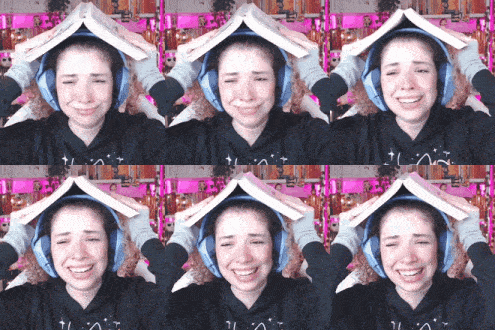
via Tenor


Take the Quiz: Which Popular YA Novel Series Should I Read Next?
Find out your next great read after this quiz!
Empathy or Spectacle? The Thin Line Fiction Walks
Trauma-focused narration has the power to transform individuals if it is handled with nuance. It expands emotional literacy. It provides agency to experiences readers may never have the opportunity to share.
It disrupts the silence that accompanies mental illness, abuse, grief, addiction, and identity. A book like The Perks of Being a Wallflower continues to resonate because it portrays trauma as a quiet, subtle truth, not a performance.
However, when trauma is stripped of its cultural, psychological, and emotional richness and simply exoticizes as a plot twist, it turns into spectacle. Pain becomes a proxy for personality. Characters become thin representations of suffering and are stripped of agency, quirks, humor, and ordinariness.
This phenomenon is perhaps most desired in the young adult space, and also where reader expectations for fiction are to move quickly. A character loses someone, and the healing seems rushed. Or worse, the trauma exists only for their love interest to "fix" them.
We have reduced survival to romance. We equate scars with wisdom... we transform pain into depth.
And readers—especially young readers—have internalized the script.

Image Credit: Shayna Douglas from Unsplash
BookTok’s Hunger for Catharsis
BookTok did something interesting: it made emotional reaction a currency. Clips of readers crying over a book; mascara smudged, tissues piled up; sell more copies than the most sophisticated marketing campaign. “Books that made me cry” is now a category with millions of views and its own mini ecosystem.
But what does that expectation do to stories being written?
Authors, purposely or not, start to write to go viral. The plot revolves around the “that moment” when is wave goodbye to your normal emotions. Trauma is the twist, trauma is the climax, trauma is the brand, trauma becomes the formula.
Then, in an attempt to be unforgettable, stories forget to be responsible. Fiction shifts from making a meaningful statement to making you feel strongly—fast.

Image Credit: Gaman Alice from Unsplash
Why We’re Drawn to These Stories in the First Place
To put it fairly, our fixation on trauma fiction is not flimsy. Many young people today live in an environment of instability, anxiety, and the feeling of the precipice of the world.
These books provide acknowledgement. They validate the pain. They let the reader know that they are not alone in the harmful patterns of the world. There is simply a comforting quality to seeing your mental wounds echoed back to you, word for word, in a well-crafted line.
It is a safe catharsis. It is a controlled catharsis. It is temporary in catharsis. It is the type of pain that can be shut even as the book closes.
But when no story takes us to a breaking point of our heart, we start to believe that pain is the most genuine form of "narrativizing". Those characters who experience a moment of happiness are not as complex. That softness is shallow unless born out of or born from pain.
It's there that the danger lies.

Image Credit: Nong from Unsplash
What Nuanced Portrayals of Trauma Could Look Like
Trauma doesn’t need to disappear from YA. We don’t need happier stories, necessarily. We need truer ones—narratives that understand trauma as a process, not a plot twist.
Depth over shock value: Show trauma with layers. Not as an explosive revelation, but as a long, complicated journey. Let characters grow through it instead of being defined by it.
Cultural and contextual specificity: Pain isn’t universal in the way fiction often pretends. Identity, community, and culture shape every trauma experience.
Space for healing: Not every book needs a hopeful ending, but trauma shouldn’t be portrayed as perpetual, glamorous brokenness. Healing is not cliché. It’s the most human thing we do.
Characters beyond their suffering: Let them be funny, stubborn, brilliant, ordinary. Let them be whole, even if cracked.
Stories that hold both light and shadow: Real life is never only tragedy or only joy. Fiction shouldn’t be either.

Image Credit: whereslugo from Unsplash
We Don’t Need Less Pain in Fiction. We Need More Truth.
The solution isn’t sanitizing stories or avoiding suffering altogether. It’s honoring the weight of trauma rather than aestheticizing it. It’s writing characters whose pain is part of their humanity, not the currency for our entertainment. It’s refusing to let trauma become an algorithmic requirement.
We deserve stories that challenge us without exploiting us. Characters who hurt without becoming symbols of hurt. Narratives that respect the lived realities they echo.
Because when fiction treats trauma responsibly, it doesn’t glamorize pain.
It gives us language for survival. It helps us find ourselves in the mess. It reminds us that even the hardest stories hold space for healing.





.jpg)


