




Beginning in the 1950s with the passage of the 14th Amendment, the Supreme Court officially outlawed the segregation of public spaces, calling it a “manifest violation of equal protection”. The same amendment states that “no State shall make or enforce any law which shall abridge the privileges [of] … any person of life, liberty, or property … nor deny to any person within its jurisdiction the equal protection of the laws”.
Why, then, are homeless communities across the United States, facing blatant attacks against their rights to use and exist in public city spaces?
Let us slide into your dms 🥰
Get notified of top trending articles like this one every week! (we won't spam you)What is Hostile Architecture?
Hostile architecture, also known as defensive architecture, exclusionary design, or anti-homeless installation, is a simple, yet brutally effective strategy used by urban planners and private owners to prevent or restrict certain “undesirable” activities or persons in a public space.
Most commonly, installations such as concrete sidewalk spikes, segmented or curved benches, and awning gaps are intentionally designed to prevent individuals experiencing homelessness from sleeping, sitting, or otherwise finding shelter in public areas.
Examples of defensive architecture include, but are not limited to:
- Segmented/curved benches
- Awning gaps
- Concrete or metal spikes on ledges, windowsills, sidewalks, or under bridges
- Sloped, uneven, bumpy, or curved surfaces
- Boulders/large rocks
- Absence of amenities such as public restrooms or comfortable seating
- Locked park gates
- Etc.
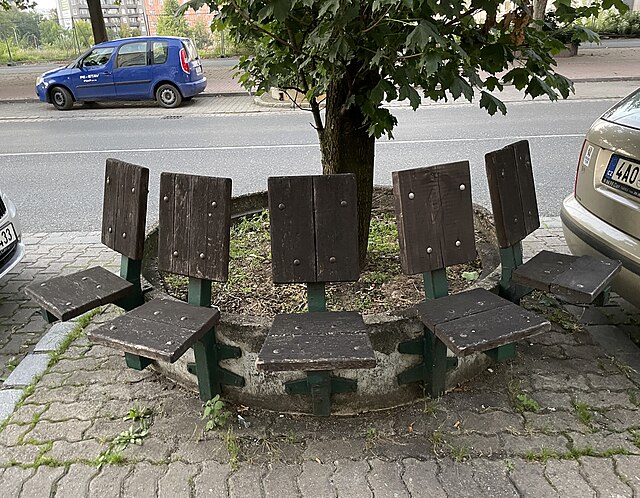
Photo by ChickSR From Wiki Images


Take the Quiz: Do You Know Gen-Z Slang?
Take this quiz to see if you're updated on the latest Gen-Z slang!
Mindset and Impact
Historically entrenched in America’s segregated past, these design elements expose the “out of sight, out of mind” mentality of privileged, empowered urban planners and city leaders. By embracing the mindset that the struggle homelessness should go unseen, rather than fixed, authorities are both undermining the humanity of those experiencing homelessness as well as creating an “us versus them” stigma that further outcasts rough sleepers and homeless individuals.
Not only does this reveal a depth of immaturity, it also uncovers the lack of empathy and understanding of those in charge of city organization.
What’s more, there’s evidence that cities are spending more on criminalising and displacing homeless individuals than it costs to house them. Observational studies prove that providing supportive housing requires less than a third of the cost of incarceration, enforcement of anti-panhandling laws, and hostile architecture. This ironic detail is truly disturbing; that the very authorities that swear an oath to the well-being of their citizens are directly choosing to harm instead of help those very citizens.
Not only is hostile architecture harming the most vulnerable members of our communities, it is transforming our cities into uninviting and, well, hostile environments. “In many…communities, vestiges of prior hostile design interventions leave public spaces devoid of healthy vibrant public life,” explains NDC Deputy Director Briony Hynson.
Lack of seating in public areas, uneven pavement, and spiked ledges make things difficult for everyone, not just rough sleepers. The elderly, those with disabilities, pregnant individuals, and people with young children find themselves disadvantaged in public spaces because of installations that prevent comfort and rest.
“...These spaces make everybody rush through them, meaning there’s less opportunity for chance encounters, for communities to form, for idle thought,” says Dr. Evie Kendall in Why Hostile Architecture is Bad for Our City’s Health. “Rather than making an area feel more safe, these designs impact us in mean and insidious ways … few people would rather lean on a pole than sit on a chair when waiting for their bus, and because uneven surfaces make using a wheelchair or buggy much harder.”
The point is, exclusionary design, which not only harms homeless individuals but everyone that uses public city spaces, is a glaring denial of equal protection, and therefore clear violation of the 14th Amendment.
So, what are we doing about it?
Responses
Recently, the city of New York has required regular inspections of privately owned public spaces, and in Connecticut, House Bill 6400 was introduced to ban hostile architecture altogether in public spaces. As awareness spreads, more and more people are beginning to speak up against this critical moral and legal issue. Public art projects, social media activism, and activist movements have been sparking not only in the US, but across the globe.
Despite a growing opposition to hostile architecture, what’s being done is simply not enough. As of today, almost every major city in the world still has some form of exclusionary design, and even cities that are making moves to outlaw it still contain hostile architecture of some type.
How You Can Get Involved
Making change doesn't have to be complicated. A simple Google search or email could be the spark in spreading awareness and getting hostile architecture removed from our cities.
If you see elements of exclusionary design popping up in your hometown, don't stay silent. Figure out who approved these projects. Who pitched the ideas?
Who approved them? How much did it cost? With this information, you can target your complaints (preferably in writing, such as an email) to the right people. Remember, complaints get these projects started, but they can also get rid of them.
For other, more specific opportunities for involvement, check out the Single Homeless Project and the National Coalition for the Homeless sites. These organizations provide opportunities for donations, volunteer work, and advocacy against hostile architecture through fundraisers, running events, and petitions.
Finally, use your resources—namely, social media. In the digital era, posting on your socials is the main way that people are going to gain awareness about these issues. Repost any content you see that spreads awareness about anti-homeless architecture and support organizations and nonprofits by following their accounts.

Photo by Piotr Chichosz from Unsplash
So, the next time you’re walking down a city street and almost trip over concrete spikes, or maybe sit down hard on a painful metal stud on a park bench, remember, as said by Dr. Evie Kendall: “...We are all being controlled the second we step outside and… should we take a wrong turn one day and experience homelessness ourselves, the city would change shape.”
This needs to change. Spread the word.







.jpg)
