





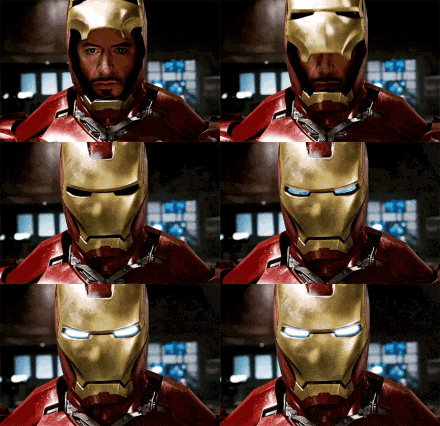
When Tony Stark snapped his fingers in Avengers: Endgame, he did not just save the universe, he also closed a chapter. It was cinematic poetry—a perfectly full circle ending for a man who once crafted weapons of destruction who gave his life for the purpose of creation. It was emotional, it was heroic, and it was unforgettable.
However, when the dust settled, literally and figuratively, something else did as well. The Marvel Cinematic Universe finally ceased to have a pulse. And for all the depth and finality of Tony's death, it was not merely the death of a character but the death of humanity in the MCU.
Let us slide into your dms 🥰
Get notified of top trending articles like this one every week! (we won't spam you)The Soul of the Story
Tony Stark was more than another superhero; he was the emotional focal point for the MCU. From the first Iron Man in 2008, he was never portrayed as a bastion of perfection, but a representation of the messiness of progress. His flaws made him captivating.
He was arrogant, impetuous, and extremely human; and he developed. He wrestled with his ego, his guilt, his addiction to control, and his fear of being irrelevant. Unlike many of the heroes that Marvel presented later on, he was not defined by his superpowers or destiny, but by his choice. He quite literally and metaphorically built his identity out of scrap.
Every stage of Tony’s narrative arc represented something significant about the MCU's tone and ethical fiber. Iron Man introduced the idea that heroism could be derived from accountability, not from a royal bloodline. Iron Man 3 assured audiences that trauma lives on long after people experience victory; even gods in metal suits experience panic attacks.
Civil War assigned a principal character to found, that a man could want to atone for his mistakes to the point that he willingly fractures his own family to atone for them, and then has to live with it. He was messy and contradictory, but human all the same. In the end, when he sacrificed himself, it felt earned. Yet, when Marvel killed him off, not only did they cut his character arc, but they also made a conscious decision to cut the narrative frame out of the MCU.


Take the Quiz: Which Cobra Kai Character Are You?
Take this quiz to find out which character from the hit Netflix series you are!
The Collapse of Emotional Continuity
After Endgame, Marvel has struggled to find another emotional anchor. The newer phases have chosen to focus on a grand scale rather than its essence. The multiverses, the variant timelines, the alternate realities were there, but none of those connected its themes.
Tony Stark was a connective thread through gods, soldiers, and spies. He embraced worlds by building something to which we can all relate—the journey of redemption. The relationship displayed between him and Peter Parker, his rivalry and friendship with Steve Rogers, and his frustration with everyone in the Avengers became the bridge from the cosmic to the human.
Since that emotional anchor, the MCU has diverged. The films have been "plots" since Endgame; like puzzle pieces, displaying a chapter in all of its stories but never showing the completed puzzle.
Eternals reached for mythology but lacked intimacy; Doctor Strange in the Multiverse of Madness tried to reach bigger spectacles without sincerity; and although Spider-Man: No Way Home was a heartfelt narrative, it relied heavily on nostalgia over development. The issue is not that Marvel lost their biggest hero, they lost the template that gave its stories resonance—growth, consequence, and continuity in feeling.
Undoubtedly, Tony's contributions made the universe feel more pitiable, but now it feels entirely mechanical, a large machine of content, rather than a living story. Characters appear, wreak havoc, and depart, only to return without emotional logic. There's plenty of action, but no heart beneath it. Tony made the MCU feel like it had a rhythm—a sense that all items were related, not intrinsically, but through something beyond marketing.
The Man Who Made the Machine
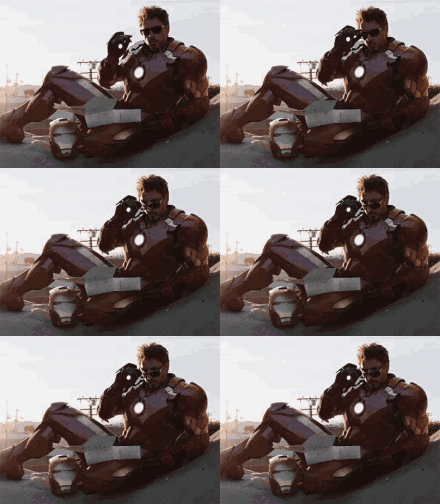
Even irony, in being the better narrative architect of the MCU, Tony Stark was our entry-point character and our reflection in a world of super-soldiers and gods. His story worked because it asked an easy question: what happens when genius meets guilt? He was the first Marvel hero that felt human enough to fail in ways that would matter.
His arrogance had implications. His wins came at a cost. When Tony declared "I am Iron Man," he said it with a morbid sense of pride. It was ownership, a declaration; it wasn't as though Iron Man was a mask he hid behind. He was re-defining what it meant to be Iron Man.
Tony's existence gave Marvel something unparalleled: authenticity. His charm was not based on zingers or science-technology, but on emotional transparency. Every invention, every ethical breach, every moment of weakness was infused with self-awareness.
He made the impossible believable because he never lost the fact that he was simple underneath it all. And when he finally achieved peace, the universe lost its reflection.
What Could Have Been
The tragedy is not that Tony died—the tragedy is that he didn't have to. His arc was not about endings; it was about evolving. There are a million directions to go without the emotional burden of an irrevocable ending.
Imagine if Tony retired but still served as a moral and intellectual North Star for a new generation. A story where he faced the life of fatherhood, confronted a legacy, and acknowledged a world that he saved which no longer needed him. That is a more beautiful and richer arc than martyrdom.
Marvel could have explored what it means to outlive your purpose, not just die fulfilling it. Tony’s genius wasn’t just his technology—it was his adaptability. He was always learning, always iterating, always finding new ways to atone.
In taking that away, Marvel lost the character who embodied the very spirit of progress that defined the MCU’s early years. Instead of watching him grow old, wise, and human, we got a perfect ending in a universe that now feels imperfectly empty.

The Vacuum He Left Behind
Marvel has worked to mimic the energy of Tony Stark in the time since his death, but through archetypes rather than resonance. Inventors are portrayed as smart and snarky, like Shuri and Ms. Williams, but they lack the existential heaviness.
Characters like Doctor Strange exude some of his arrogance but lack his vulnerability. Even Spider-Man, whose connection to Tony once shaped a lot of Peter's narrative journey, has reverted to a state of narrative isolation. These successors are capable from the outside, even compelling, but they all exist in the shadow of an absence that no one can ever fill.
Because Tony Stark wasn't just a character—he was the emotional architecture of the MCU. He made every conflict matter, every alliance make sense, and every heartbreak feel impactful. The Avengers weren't a team; they were merely a reflection of his growth. When Tony died, the cinematic universe didn't just lose its main character, its lead figure, it lost its reason for being lead.

A Universe Without Its Heart
The MCU currently encapsulates what Tony might have feared: a machine whirring about without its maker. The gears still move, but now the core is absent. The early supports of the project brought together heart and humor, reflection, and spectacle. Now the edges balance is flatter and skews toward chaos; a delightful mischief multiverse of opportunity with no emotional center to terrorize.
Tony Stark’s instinctual narrative was about the messy work of becoming better. It was never tidy—but it was true and existing. That trueness is the connection that led to profit, so the new kind of formula haphazardly tossed aside in the trail of after his death.
Iron Man didn't need to die. All he needed to do was change. Because if the MCU taught us anything at all it's this: heroes are not defined by how they fall but by how they rise.
And this time, Marvel's biggest mistake was not letting Tony Stark go out as a hero. It was unlocking extended developed story to have him go out something else altogether.


