






Geoengineering is a complex and controversial solution for a very complicated problem (that problem being climate change). But first of all, what is geoengineering, why is it so controversial, and what are the implications if it is eventually used?
Geoengineering is a catch-all term for the deliberate large-scale manipulation of various environmental processes that affect earth’s climate. This is usually done to counteract the impacts of climate change. A lot of the time these manipulations use reflective materials that send light back into space, thus helping cool the Earth and mitigate one of the main impacts of climate change.
This particular type of geoengineering is called solar geoengineering. Please note that geoengineering does nothing much for the increasing acidity for the oceans, another major impact of climate change, unless you consider carbon sequestration to be a form of geoengineering.
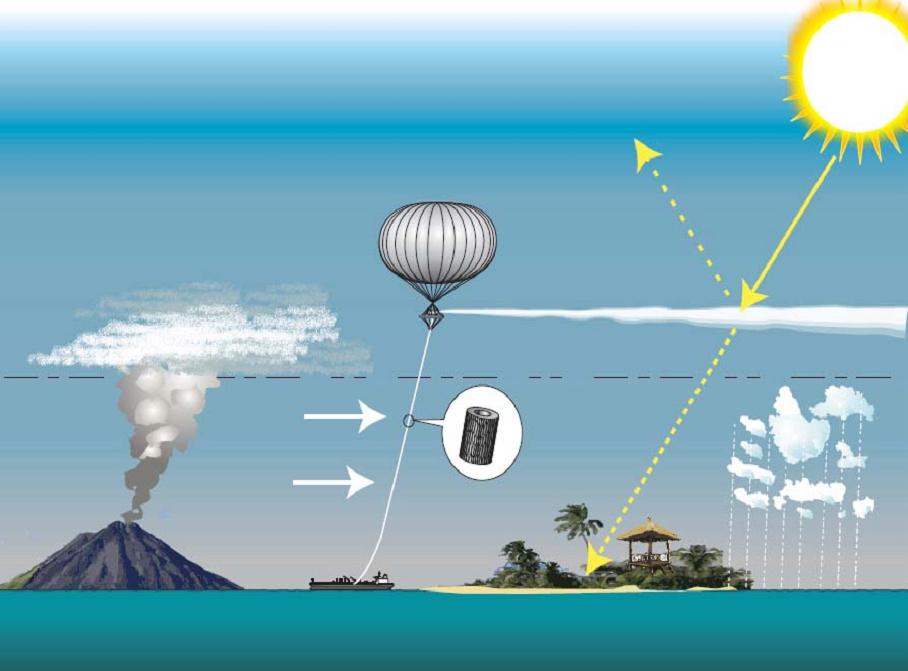
Image Credit: Hughunt from Wikimedia
A diagram showing the process of geoengineering
To understand how exactly solar geoengineering helps cool the Earth and how it counteracts the impacts of climate change, you have to understand how greenhouse gases help warm the Earth in the first place. The simple version is that after sunlight hits the Earth, it gets absorbed and then is remitted as infrared radiation. As the radiation passes through the atmosphere, it gets absorbed by greenhouse gases. After a little while, the infrared radiation is released and sent into random directions with some of it going back to Earth and warming it up.
Now back to the geoengineering.
There are many forms of solar geoengineering including but not limited to sulfate aerosol injection, brightening clouds, calcite aerosol injection, and cirrus cloud seeding. These are the ones that this article will be focusing on.
Sulfate Aerosol Injection
This particular form of geoengineering is a rather well-known one, partially because sulfate aerosols are how volcanic eruptions have a cooling effect on the atmosphere. (By the way, for our purposes, an aerosol is defined as particle suspended in the atmosphere). This cooling effect comes about because sulfate aerosols are a reflective material.
For the purposes of geoengineering, the injection of sulfate aerosols into the atmosphere is actually a rather cheap and very effective way to rapidly cool down the atmosphere and reverse the warming effects of climate change. In fact, for every 1.1 million tons of sulfate particles (or one teragram) that are injected into the atmosphere, global temperatures will decrease by 0.2°C. Of course, those particles will have to be continuously dumped into the atmosphere because greenhouse gases last a lot longer than sulfate aerosols do in the atmosphere.
Even so, this is a rather inexpensive solution that would only cost 2.25 billion dollars each year to halve the warming effect of climate change. This may seem expensive to you, but keep in mind that extreme weather events have been costing the world in damages an average of 140 billion dollars yearly for the past 20 years. To top it off, injection of million tons of sulfate aerosols into the atmosphere is technically feasible and theoretically could be started today.
So why isn’t sulfate aerosol injection a widely used method to cool down the world? This is where we come to the many downsides of this form of geoengineering. Here is a list of some of them.
- Impacts on the Climate: Sulfate aerosol injection, depending on where it is done, could bring about negative side effects to other parts of the world. For example, doing it only in the tropics would still allow greenhouse gases to influence the climate in the northern hemisphere. This, along with sulfate aerosol’s warming impact on the stratosphere, would cause a strong temperature gradient change between the stratosphere and the troposphere. In the end, this might make climate conditions even worse than if nothing had been done at all.
- Damage to the Ozone Layer: Another problem with sulfate aerosol injection is that it can damage the ozone layer. The exact amount of ozone that would be destroyed by sulfate aerosol injection depends on the latitude, time of year, which hemisphere you are in, and the number of other important particles in the atmosphere. The whole process is fairly complicated but you can read about it in this article.
- Disruption of Rainfall Patterns: Injection of sulfate aerosols could disrupt the Asian and African monsoons. These two monsoons are depended on by billions of people for their livelihoods, and water source. Needless to say, that would not be a good thing.
- Termination Shock: The risk of termination shock is another problem with not only sulfate aerosol injection but solar geoengineering in general. Greenhouse gases can last for centuries in the atmosphere. Carbon dioxide, for example, can last anywhere from centuries to millennia. However, if geoengineering is used to counteract a majority if not the whole warming impact of climate change and is suddenly stopped, all the greenhouse gases remaining in the atmosphere will immediately start heating up the world again. When this happens, there would be a far more rapid and damaging rise in global temperatures at a much faster rate than we are experiencing today.
- Unforeseen Consequences: There are still many uncertainties when it comes to geoengineering and how the global climate system works as a whole. As a result, we probably do not know enough to be aware of all the possible impacts solar geoengineering will have on the global climate.
Brightening Clouds
This geoengineering strategy may seem like a great idea. After all, clouds are responsible for reflecting half of the solar radiation that hits Earth to be sent right back out into space. Simply making clouds brighter (enhancing their ability to reflect light) seems like a great way to help cool down the Earth. Doing so would not have as many serious detriments as sulfate aerosols as clouds are mainly located in the troposphere, not the stratosphere where sulfate aerosols do a lot of their damage.
To enhance the reflectivity of a cloud, all that needs to be done is to “seed” it with small particles or aerosols. These particles act as condensation nuclei and allow for the formation of artificially small water droplets. This simultaneously enhances the reflectivity of the cloud and its average lifespan which would help reflect even more light back into space. Sometimes the size of the cloud itself is even increased.
However, there are some problems with this form of geoengineering. One, it will not work over most oceans and rainforests. This is because cloud reflectivity for thinner clouds over these areas actually decreases with higher aerosol levels. Even if thicker clouds were seeded, this still would not work for the world’s oceans because clouds (with the exception of cirrus clouds which have a warming impact) do not have much of an effect on sea surface temperatures.
By now, you are probably thinking that simply seeding clouds over continental non-rainforest areas would be helpful. Wrong! There have been some studies that found out that clouds, not just the cirrus clouds, will have an overall warming effect on the world as temperatures climb. This is because while clouds may deflect solar radiation, they also trap infrared radiation coming from the Earth. As a result, seeding clouds may actually accelerate the warming impact of climate change. There is some debate among scientists as to what effect clouds will actually have on global temperatures but clearly that will have to be figured out for certain before this geoengineering idea can be implemented.
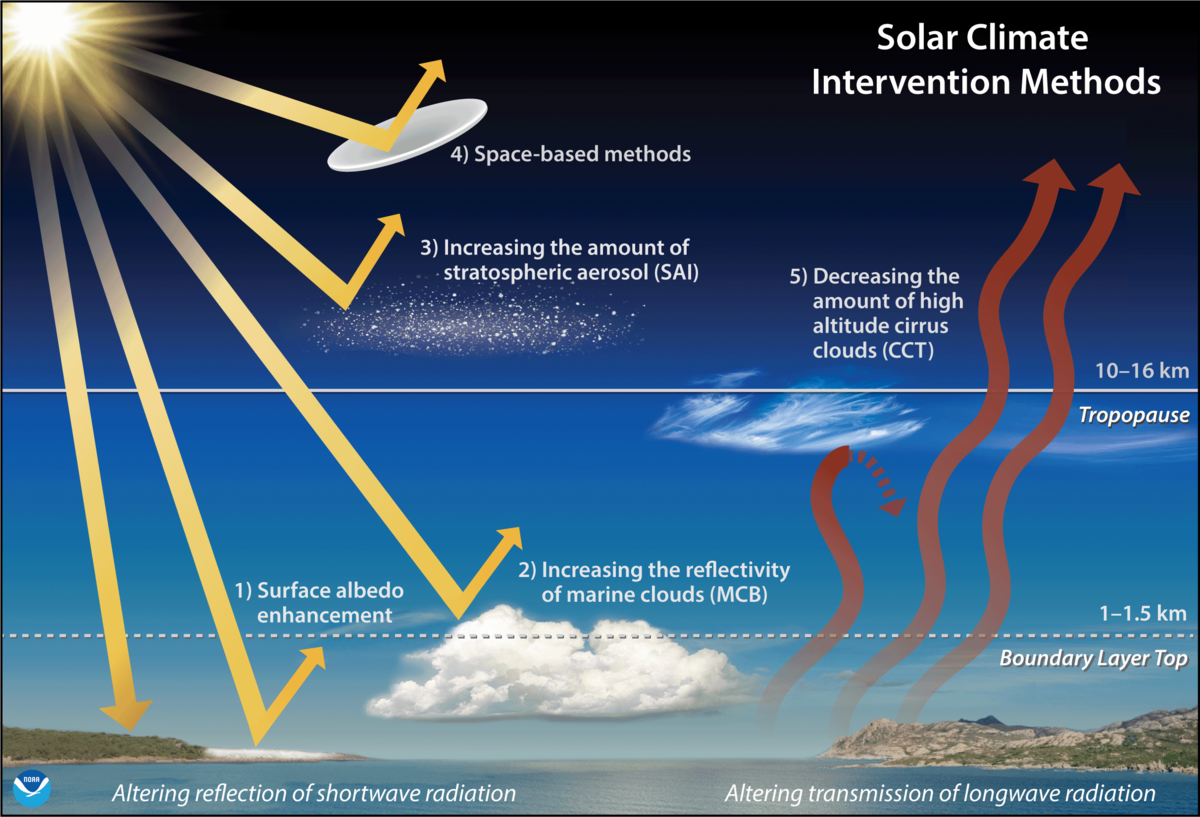
Image Credit: Chelsea Thompson from Wikimedia
Cirrus Cloud Seeding
Now, you may have a bad feeling about seeding a different type of cloud after learning that seeding clouds just enhances the impact of climate change but this form of geoengineering might actually work. Not very well mind you, but it might actually reduce the warming impact of clouds by a little bit. This is because cirrus clouds have a proven warming influence on the Earth.
Seeding cirrus clouds would help reduce their lifespan in the stratosphere and thus their warming impact. According to one study, seeding mid- and high-latitude cirrus cloud could potentially cool the earth by about 1.4°C which is more than the Earth has already warmed by since the Industrial Revolution.
This form of geoengineering has the potential to reduce global temperatures with reduced side effects when compared to other geoengineering strategies. However, removing those cirrus clouds from the stratosphere would still have a negative impact on the atmosphere. If there are no cirrus clouds to reflect the infrared radiation back to the Earth’s surface, a higher proportion of that radiation warms the stratosphere. Stratospheric warming has its own numerous consequences and impacts on global climate but that is a topic for another article.
Unfortunately, the actual effects of reducing the number of cirrus clouds by seeding them is debated. According to another scientific research paper, cirrus cloud seeding will not have a substantial cooling effect on the atmosphere due to “complex microphysical mechanisms.” And even if cirrus cloud seeding did work to a noticeable degree, it would not work for many cirrus clouds due to specifics in their formation.
Calcite Aerosol Injection
Out of all the geoengineering methods discussed so far, this idea holds promise and could even be an effective and viable solution to mitigating the warming impact of climate change should greenhouse gas emissions get out of control.
This is because calcite aerosols have the ability to simultaneously repair the ozone layer and cool down the Earth by reflecting light back into space. Another bonus for the use of calcite when compared to sulfate aerosols is that it barely warms the stratosphere at all.
However, how effective is calcite aerosol injection really? To solve that question, we come to the term “radiative forcing.” Radiative forcing simply measures the difference between the amount of energy entering the Earth’s atmosphere and leaving it. This means that greenhouse gas emissions, because they trap infrared radiation, have a positive radiative forcing value while reflective substances such as sulfate and calcite aerosols cause a negative radiative forcing, equivalent to cooling down the atmosphere.
Now, for calcite specifically, a radiative forcing of -1 watts per square metre could be achieved with a simultaneous 3.8% increase in column ozone using 2.3 million tons of calcite (2.1 teragrams if you want to be fancy) each year worldwide. For comparison, human greenhouse gas emissions have resulted in a net worldwide positive radiative forcing increase of 1.6 watts per square metre since the beginning of the Industrial Revolution.
Using calcite aerosol injection could then be used to heavily offset the warming greenhouse gases have caused, probably with much better results than sulfate aerosols. This is not to say that calcite aerosol injections will have no negative side effects, but it is a much better idea than sulfate aerosol injection.
The Problem with Geoengineering
However, no matter what form of solar geoengineering is used, it still will have an impact on global climate and not just by cooling it down. This makes sense because the injection of greenhouse gases into the atmosphere is also technically a form of geoengineering and climate change is certainly having an impact on global climate.
The global climate system is very complex and there is still so much that scientists do not know about it. Even though calcite aerosol injection may seem like a relatively risk-free form of geoengineering, extensive research on it has not yet been done to fully understand all of its risks and benefits.
In the end, the best way to combat climate change is to simply reduce global greenhouse gas emissions. That will always be the best option. Geoengineering is simply a solution meant to be used when there is no other option and warming due to climate change has gotten out of hand. Many people do not even consider geoengineering a possible solution due to its multifaceted impacts.
Even so, the actual negative climate impact of geoengineering may be overstated. If solar geoengineering is used to halve the warming effect of CO2 emissions, neither temperature, water availability, extreme temperature, nor extreme precipitation are increased in severity when averaged over any region. Neither extreme precipitation nor water availability undergo a worsening for nearly all ice-free land surfaces when solar geoengineering is implemented.

Image Credit: Getty Images from Unsplash


.webp)

.jpg)