



.jpg)

Here’s the thing no one seems to understand: Lolita is not about Lolita.

I’ve been vilified for loving Lolita more times than I can count. Not just side-eyes or hushed comments but actual hostility. People assume things.
About me. About what I like. About what I condone. All because I carry around a pink-spined paperback with a girl’s legs on the cover and a name that now lives somewhere between a slur and a punchline.
But here’s the thing no one seems to understand: Lolita is not about Lolita.
It’s about Humbert.
It’s about rot disguised as love. It’s about the language we use to trick ourselves into thinking evil is elegant. It’s about what happens when a man narrates a girl out of her own story.
That man’s name was Samuel Z. Harris, the producer of the 1962 Kubrick adaptation.
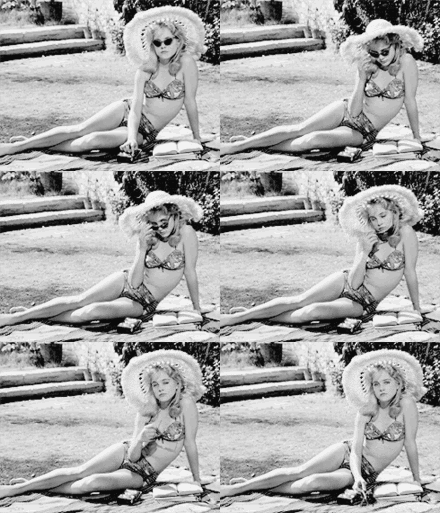
Stanley Kubrick’s Lolita was released only seven years after Nabokov’s novel came out. While Kubrick was already known for his cool, stylized sensibility (Paths of Glory, The Killing), Lolita marked the first time he would bend art into something marketable by softening its teeth. To get the film past censors, Humbert’s obsession had to be veiled, and Dolores Haze, twelve years old in the book, was played by 14-year-old Sue Lyon, made to look at least sixteen. She was blonde, pouty, seductive, and styled like a coquette.
The infamous heart-shaped sunglasses, now synonymous with the character, weren’t even in Nabokov’s novel. They were a prop for the movie poster, pure marketing. And they did what the Motion Picture Association of America couldn’t: they gave the audience permission to eroticize her. They turned child rape into vintage iconography.
Even Nabokov was uneasy with the adaptation. He wrote the first screenplay (which was almost entirely discarded), and later remarked that “only ragged odds and ends of my script were used.” In an interview with Playboy, he even called Kubrick’s version “nothing but a hoax.” But the public never got his version. What they got instead was Sue Lyon in a bikini, a lollipop in her mouth, and James Mason’s charming voiceovers convincing us that he was, perhaps, just a tragic romantic.
Undoubtedly, the POV Harris had of himself when he pointed out that it’s not illegal for a man of Humbert’s age to marry a twelve-year-old in some states with the consent of her parents.
(The allegations of a sexual relationship between Sue Lyon and the producer of the film "Lolita," Samuel Z. Harris, during the filming of the movie, when Lyon was 14, were made in a 2020 article by journalist Sarah Weinman.)
What Kubrick’s version did, perhaps unintentionally, was make Lolita palatable. Consumable. It made viewers feel okay about watching a child be sexualized, so long as she looked like she could be legal. As long as the lighting was soft, the music was romantic, and Humbert was well-dressed and literate.
And then came Tumblr.
Fast-forward to the 2010s: Lolita became an aesthetic again, this time filtered through indie music, #softgirl selfies, and Lana Del Rey lyrics. Heart-shaped glasses, strawberry-print crop tops, cigarettes and ballet flats. It didn’t matter if people had read the book.
It didn’t even matter if they’d seen the film. They knew what Lolita looked like. A girl who was dangerous because she wanted it. A girl you could blame.
But what’s been erased - again - is the girl who didn’t choose any of this.
Nabokov’s Dolores is not a seductress. She is a child orphaned by her mother’s death, manipulated by her abuser, and held captive as he drags her across America. Sarah Weinman, in The Real Lolita, reminds us that Nabokov’s novel was almost certainly inspired by the real-life kidnapping of Sally Horner, an eleven-year-old girl who was taken by a man who posed as an FBI agent.
She was held for two years, much like Dolores. Weinman’s book re-centers the true horror behind Nabokov’s work—the real girl behind the fiction. A girl with no sunglasses, no movie poster. Just silence.
So why does the book still make people uncomfortable in a way the films and aesthetics don’t?
Because the novel forces a reckoning. Because it makes you sit with the truth that the girl never had a voice, and neither do the girls you know. And maybe that voice reminds you of your own.
Andrea Dworkin, in her infamous critique of Lolita, said: “Nabokov writes the book so well that the rape of a child becomes literature. It becomes a love story.”
She wasn’t wrong. But she also wasn’t reading the novel as Nabokov intended: as a trap. As a study in how persuasive evil can be when dressed in artful prose.
Lolita is not a love story; it’s a confession. And if you find yourself empathizing with Humbert, the book is working exactly as it should.
But instead of having that conversation, people turn their discomfort into moral outrage. They go after the book. They go after the people who read it.
Especially women. Especially women who admit that they see themselves in Dolores—not because we want to be her, but because we’ve been her.
And maybe that’s the ugliest truth of all: that women know what it’s like to be desired too early. To be misread. To be narrated by someone else.
To have your pain misunderstood as provocation. To be told that if you want [censored], you must want all [censored], from everyone, at all times.
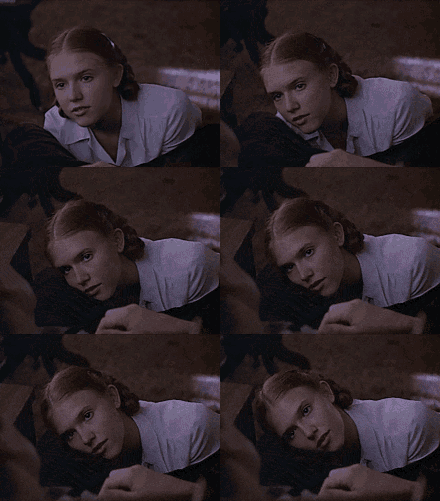
When it comes to women's sexuality, 'not without consent' seems still a difficult to grasp nuance. The moment we speak, dress or even hint at sexuality, it’s treated as an open invitation. And so we learn to express our desire only in code.
Through characters. Through novels. Through complicated, dark, often-misunderstood works like Lolita.
The 1997 version, directed by Adrian Lyne and starring Jeremy Irons, made things worse. If Kubrick’s version veiled the abuse, Lyne’s romanticized it.
(Jeremy Irons, you’re my favorite Disney villain, why did you say yes to this project? I can excuse fratricide, but I draw the line at sleeping with a twelve-year-old.)
The cinematography was gauzy, almost dreamlike. Dominique Swain, seventeen at the time of filming, was filmed in lingering close-ups that suggested sensuality, not horror. Humbert, again, was tragic.
Dolores, again, was complicit. The line between victim and vixen was blurred even further. And audiences didn’t seem to mind.
Lolita is not a story about seduction. It’s a story about theft. And we keep stealing it.
We stole it when we put sunglasses on her. We stole it when we sold her image on shirts and posters and playlists. We stole it when we ignored Nabokov’s warning and embraced Humbert’s fantasy as our own.
So is Lolita ugly?
Or are we?