







Are you a teen thinking about potentially going into law in the future? Or are you just curious about your rights and how the justice system works? Either way, here are the basics of the U.S. legal system and a breakdown of what you need to know:
Let us slide into your dms 🥰
Get notified of top trending articles like this one every week! (we won't spam you)What is the U.S. Legal System?

Image Credit: Giammarco Boscaro from Unsplash
There are two levels of law in the United States--one being federal law, and the other state law. Federal law encompasses the entire nation while state law applies only to each individual state, and though each has its own courts and systems they have one thing in common: they must follow the U.S. constitution, the highest law of the land.
Take the Quiz: What Kind of Political Personality Are You?
Ever wondered what role you’d play in the political world? Take this fun quiz to find out!
The Constitution
The Constitution was written in 1787 and is essentially the ultimate rulebook of the country. It outlines how the government works, what power it has, what it doesn't have authority over, etc. The first ten amendments to the Constitution--also known as the Bill of Rights--highlight a specific set of rights and protections for all people in the U.S. This includes:
- Freedom of speech
- Freedom of religion
- Freedom of press
- Right to vote
- Right to a fair trial
- Protection against unreasonable searches
- Protection against self-incrimination
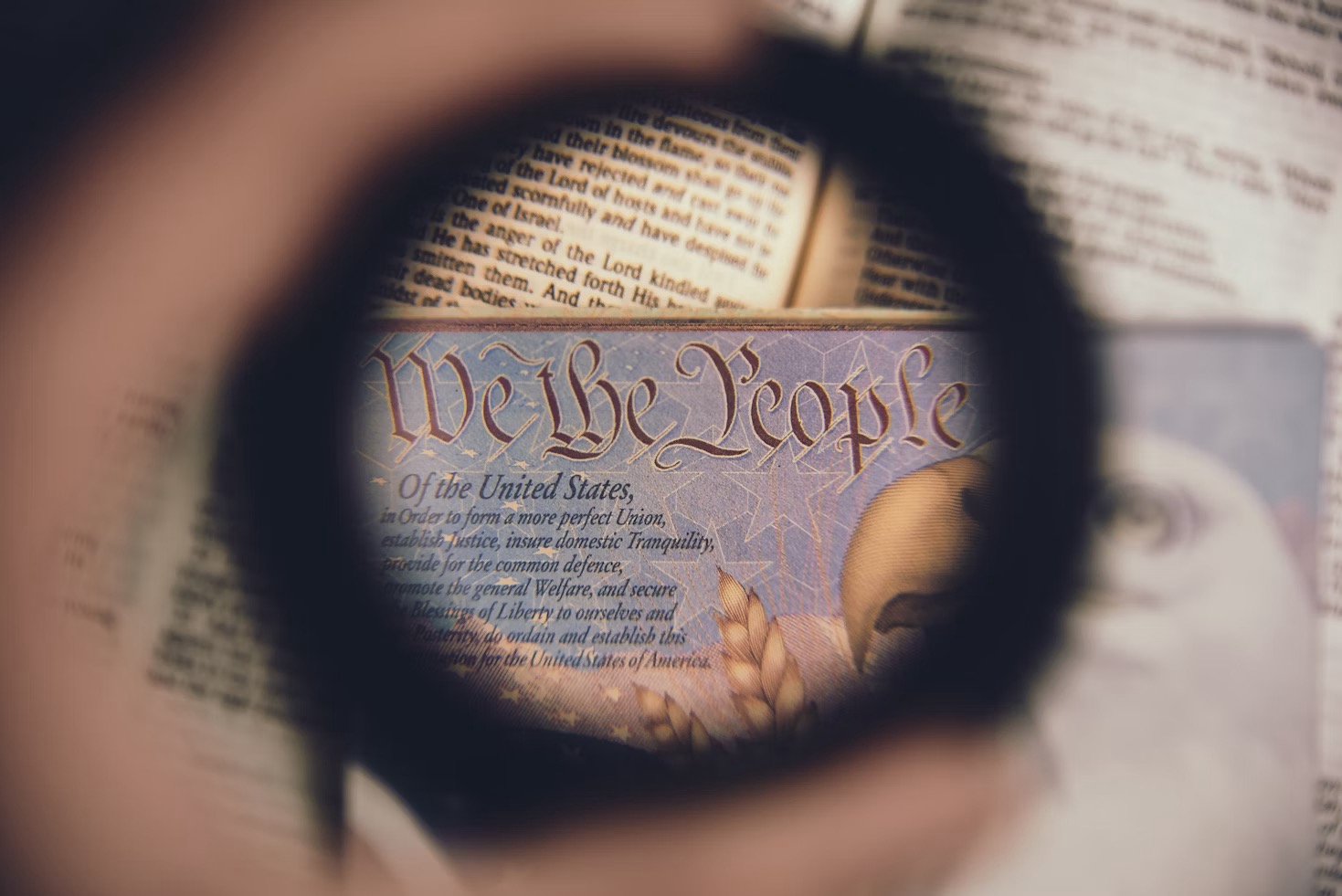
Image Credit: Anthony Garand from Unsplash
It's imperative to be cognizant of these rights, as well as the other parts of the Constitution--the Preamble, seven articles, and the total of 27 amendments. The Constitution is what protects your rights everyday, in even the most minor ways such as what you post online or how you're treated in school.
It lays out a very detailed structure for government, with the preamble stating the purpose of the Constitution--to protect justice, peace liberty, and general welfare--and the Articles explaining how the government works. The Articles explain the roles and powers of Congress (legislative branch), the president (executive branch), the Supreme Court and lower courts (judicial branch), the states' rights and powers, how to amend the Constitution, the establishment of the Supremacy Clause, and how it was ratified in 1787.
Three Branches of Government
To delve deeper into what the roles of the three branches of government (legislative, executive, and judicial) actually are, it's important to understand that each one plays a distinct yet interconnected role in protecting the Constitution and maintaining balance for the country.

Image Credit: refargotohp from Unsplash
The legislative branch (Congress) writes and passes the laws. They are made up of two parts: the Senate and House of Representatives, who together write and debate and pass bills. However the executive branch (president, vice president, and federal agencies such as FBI, EPA, and Department of Education) is the entity that enforces and carries out the laws--this doesn't mean they have full authority over everything, however. The judicial branch is the one that interprets said laws and makes sure they align with the Constitution before they give a green light on them.
These three branches were designed to check and balance each other so that no one branch would gain too much authority and shatter the delicate balance of government. This is why power is so evenly distributed and not concentrated on any one person or entity.
Civil vs. Criminal Law: The Difference?
On a different note, you've probably heard the terms civil and criminal law thrown around a lot. But what is the difference between the two--and why does it mater?
Criminal law is what handles actions that are considered offenses against society or the state--even if only one person is directly harmed. Its cases are brougth forth by the government (prosecution) and are focused on an individual / group accused of committing a crime. The consequences of these cases lie in jail time, fines, probation, community service, or life imprisonment, and examples of what could lead to this include theft, assault, drug possession, murder, vandalism, etc.

Image Credit: Inaki del Olmo from Unsplash
Civil law on the other hand deals with disputes between individuals, groups, or organizations. No one goes to jail in a civil case because the objective is not to judge how 'wrong' someone's actions were--it's to resolve an issue and reward money to the party that is judged as harmed. In the case of civil law, the case is brought by a private person or group (the plantiff) and another person, business, or organization (the defendant) is being sued.
Again, the stakes of these cases are often money, but sometimes they can be something else, such as property or other actions. Examples of civil cases include contract disputes, property damage, divorce and child custody, medical malpractice, etc.
That being said, one act can lead to both civil and criminal consequences--it's not all necessarily separate. An example where the two cases would interest is if someone were to assault another person--the victim in this scenario would get to file a civil lawsuit to get compensation for medical bills / emotional distress and the government would additionally press criminal charges for assault.
Now. Why does this matter?
If you are interested in becoming a lawyer, you will most likely specialize in either one of the two--criminal or civil--though you could practice both. When considering which you would like to do, you could start by thinking about whether you feel more passionately about justice, protecting rights, and defense, or negotiation and advocacy for individuals and businesses--this is clearly an oversimplified version of the consideration you would be doing, but this is a good place to start.
In the case of the latter you may be a better fit for criminal law, and in the case of the second civil law may be more suited for you. Just know that both types are crucial to the running of a fair, functioning society, and understanding the difference is a key step in gaining an awareness of how the legal system works.
Why This Matters For You If You Don't Want To Work In Law

Image Credit: Sebastian Pichler from Unsplash
It doesn't matter whether you want to be a lawyer, a judge, a politician, etc., or not--it's still critical that you are an informed citizen. Having a firm understanding of the law will always benefit you in situations where you have to stand up for yourself and others because the legal system imbues a lot more areas of life than you would assume--school rules, social justice movements, your online privacy, and more.
For example, if a school tries to punish you for something you said off-campus, does that violate your first amendment rights? If you're stopped by police, are you cognizant of your fourth and fifth amendment protections? If you're disrimianted against for your race, gender, or identity, do you know how to take legal action? Knowing the answers to basic questions like this is imperative to understanding your place in a system that governs everything from justice to equality to freedom.
And in that sense, here are the rights that you should at minimum be aware of:
Your Rights
Even if you are still a minor, you have constitutional rights. You have the right to remain silent if you're being questioned by the police, the right to a lawyer if you're charged with a crime, and at school your rights may be limited, but you still have freedom of expression. You also have the right to be protected from discrimination based on race, gender, religion, or disability.
You also have a right to privacy when it comes to your belongings and your body. Schools can only search your backpacks or lockers if they have a veritably justified reason. Your digital rights are protected under certain privacy laws, especially from school and government outreach.
Schools cannot punish you for things you post off-campus--on your own time, outside of school hours--unless it causes a very substantial disruption at school. On top of all this, you have the right to due process, meaning you can't be punished or suspended without a fair process.
Always be aware of your rights. It will serve to protect you in more common scenarios than you would assume.