

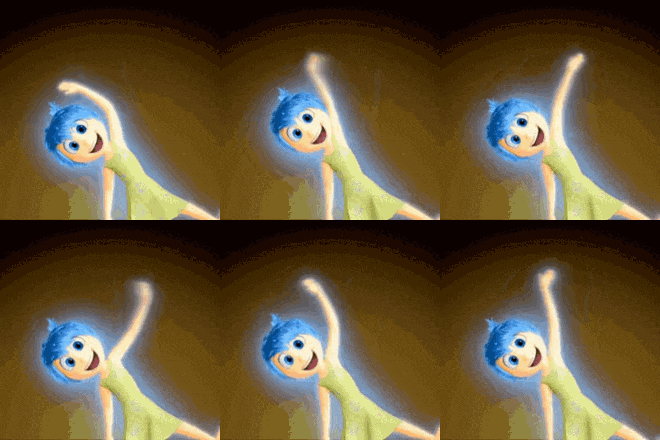



Sometimes being messy kills “aura”. Whether it's crying to tears after ending a relationship or screaming in bustling excitement when you get a good grade on a test. Expressing your emotions in an overt, obvious manner, in this era, has become a niche representation of audacity.
Chances are, not everyone can do so, and not everyone wants to do so. And this is when the word “nonchalant” kicks in: it’s a term you can probably see in frequent usage nowadays, often being offered as a sort of compliment.
According to Merriam-Webster, a "nonchalant" person is someone who remains relaxed and calm, either because they do not care about something or because they are not worried about something. You are “nonchalant” when you act calm after an achievement. You are “nonchalant” by giving a simple head nod instead of a hug in the encounter with a friend. You are “nonchalant” by expressing indifference towards a certain topic, subject or person.
The word “nonchalance” didn’t come from nowhere. It developed from the French word “nonchalant”, which means careless or indifferent. The French word came from the Latin root "calēre", which means "to be warm," showing how the word evolved to mean emotional detachment or the lack of warmth.

Image Credit: Piacquadio from Pexels
Let us slide into your dms 🥰
Get notified of top trending articles like this one every week! (we won't spam you)Why Nonchalant? How Nonchalant?
Nowadays, influencers have continuously preached the mindset that being nonchalant is cool. The reason is simple: by being nonchalant and care-free in the first place, you would never really get hurt after an unequal emotional response because your emotional attachment is extremely low in the first place.
However, there is a paradox to this cultural exaltation of indifference. Nonchalance itself turns into a performance if everyone strives to seem unconcerned. Shrugs and blank expressions are carefully chosen gestures intended to convey a particular kind of power; they are not always true representations of how someone feels.
After all, detachment reads as control, and control has always been alluring. Having the power to not feel hurt (or so it seems) acts as a form of armor that shields you from the very textures of human feelings.
However, I do not deny that I have also been lured into such a trap. Thinking from now, there was a moment in my life when I loved responding to people’s text messages with a single “K”. It’s not an “OK” or “okay”, but just one, single letter.
In that very moment of response, I might have felt like I was sending a true literary masterpiece. Beautiful as the azure sky on a summer day, mysterious as an algae-covered pond with a serene, translucent surface. Aristotle and Plato pondered it. Shakespeare and Jane Justen were inspired by its depth and philosophical connotations.
Okay, this is a joke. But in reality, not a lot of us are poets or playwrights who are willing to excavate meaning behind a text message. People see, receive, feel and respond.
All is done in the sheer span of 0.01 seconds. This is what my friends also usually felt: that I wasn’t truly listening to them or I didn’t agree with their ideas, and that I was just casting their thoughts off with a succinct letter. When the nonchalance really turns into the killer of genuine connections and relationships, things get really toxic.

Image Credit: Karpovich from Pexels

Take the Quiz: Which Halloween Costume Should You Match with Your Bestie?
Take our quiz to discover which Halloween costume theme you and your bestie should rock this year!
What About “Chalant”?
Admittedly, I am now a very “chalant” person. Before the first bubble has a chance to inflate, I sometimes double-text, reply with paragraphs, and embellish my messages with emojis because I care too much. With friends, I often crave emotional responses.
It is, perhaps, the opposite of aura, but it is also the opposite of detachment. This doesn’t mean my life is void of coolness or composure. I have realized that coolness is overrated when it comes at the cost of sincerity. After all, what could be more alluring than someone who embraces their entire humanity?
Repressing visceral emotions like excitement, grief, and longing for the sake of maintaining composure may diminish their importance. We lose the intimacy that comes from emotional honesty as well as the freedom to be vulnerable when crying is viewed as weakness or excessive joy as cringe. Authenticity may be sacrificed in order to maintain the so-called "aura" of mystery.
Conclusion
Now, I am not saying that one state of expression is better than the other, but oftentimes we need to strike a balance between the two in order to live a full, rounded experience. The reason why we want to be nonchalant is that the art of aloofness brings us security of not being deemed weird or awkward.
Hence, I believe that the real revolution should, instead, lie in a change where these intimate feelings (such as being affectionate or vulnerable) become an acceptable and admirable quality. My take on this is that being chalant is to risk awkwardness, and thus a sign of courage, inviting people to deeper, sincere human bonds.
While nonchalance can shield us from harm, chalantness ties us to one another. In the end, I would prefer to live in a world that is meticulously ironed flat with indifference than one that is pieced together by haphazard, sincere threads. Nothing is more radical than being fully human in this age that exalts perfection.


.jpg)