



It is a particular dread to hear that your favorite book is becoming a movie or series. While excitement comes instantly, it is followed closely by a low-grade anxiety: will they get it right this time? Most times, they do not.
Somewhere between all of the script rewrites, the aesthetic choices, and “fan-service” moments, the story's heartbeat disappears from the story. The heart that made the book special is lost beneath shiny cinematography and formulaic storytelling.
Lately, studios appear to have confused accuracy for authenticity as if ticking off every box to every plot point is enough to make something meaningful. However, adaptation is not transcription; it is translation, and creators have too often forgotten how to translate feeling.

Image Credit: Susan Q Yin on Unsplash
Let us slide into your dms 🥰
Get notified of top trending articles like this one every week! (we won't spam you)The Rise of the Aesthetic Adaptation
Consider Eragon, The Dark Tower in addition to the Percy Jackson films. They all came with the promise of bringing favorite worlds to life. They had the budgets, the names, and hopes of readers that were eager to believe again.
Instead, viewers experienced hollow representations of the stories that once inspired such emotion. Eragon took a sprawling, coming-of-age fantasy, and remade it into an interminable action removed of any emotional presence; The Dark Tower took a mythic, genre-defying epic, and made it a confused ninety-minute summary that could be followed; Percy Jackson—ready, from the material, to be a celebration of the heart, humor, and growth of its hero—was turned into a forgettable franchise.
It wasn't just the absence of plot points or poor pacing. It was the absence of tone, of intimacy. The emotional language of the books—the slow build of trust between characters, the sense of discovery, and that sense of awe that kept readers turning pages past bedtime does not magically move to the screen. You can have the same scenes, but if you lose that sense of emotion that made the moment; by then it becomes a mere spectacle.


Take the Quiz: Which Studio Ghibli Character Are You?
Are you a brave warrior, a free-spirited dreamer, or a gentle guardian?
The Casting Problem No One Learns From
There’s also the issue of casting—arguably the most personal issue of all. Readers spend years imagining these characters, giving them their own identities, idiosyncrasies, and chemistry. So, when a studio announces a cast that feels very wrong, it isn’t just nitpicky—it’s emotional whiplash.
Take for example The Off-Campus series. The books became popular in part because of their connection to the characters—readers felt like they knew Garrett, Hannah, and the rest of Briar U. So when the cast list came out, many fans felt distanced even though the actors were not the issue; the casting felt algorithmic.
It felt as though the casting was focused on potential market appeal instead of connection to the characters. It felt as though producers built the cast from a focus group that told them what college romance looked like instead of what college romance felt like.
However, the thing is that the fans did, and not just for Off-Campus. The fancasts may be a little cynical and unrealistic but the fans did not pull that actor from thin air. Readers aren’t thinking, “I just think she looks e x a c t l y like her!” Readers are thinking, “She has the best presence!” These readers weren't just thinking if the actor or actress met the physical standards most people have for attractiveness, these readers were determining if she embodied the role vs played the role. And this is how studios can start the process of adaptations going wrong, before the cameras even start rolling.
Casting not only has a misfire, it changes the entire emotional temperature of the story. It is easier to believe in the intimacy or tension between characters if they seem like the people we've allowed to carry our emotions.

Image Credit: Chris Liverani on Unsplash
The Franchise Over Feelings
We are in an era where everything is meant to be clicked and binged, and studios often think of stories as distribution brands. They ask not what this story means, but how can we expand this? Emotional pacing gives way to franchise potential.
Characters become the content pillars. Even when wonderfully adapted, it starts to feel vacant because it isn't being felt, it is being consumed.
And the same seemingly is occurring once again. On the table is a "contemporary reimagination" of Wuthering Heights—supposedly transforming Gothic power of Brontë into acceptability and Instagram-worthy material—and again it feels like symptoms of the same malaise. It’s not that the stories are not worth re-collecting, it’s that you have the potential for this onerous recitation to turn into something otherwise known.
What has caused Wuthering Heights to endure has nothing to do with its beauty, it has to do with its rawness, for its protracted obsession, and for its plodding march into madness. Transform that into something that you are prepared to post to your various social media feeds, and you've indisputably stripped it of anything that knows how to haunt.
So, while there have been many adaptations lately, they tend to captivate us in a way that is emotionally flat much of the time. We get the what; the twist, the big reveal, the "viral moment," but we miss the why.
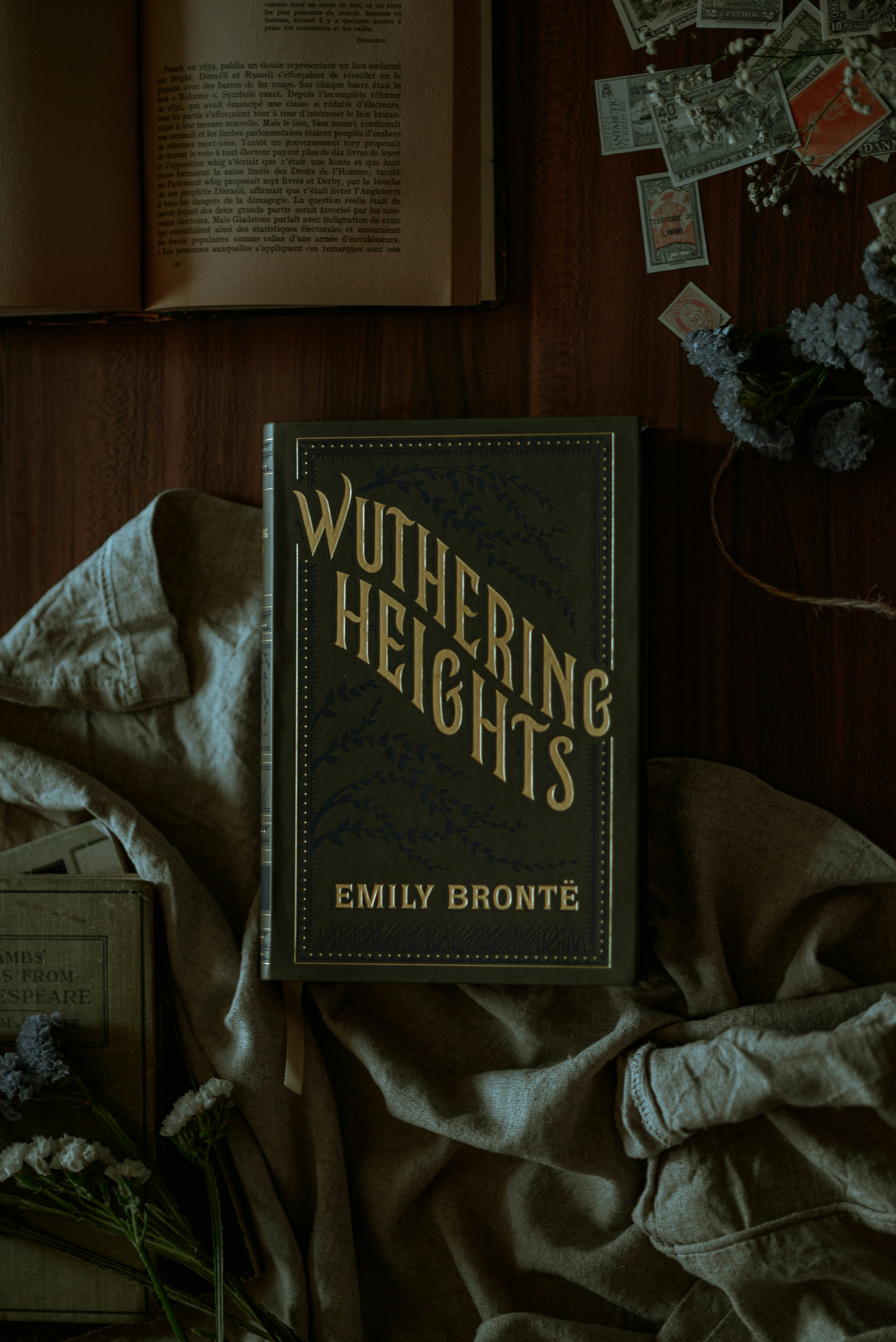
Image Credit: Zoe on Unsplash
The Goldfinch Effect: When Prestige Isn’t Enough
Think about Donna Tartt's The Goldfinch. It is a heavy, meditative, and deeply human coming-of-age story of trauma and art. The film adaptation had a lot of potential, one of the best casts one could assemble, a very large budget, an eye toward Oscars, but ultimately failed because it did not trust stillness.
One of the most powerful aspects of the book is its ability to go deep into introspection and wallow in pain, confusion, and guilt. The film, pacing and momentum obsessed, jettisoned stillness, and absorbed introspection, leaving an aesthetically beautiful frame behind, but a soulless one.
That's the connection. The industry's obsession with pacing and spectacle is akin to some sort of an allergy to silence. Yet silence is where literature breathes.
Silence is where characters think or ache or exist; silence is where action coalesces. If adaptation forgets to be silent, adaptation forgets humanity, which is what makes the original work worth adapting in the first place.

Image Credit: László Glatz on Unsplash
When They Get It Right-ish
Not all adaptations miss the mark. Some adaptations, like Greta Gerwig’s Little Women (2019) or Normal People, let us demonstrate that if you have accuracy, it does not need to be accuracy to the structure of the book but accuracy to the emotional heart of the story.
Gerwig does not adapt Little Women faithfully. She adapts and reinterprets it. She understands what is important about Alcott's book—a book that does not represent chronology or time, but intimacy, or time spent intertwined with ambition, sisterhood, and grief.
It is the brilliant insights into the female condition and friendships that matter. She alters time and takes Jo's creative frustration and brings it to life and honors the spirit of the work, not the syntax.

Similarly, Normal People succeeds in what it refuses to say. It is successful because it takes the aching silences of Sally Rooney’s writing and uses close up shots, breath, and hesitations in the emotional language of the book to produce a compelling rendition. I see it and I am not seduced by spectacle or scale. I just want to feel the feels—and I can.

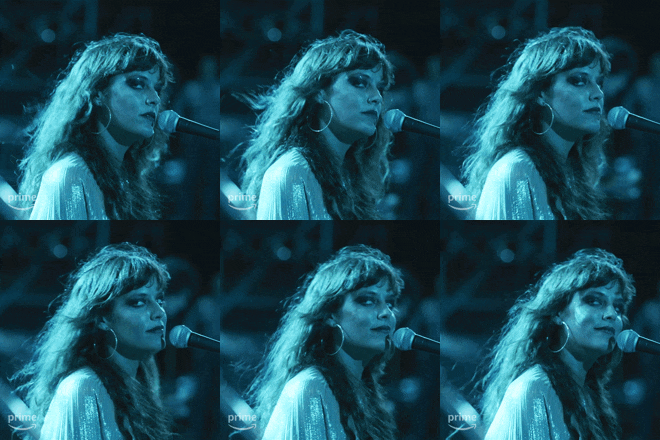
The same idea can be made, in part, for The Summer I Turned Pretty and Daisy Jones & The Six. Those adaptations had a sense of nostalgia pulsing quietly throughout the text. Those adaptations leaned into feeling, aesthetic, and environment over value and plot.
When TSITP is successful, it is not replicating Jenny Han's words but capturing that tenuous painful moment of crossing from adolescence to womanhood. Daisy Jones uses Taylor Jenkins Reid's oral-history conceit to create immersive, textural place where music is memory, and then myth.

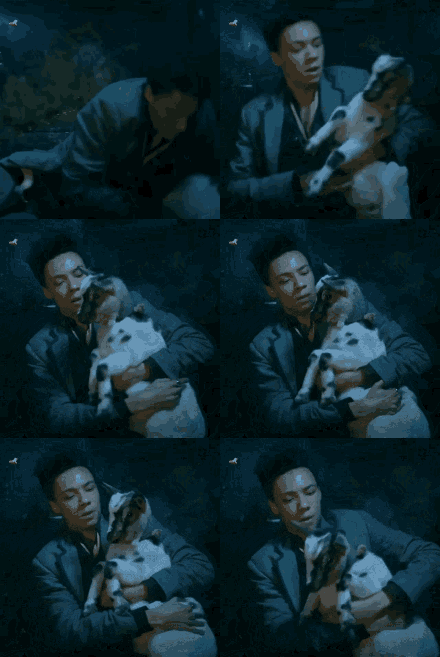
Not all "successful" adaptations achieve that status by staying authentic to the source material. Shadow and Bone and A Good Girl's Guide to Murder demonstrate how fragile the balance can be. The former created a beautiful, striking world before losing its way.
It began merging different storylines, softening character edges, and simply overproduced everything that once felt organic and localized. The latter started promisingly yet fell apart with tonal flailing and hurried pacing that dulled the sharp intelligence of the novel and stripped it of its emotional heft. In both cases, they remind the viewer that attempting to prioritize too many aspects—fans, algorithms, aesthetics—ultimately leads to losing the very heart of the story that made it worthy of adaptation in the first place.

The lesson is not that accuracy leads to authenticity; it's that clarity of emotion does. The finest adaptation attempt to fill the viewer with feeling over formula, energy over exactitude. The best stories understand that the act of storytelling is not simple replication or adaptation—it is resonance.
Adaptation in the Age of Algorithms
The streaming era has reshaped the process of story-making. The 21st-century adaptation has become less an act of art and more an act of advertising. The pacing of the story is determined by data.
The structure is driven by engagement. The value of patience in storytelling has been supplanted by the (scientific) imperative of retention.
And so, we see beloved properties like Percy Jackson not redesigned to move us, but to sustain us; to keep us subscribed, engaged, and revisiting the property. They have a formula for that: nostalgia + recognizable IP + serialized structure. But formula is not feeling.
Image Credit: Francisco Ghizletti on Unsplash
We can even witness the length to which that formula runs with that next crop of adaptations. The Off-Campus series is being pitched less as a story about intimacy and discovery and more as a new adult lifestyle brand. The Wuthering Heights adaptation is going to give “modern relevance” at the risk of aesthetic polish dislodging emotional ferocity.
These ideas are not bad. They are indicative of an industry that is more interested in content ecosystems than art.
That’s not to say adaptations shouldn’t evolve. They should. The best ones have always evolved, and generally only get better for it.
But evolution should be about deepening the story, not diluting it. It should mean transcribing the intention of a book onto a new platform...not flattening it to a template.
The Soul That Gets Lost
As both a reader and a writer, I have observed time and again that the 'magic' in books is not based on the events that happen but how a book makes you feel. An adaptation must carry that emotion, that emotional trace that remains long after putting the book down.
When studios miss that, the film is not bad, it is hollow. A story that glorifies all of the plot points, but forgets why it mattered.
I don’t want a perfect recreation of the books I love. I want an adaptation that cares to think about the book—to thoughtfully ponder what makes a story powerful and then think about how to convey that truth into another medium. When a story loses its heart, it fails the book, but it fails the audience that believes in the story's heart as well.

Image Credit: Thomas Schweighofer on Unsplash
In my opinion, yes, adaptations of books onto screens keep missing the point. But perhaps what audiences really want isn’t an authentic adaptation, it’s intimacy. Intimacy which reminds us of our original love for storytelling. When a film remembers the spirit of the book it’s based on, the film doesn’t simply adapt a book, it revives it.


