



_poster.png)

Like so many, I spent part of my Valentine’s Day at the theatre, watching Emerald Fennell’s highly anticipated (and equally controversial) new film with a friend. Having consumed enough online discourse, I went in with low expectations and the assumption that I wouldn't enjoy it. In the end, my low expectations were somewhat exceeded, and I ultimately gave it a solid 3-star Letterboxd review.
So, does Wuthering Heights do justice to the novel it's based on? The short answer: Not exactly. But that shouldn't stop you from seeing it for yourself, nor should it stop you from enjoying it.
Wuthering Heights--Emily Brontë's Version

Image Credit: National Portrait Gallery via Wikimedia
First published in 1847, Wuthering Heights is the only novel by writer Emily Brontë, depicting the doomed romance of Heathcliff and Catherine Earnshaw while addressing themes of class inequality and prejudice in Victorian England. While the book was initially met with polarized reviews, it's currently regarded as a pillar of English literature.
And with over 30 adaptations and a chart-topping song by Kate Bush, its impact on pop culture is undeniable. But when Emerald Fennell announced that it'd be the subject of her next film (along with a soundtrack by Charli xcx), Brontë fans and casual readers alike were skeptical of how she'd handle the story.
Let us slide into your dms 🥰
Get notified of top trending articles like this one every week! (we won't spam you)Wuthering Heights-- Fennell's Version

Image Credit: Jaggery via Wikimedia
Fennell's intentions were never to make a faithful adaptation of Wuthering Heights, something she's been open about. In an interview with Fandango, she stated, "I can’t say I’m making Wuthering Heights. It’s not possible. What I can say is I’m making a version of it [....] And so [this film] is Wuthering Heights, and it isn’t.”
The first change fans will notice is the portrayal of Heathcliff and Cathy's romance in the book and in the movie. The novel isn't exactly a romance or Valentine's Day worthy. It's more of a tragic story of two people who can never be together, ultimately causing heartbreak and intergenerational trauma (more on that later). The movie, on the other hand, depicts the pair's dynamic as a great love story, with a particular emphasis on physical attraction. (While Heathcliff and Cathy only kiss once in the novel, and spend the rest of the time yearning for each other, Fennell's version contains extended passionate montages of the two).
The next big change Fennell made was eliminating the second generation that the novel explores. In the second half of Brontë's book, Heathcliff is depicted as abusing Cathy's daughter and his son, thus continuing the cycle of intergenerational trauma. In Fennell's version, the story ends with Cathy dying of sepsis following a miscarriage, thus cutting out a large part of the novel's contents. Despite this large change, it's often ignored in social media discourse about the film.
The public's first grievance with the movie came with its casting. Described as a 17-year-old with long brown hair, it seemed odd that the role of Cathy would go to Margot Robbie. But beyond creative liberties, serious controversy came from casting Heathcliff as Jacob Elordi.

Take the Quiz: Which Sex Lives of College Girls character most suits you?
Are you a messy genius like Bela, a quiet powerhouse like Leighton, or a lovable chaos magnet like Kimberly?
Heathcliff
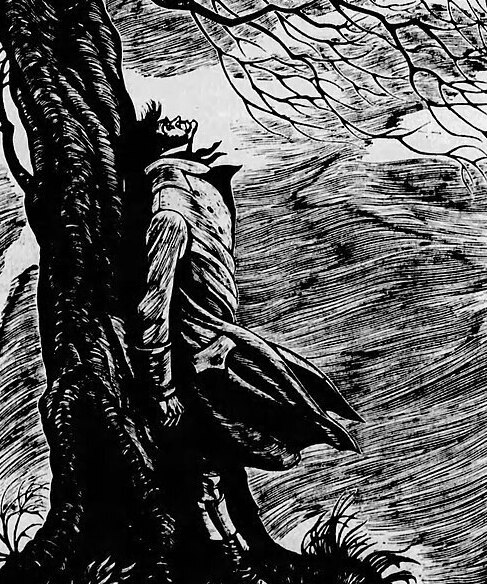
Fritz Eichenberg's Heathcliff
Image Credit: Fritz Eichenberg via Wikimedia
Described in the novel as a "dark-skinned gypsy" and a "little Lacar" (a word which was used towards people from Africa, South Asia, and the Middle East), Heathcliff's race has often been an important part of understanding his character. At one point in the novel, he compares himself to Cathy's husband (Edward Linton) by saying, "I wish I had light hair and fair skin." His race is used as a factor that sets him apart from the other characters, specifically contributing to the divide between him and Cathy. Additionally, some scholars (such as Reginald Watson from East Carolina University) have theorized that Brontë included his character as commentary on the slave trade in Liverpool.
Many critics have also assumed that Heathcliff's character is Romani, an ethnic group in Europe that has long faced discrimination. And while the novel never specifies his race, it's understood that Heathcliff is not white, and his race is a crucial part of understanding Wuthering Heights.
So when Jacob Elordi, a white actor, was chosen for the role, this part took center stage in the controversy around the movie. Many were quick to accuse Fennell of "whitewashing" the character and ignoring an important detail of the source material. By eliminating the race factor, the film relies on the economic divide between Heathcliff and Cathy, with his lack of money being portrayed as the reason they can't be together.
Conclusion
If we're answering the question of whether Fennell's movie "did justice" to Brontë's Wuthering Heights, then the answer would objectively be no. But if one is asking whether or not the movie is good, then the answer is more murky. It's a visually beautiful film with an easy-to-follow plot and emotional moments (Even a skeptical viewer like me cried at one point).
Ultimately, no amount of social media discourse or negative reviews should interfere with whether or not you decide to see a movie, or even whether or not you enjoy it. So whether you're a die-hard Brontë fan or someone unfamiliar with the novel, Wuthering Heights might just be for you.


.jpg)