



"I fell in love the way you fall asleep: slowly, and then all at once," John Green, The Fault In Our Stars
The winter season has started and the rainfall and cold weather can only lead to me curling up in a blanket, invested in my favorite books. When I'm even lazier, I turn on one of my comfort rom-coms or tv-shows (Friends and Gilmore Girls on top!)
Really, taking a step back, we're looking at words on pages. Bits of ink splattered together to weave this amazing story line that we can't put down. In movies, we're watching people we don't even know (unless you're lucky) yet we don't close the Netflix app or turn off the phone.
To us, these are real, round, imaginative characters. We can see them in our mind, we smile when they laugh, we cry when they're lost.
We become invested in literal pieces of fiction. Why is it that we hurt when they hurt? Why do we love them like we know them?
Let us slide into your dms 🥰
Get notified of top trending articles like this one every week! (we won't spam you)Talented Writing and Characterization
If you're chronically on Pinterest, you've probably seen those "whispers" where they write "RIP (fictional character) you would've loved (modern reference)."
Personally, these are hilarious to me, but also astonishing at the same time. Because really, assuming the creator has read or watched the media with the character, they're true in my mind. Like, yes, I could definitely see Olaf from Frozen loving modern-day brain rot.
When books and movies are written extremely well, they create these real characters in our mind. They have developed personalities, their own vibes, that makes us feel like they're talking in our ear next to us. The show director or author may have no idea who we are but the people they create speak to us, and we get to know them like they're our lab partner in science class.
It's important that characters have their perks and their flaws. No one in life is perfect, and that's normal and expected. When we see perfect characters, we lose feelings for them because they're not realistic in our eyes. We love the little habits and fidgets that only tell us more about their personality, at the very least subconsciously.
In Tangled, Rapunzel never puts on shoes. First of all, ouch because walking on rocks barefoot cannot be fun. But its the little detail that tells us that she likes her freedom.
She appreciates her new life outside of her tower, and experiences it every way she can. She's a free, happy, energetic person who can't be contained any more.
In the tv show, Friends, Monica is known for being a neat freak. Is it the main plot of the story? No.
But does it tell us more about Monica? Yes. We learn how she appreciates order, and cleanliness. She can't stand tiny imperfections in her apartment. This quirk is useless in the story, but it helps us love Monica a little more now that we know her.
Characterization is single-handedly the best way to get us to love a character.
"I spend all of my time imagining What it would be like if they existed"- Khloe Rose, Fictional
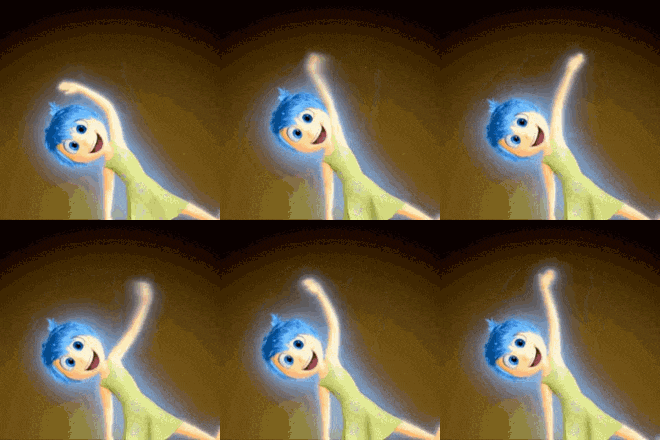

Take the Quiz: Which Inside Out Character Are You?
Inside Out is a classic but what character matches you best?
Controlled Empathy
We all have our natural capabilities for empathy. We're all human, we all have hearts, and we all have the ability to at least try to understand another persons feelings.
When we watch movies, or read books, we experience the journeys of the characters like we're in the story as well. An immersive experience, in words and colors. When we see characters with their struggles, and their heartbreaks, it makes us feel bad for them knowing everything they have to go through. We offer empathy because we have our bad days too.
"We often choose our favorite characters because we see ourselves in them"
A well-known YA tragedy, If He Had Been With Me, is popular for it's unique, raw writing style. In it, we see the main character Autumn's inner thoughts, even the meaner or selfish ones, as we read every moment from her core. But we also see everything that touches her in some way, and all the little things that break her heart.
Understanding her thoughts and perceptions helped us learn how she goes through life, and in turn, we connect with her. We form our little "empathy link" like in Percy Jackson.
The same goes for positive emotions. We see these characters work so hard, through the pain and the hardship, to get what they want. And when they do, or when they reach a happy point, we feel their excitement because we understood how hard it was for them to get there.
For example, in Elemental, a movie about love beyond the elements, we watched the hour and a half struggle between Ember and Wade. We know the chemistry between them, and the extremely annoying factors that keep them apart (ie, their contrasting elements, family pressures, etc.) So at the end, when Ember finds her voice and her courage to be with Wade, she gets to live the life she wants and love the man she wants. This happy ending is so satisying to us, and it makes us happy knowing our characters found a work to work it all out.
This all comes from being invested in a good story with likable characters Writers know how to utilize their words as power to get us to love their audience, not just for their quirks and personality, but for their strength in harder moments. They take the natural emotions we pick up from other people and they manage to put that into their characters, making us feel every loss or every success for them.

Love Through Loss
One concept I found a lot whenever I looked up my favorite books and movies, was that the best side character often dies. Whether it was Tadashi, the charming, caring older brother from Big Hero 6, or (Spoiler for Dead Poet's Society People!) tragic, anguished, Neil Perry in The Dead Poets Society.
Basing off the idea "it's better to have loved and loss, than never to have loved at all," the best way a writer can invoke emotion is through sadness and grief. They show the brightest best parts of the best characters, before they die in the worst ways. And without them to fill the pages or the screen, the whole story seems darker as a whole, especially when we watch the characters try to fix the gap they left behind. You feel the absence of them, which only makes you love them more.
The characters that made us cry when they lost their happy ending, like with (Stranger Things Spoiler!) Eddie from Stranger Things, are ultimately much more memorable.
Without digging too deep into the rabbit hole of grief, when we remember someone we lost, we remember the best versions of them. With this best version in mind, they become a character we cherish.
Killing off a character is an incredibly efficient way to get us to miss them, and therefore love them more.
In Short
Loving fictional characters is a complex mix of elements, from the writers, to the animators, and the actors. Often, we just love characters because they're funny, or cute-looking. Or maybe they remind us of ourselves, or someone in life that we love. They're also our ways to escape from real, hard relationships of our world, since the relationship between a book or tv and it's viewer is one sided, but it can mean everything to us, the audience.
Books, movies and shows are amazing, but its the characters that hold them all together. So, who's your favorite character?