






Fans of Star Wars have argued for years that Anakin Skywalker’s turn to Darth Vader felt sudden; a sudden drop into the darkness constrained to the handful of tragic moments. I mean, it's a decent conclusion to make on first glance– one moment he's flying an Eta-2 Actis-class light interceptor, shooting at the enemy, the next he's killing younglings. But was it sudden? Or were we only paying attention to his final descent for so long that we didn't even notice the less-dramatic dissolving that got him to that point?
The truth is, Anakin's fall was not a light switch that was flipped on. It was a long, drawn-out, tragic disintegration that had been in play the whole time.

Let us slide into your dms 🥰
Get notified of top trending articles like this one every week! (we won't spam you)The Making of a Fall
Anakin has always been a story about potential and the fear of losing it. From the moment Qui-Gon Jinn first finds Anakin on Tatooine, he is treated remarkably because he is the chosen one.
But with that potential, there is also the burden to fulfil a prophecy that Anakin never even asked for in the first place. Even as a kid, Anakin had his power to be both a gift and a burden. The Jedi Council sees Anakin as too emotional, too rash, and too dangerous.
They begin to keep their distance from him. The process of Anakin's alienation is much, much earlier than Revenge of the Sith; it starts as early as The Phantom Menace.
As Anakin develops, the divide between his emotions and the demands of the Jedi grows wider. Every demonstration of valor takes him into the realm of suspicion, and every emotional response he displays evokes reprimand for not controlling himself. People reward him for acting weak, simultaneously reprimanding him for being human, which has a slow, quiet, and derailing effect on belonging.
By the time he is Obi-Wan’s Padawan, his need for validation and recognition has already begun to shape him. Anakin doesn't want power for the simple sake of power; he desires to be told he has a right to be "in the presence of power."
The death of his mother in Attack of the Clones shatters something in him. The grief is immediate and raw, the rage is instinctual, and he is not met with compassion, or support, or understanding, or a shoulder to cry on, but with lectures about detachment.
The Jedi's moral teachings may be wise in the abstract, but they place Anakin into an emotional desert where grief leads only to isolation. He learns to repress what makes him human and begins to feel he is somehow wrong to have those feelings. Before long, he comes to believe that love is actually weakness.
Repression does not lessen the feeling he has; it only intensifies it. He is a man in Revenge of the Sith who has been told to suppress the parts of himself that probably needed the most healing.

Take the Quiz: Which ’90s Movie Character Are You?
Are you ready to travel back to the iconic ’90s and discover which unforgettable movie character matches your personality? Take this quiz to find out!
Manipulation Masquerading as Mentorship
Enter Palpatine. Palpatine disguises what the Jedi would refer to as discipline, and he reframes it as denial. He suggests understanding when the council suggests restraint.
He offers what every singularly isolated person desires to hear: that you are seen. Palpatine did not create Anakin’s darkness; he nurtured it. Palpatine feeds Anakin’s fears, feeds Anakin’s guilt, feeds Anakin’s fierce need to control, until what is protection and what is possession becomes indiscernible.
The power of Palpatine’s manipulation is in how soft it is. He does not confront Anakin’s pain; he comforts it. He positions himself as the only person who understands the boy inside the prophecies.
In this, every scar left by the Jedi is completely reframed. The Jedi told Anakin, after being separated from his mother, that love was dangerous, while Palpatine talked to him about love as destiny.
The Jedi told Anakin that fear is what turns you to the dark side, while Palpatine insists that fear is the way to power. Each whisper plants a seed, and Anakin, needing some stability in his life, attaches to the one connection in his life that doesn't tell him to feel less or be less emotional, to be worthy.
When Anakin dreams of losing Padmé, he simultaneously connects it with the death of his mother. Two traumatic events become one, and his infatuation/emotional obsession with saving Padmé becomes a motive to rewrite the past. The tragedy is not the manipulation, but that the manipulation feels like love.
Palpatine becomes the ultimate father figure; it is not that he is judging Anakin for being emotional, but he is using that emotion against him. All of Anakin's decisions in those moments feel like decisions of caring. That is what makes it all so convincingly painful.

A Study in Gradual Corruption
If you go back to the prequels and provide a closer look at Anakin's actions, looking at every rash decision, every look, and every defensive comment, you can notice they're all just another micro-crack. Every outburst of anger in the chambers of the council, every moment of distrust in Obi-Wan, every instalment of resentment about the hypocrisy of the Jedi gallop towards this, building up.
In isolation, they do not feel alarming, but they build an emotional architecture that inevitably falls. The arc is so beautiful because it is all mundane. People do not just fall into darkness; they get nudged, coerced, or kept in it by people who are ready to take advantage of a vulnerable moment.
It’s another tale of silence, of all the moments when no one steps ahead, or engages. The Jedi saw Anakin in pain but thought he was being defiant! Obi-Wan would have loved him, but was bound by the doctrine of the Council.
Padmé could see his fear but thought that love would be enough to overcome it. Everyone around him saw the cracks, but thought they were confidence, youthful arrogance. The real tragedy is that it was always just there; we just didn’t want to see it, nor did they.
The tragedy of Anakin Skywalker is not that he “turned”, but that he thought he had no choice. The fall of the hero never comes with a lot of bells and whistles, and to the audience is not always clear. It can get cloudy with mercy, it can be the love we have for others, or the promise we have that this time we will be strong enough to save the very people we were too weak to save before.
The Inevitable Descent
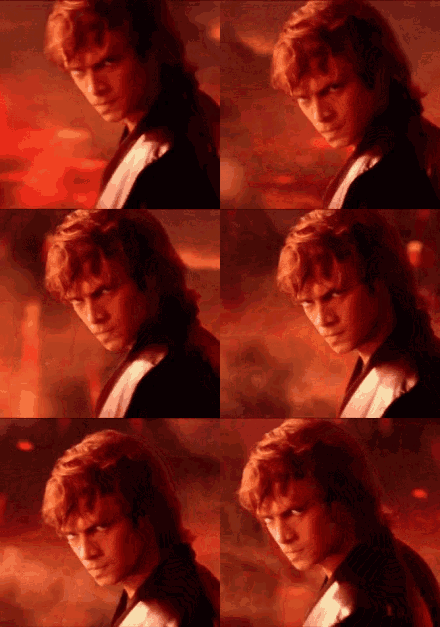
When Anakin kneels to pledge his allegiance to the Sith, I don't consider it a betrayal of character; it is simply the final step in a sequence that has taken years to prepare through dissociation and emotional fatigue.
His tragedy is not that it happens fast but that it happens according to design. He is manipulated by every system that is charged with his protection: the protection of the Jedi who taught him the way of non-feeling in replacement rather than working through his emotional injuries; the protection of the Republic that converted justice into bureaucracy; and Palpatine, who merely saw potential power in Anakin as a pawn, both impotent and powerful.
The final transformation of Anakin into the physicality of Darth Vader feels like not a new reveal but just a grieving. Each scar and each sputtering breath behind the mask shows each remnant of the boy who wanted nothing more than to set the slaves of Tatooine free. And therein lies the greatest sadness: the darkness did not erase the light in Anakin but grew to enfold it slowly like grief. What we witness at the end is not a monster but the inevitable conclusion of a person who loved too much, feared too much, and was not taught how to be in a relationship.
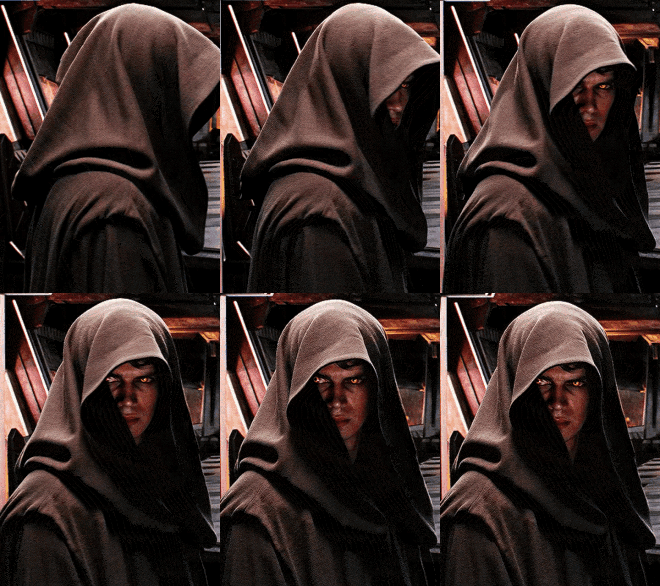
No, Anakin's fall was not sudden. It was years of agony, finally bubbling over, and it was not an issue of writing, but an expression of something fundamentally human. Love can easily morph into fear when we connect without forward defenses, and fear can effortlessly morph into constricting control when left unchecked.
Anakin became Darth Vader, never as an instantaneous rupture, but ultimately as surrender—self vacated beneath the immense burden of expectations. Within the weighty hollow of his mask, we still hear faint echoes of the boy from Tatooine who merely wanted to save the people he loved.
The tragedy is not that he became a 'monster,' but that he became who he thought he had to be to stop feeling pain and suffering. The moment he was enacted as the 'Chosen One,' there was nothing beautiful about it whatsoever; it was ultimately a story about how much of yourself you can lose long before you realize there is no self left.