





A Trip to Reality
During spring break, I went on a trip to Kansas and Oklahoma to gain a more profound understanding of Native American history. I had spent months researching the Missing and Murdered Indigenous Women Crisis (MMIWC). This crisis, which I had never once heard of before, includes at least 4,000 Indigenous women in the United States who have gone missing or been murdered in recent decades. Indigenous women face disproportionately high levels of violence, and murder is the second leading cause of death for them in the U.S. The MMIWC is described as a [censored] by a landmark 2019 report. Before the trip, much of my understanding still came from research, textbooks, media, and secondhand representations.
The first place I went to in Kansas was the University of Kansas, where we met Lori Hassleman, a citizen of the Shawnee Tribe and the Delaware Tribe of Indians and an alumna of Haskell Indian Nations University. Haskell is one of the only universities in the United States created specifically for Native American students, serving students from more than 140 tribal nations.
Hassleman introduced herself to my classmates and me in her Native language, and I immediately noticed how narrow my understanding of Native Americans had been. Growing up, nearly every image of Native people I had seen came from textbooks, movies, or lessons in class. Because of that, I unconsciously expected Native Americans to look, dress, and live the way they were historically portrayed.
Hassleman and every other Native American I met on the trip completely challenged that assumption. They looked and lived like any other modern community while still maintaining their own traditions and identities. Visiting Haskell forced me to confront how stereotypical my understanding had been.
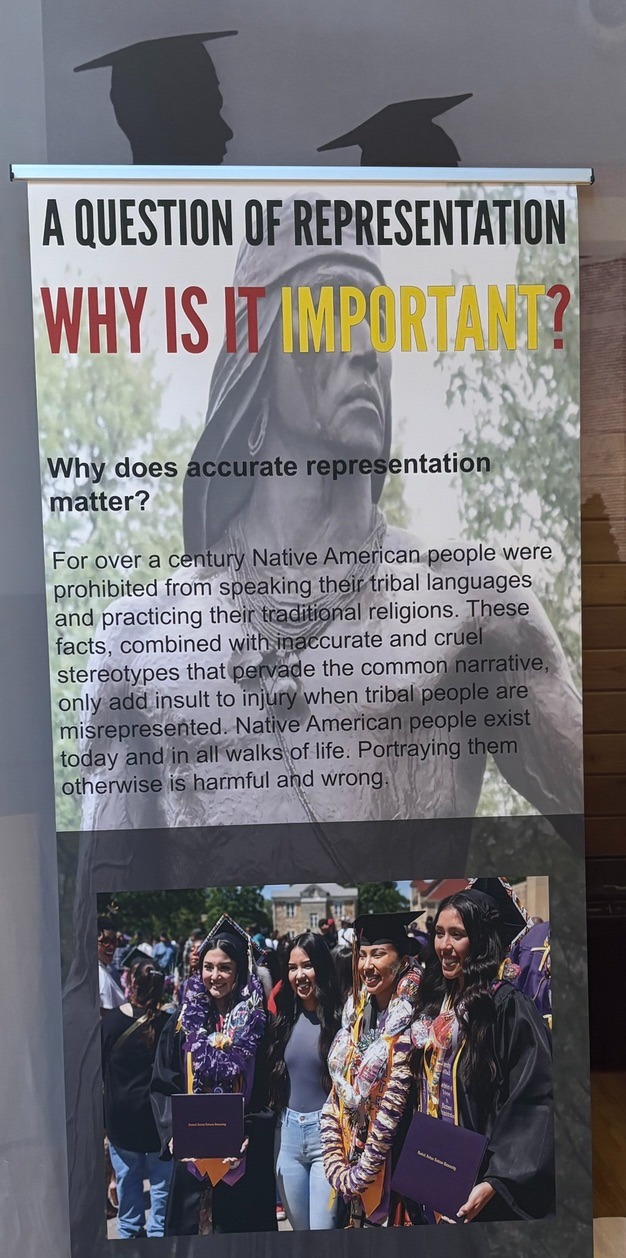
Image Credit: Brooke Muntner
The Editor-in-Chief of Haskell Indian Nations University's school newspaper, Tara Roanhorse, described this same misconception. “Whenever people think of Indigenous people, they think of old Western movies, or images of people with headdresses. But modern Indians are not like that. We're still here. We're still fighting. Natives are everywhere, you just have to look for them.”
Her words exposed just how little accurate representation of Native people exists in mainstream education and media. According to the American Academy of Arts and Sciences, 95% of Google searches for the terms “Native American” or “American Indian” showed portraits of Native people in traditional clothing and feathers, while contemporary depictions were almost nonexistent. Contemporary Native identity becomes close to invisible, reinforcing the inaccurate idea that Indigenous people belong only to history.
After talking to others on the trip, I learned that many of us had similar misconceptions, not intentionally or consciously, but because we had rarely seen or heard Native perspectives or present-day Native life at all. My overall understanding of Native Americans had been shaped more by what was absent than by the truth and reality.
I felt guilty as I tried to process how I went my entire life without questioning what I saw in textbooks, rather than opening my eyes to what is right in front of me. However, the more I researched, the more I saw that my own ignorance wasn't unique.
That is where the way we learn history becomes important. The problem isn't necessarily that Native American history is completely absent from our textbooks. Students learn about the Trail of Tears, westward expansion, Manifest Destiny, and other moments in Native history. The problem is what we learn, how we learn it, and where the story ends.
Let us slide into your dms 🥰
Get notified of top trending articles like this one every week! (we won't spam you)Times When History Leaves Out the Rest of the Story
People erased from the past are just as easily erased from the present. The experiences Native Americans face today can't be understood without analyzing the history of federal policies designed to remove, assimilate, and control Indigenous peoples.
One example is the history of Native American boarding schools. The United States government established these schools as part of a larger effort to assimilate Indigenous people and strip them of their cultures. The government and religious organizations operated about 357 boarding schools across 30 states, housing more than 60,000 Native children.
Attendance was required, regardless of whether Indigenous families gave their consent. When children arrived, school officials assigned them Anglo-American names, replaced their traditional clothing with military-style uniforms, cut their hair, and banned many forms of cultural expression. Anything that resembled their Indigenous culture and identity was considered dead.
The boarding schools operated under the belief that Native cultures, languages, and traditions were obstacles to “civilization.” Richard Henry Pratt, the founder of the Carlisle Indian Industrial School, famously described the goal as “Kill the Indian, save the man.”
But the story of Haskell doesn't end there.
Before becoming a university, Haskell itself operated within this boarding school system. Knowing this completely changed the way I viewed the cultural pride and community I witnessed there. The same institution that once attempted to erase Native identity has become a space where Native students from more than 140 tribal nations actively preserve and celebrate their cultures, languages, and traditions.
That is part of the story, too. However, this is the part I was only able to witness because I searched for it. This is the part that is left out of history.
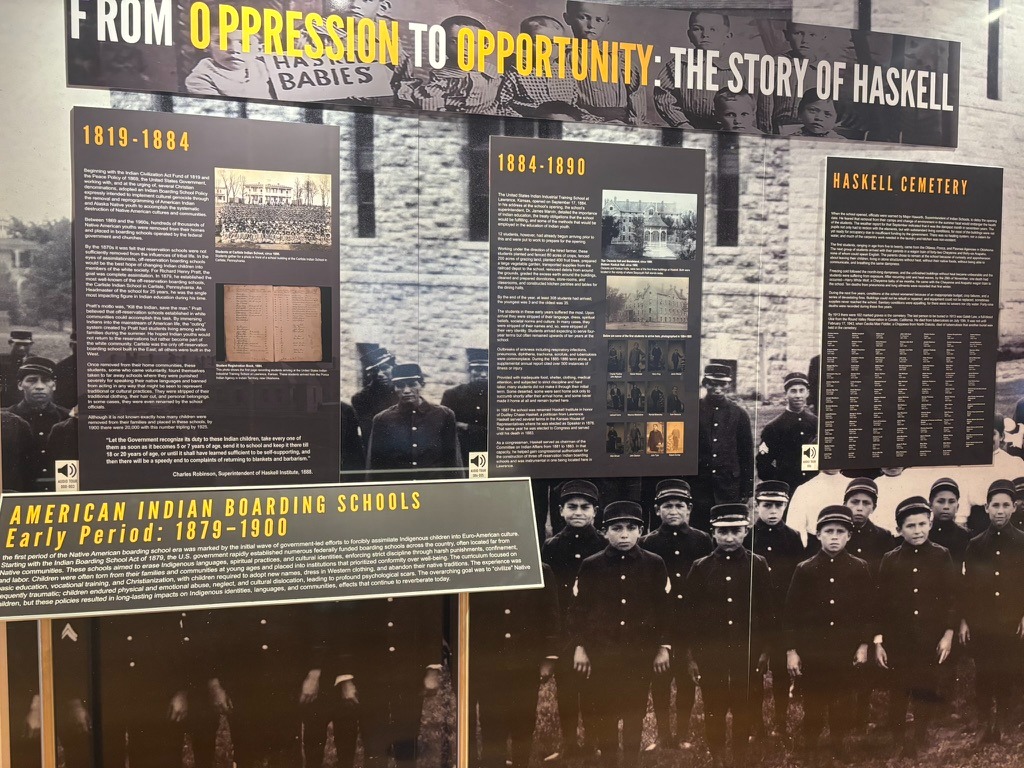
Image Credit: Brooke Muntner
If students only encounter Native Americans while learning about colonization, forced removal, boarding schools, or westward expansion, it becomes easy to unintentionally view Indigenous people as people who existed in America's past rather than communities that continue to shape the country today.


Take the Quiz: What is your IQ level?
Find out how smart you are by taking this quiz!
Questioning the Story of American Expansion
Updating our history textbooks doesn't only mean adding information. It also means reconsidering how the information already included is presented.
Traditional American history often defines westward expansion as a story of brave settlers who built a nation across supposedly empty land. Manifest Destiny reinforced this narrative by portraying American expansion as both natural and justified.
However, these territories were not empty. They were already occupied by hundreds of Indigenous nations with their own forms of government, economies, cultures, and histories long before the United States existed. Expansion didn't take place across empty land, but through the displacement and removal of Native people whose communities stood in the way of American growth.
The Trail of Tears is just one of many examples. During the 1830s, around 100,000 Indigenous people were removed from their homes, and approximately 15,000 died from disease, starvation, exhaustion, and exposure during forced relocation. For settlers, westward expansion represented economic opportunity, land ownership, and national growth. For Native Americans, the same process meant displacement, cultural destruction, family separation, and death.
Many textbooks acknowledge events like the Trail of Tears as tragedies. The problem is that they can be separated from broader discussions of American expansion and development. Students can learn about westward expansion mainly through stories of settlement and opportunity without fully comprehending the violence and forced removal that made that expansion possible.
Native American history isn't separate from United States history. It is connected to the very existence of this country.
My opinion
Because I went on this trip, I had the opportunity to see beyond a stereotype I didn't even know I had. The problem is that before I went, I didn't know there was anything different to look for or question.
When a group of people is reduced to stereotypes or made invisible, it becomes easier to ignore their real experiences. The historical erasure of Native Americans doesn't remain confined to a history textbook. Native communities still experience the effects of displacement, broken treaties, conflicts over land and resource rights, and generations of federal control. At the same time, Indigenous communities continue to preserve their cultures, languages, and traditions despite centuries of attempted assimilation and removal.
History textbooks do not need to erase everything we currently learn and start over. They need to tell the rest of the story. Native Americans should not appear only when students open a chapter about the country's past. Native perspectives need to be included within the story of America itself, and that story needs to continue into the present.
Toward the end of my trip, I asked Hassleman what people like me could actually do to help.
“You are non-Native, but you don't know about any of this stuff because you don't learn it in school,” she told me. “At this time in the world, we need our allies. We need people who can stand up and talk because they [the federal government] aren't listening to us.”
Then she gave us a much simpler directive.
“What I think would be a good directive for you is that you tell your children what you've experienced here and keep this information going from one generation to the next so that history doesn't repeat itself.”
“That's why we have history.”
