






Someone on Instagram said: "I miss when he was French and quiet." Lmao.
Timothée Chalamet’s little opera-and-ballet detour into public stupidity would be boring if it were just another celebrity saying something smug about an art form he clearly does not understand. Celebrities say dumb things every day. The sun rises, a man with cheekbones says something inane, and the internet briefly develops a moral backbone.
What makes this one interesting is not the insult itself. It is what the insult reveals about the modern celebrity machine, and more specifically, about the bizarre authority we hand to actors simply because they have mastered the art of being looked at.
Chalamet reportedly dismissed opera and ballet with the line that “no one cares,” prompting backlash from arts institutions, performers, audiences, and Doja Cat, which is frankly the most 2026 sentence imaginable. Major organizations, including the Met and the Royal Ballet and Opera, pushed back by pointing to sold-out performances, growing audiences, and the continuing vitality of both forms.
So already, before we even get to the cultural commentary, the statement fails on a basic factual level. People do care. Quite a lot, apparently.
Enough to fill theaters. Enough to get angry. Enough to defend these forms with the zeal usually reserved for constitutional crises and limited-edition vinyl.
But the factual error is almost beside the point. The more interesting question is why anyone was supposed to take his remark as insight in the first place.

Credit: Warner Bros. Pictures, giphy.com
This is where parasocial authority enters the chat, wearing expensive knitwear and pretending to be authentic. Parasocial relationships are those one-sided bonds audiences form with public figures, bonds built through repeated exposure to a carefully managed media persona rather than any actual reciprocal intimacy.
Researchers have been describing this phenomenon for decades: people feel they know the celebrity, even though what they really know is the performance of a public self. In other words, the Timothée Chalamet most people think they know is not a man. He is a campaign.
And campaigns change. That is their whole job.
Think about it. Are you the same person at the workplace as you are with your significant other? Are you the same person with your mom as you are with your best friend?
Exactly. And you are not even paid to act.
Credit: A24, giphy.com
When Chalamet was being sold as the delicate, yearning, emotionally fluent object of internet devotion, he leaned beautifully into the role. Soft voice, shy smile, tousled vulnerability, the general aura of a boy who looked as though he might apologize to a flower before picking it.
Then he plays Bob Dylan, and suddenly the vibe shifts. Now the energy is more high-on-his-own-myth, more abrasive, more too-cool-for-the-room. People read these transitions as personal evolution, the gradual revelation of the “real” guy underneath.
That is adorable. What they are actually watching is branding drift. The persona changes because the product changes.
Actors do not owe the public raw authenticity. That would be insane. But the public should stop pretending it is receiving raw authenticity.
An actor on a press circuit is not unveiling his soul like a Victorian heroine at the piano. He is moving units.
He is extending the atmosphere of the role into interviews, clips, memes, and now apparently into drive-by declarations about which centuries-old art forms deserve to live. The issue is not that Chalamet has a persona. The issue is that modern celebrity culture encourages that persona to trespass into areas where it has no competence and still be treated like something we should give attention to.
Is it nice to see so many artists come together? Yes. Do I think arrogance should be humbled?
Yes. Do I think this is the right thing to spend so much energy on? No.
Credit: A24, giphy.com
That is the epistemic overreach part. Looking good in profile should not qualify anyone to pronounce on the cultural value of opera. Being charismatic in a well-cut coat is not an expertise. But in the attention economy, confidence regularly outranks knowledge, and a dismissive one-liner from a famous man spreads faster than years of audience data ever will.
So a glib remark becomes a referendum on relevance, and suddenly people are acting as though ballet and opera are old houseplants Chalamet has kindly informed us were already dead, and we should promptly correct this.
There is also, and this is where his strategic stupidity really shines, the matter of who built his stardom in the first place.
Teenage girls and women are routinely treated as though they merely consume culture, when in reality they help manufacture it. Research on fan communities has long shown that fandom is not passive. It is social organization, identity-building, emotional labor, circulation, interpretation, evangelism, and free promotional work on a scale that most studios would kill to automate.
Girls do not just “like” stars. They make them unavoidable. They turn an actor into an event, a mood board, a miniature economic system. Middle-aged women do this too, incidentally, which makes the old sneer about hysterical girls not just sexist but empirically lazy.
As if you weren't cringe when you were fourteen.
And many of those same audiences are not hostile to “high art” in the cartoonish way certain men with sudden access to vintage sunglasses seem to imagine. Opera and ballet are not just institutions. They are fantasy, discipline, glamour, suffering, beauty, melodrama, costumes, bodies pushed to impossible limits, and emotion performed at a mythic scale. In other words, they contain many of the same things that fuel fandom in the first place.
Insulting them is not some brave anti-elitist intervention. It is a very efficient way to tell a substantial portion of your audience that the forms of beauty and intensity they cherish are silly, irrelevant, or fake-alive.
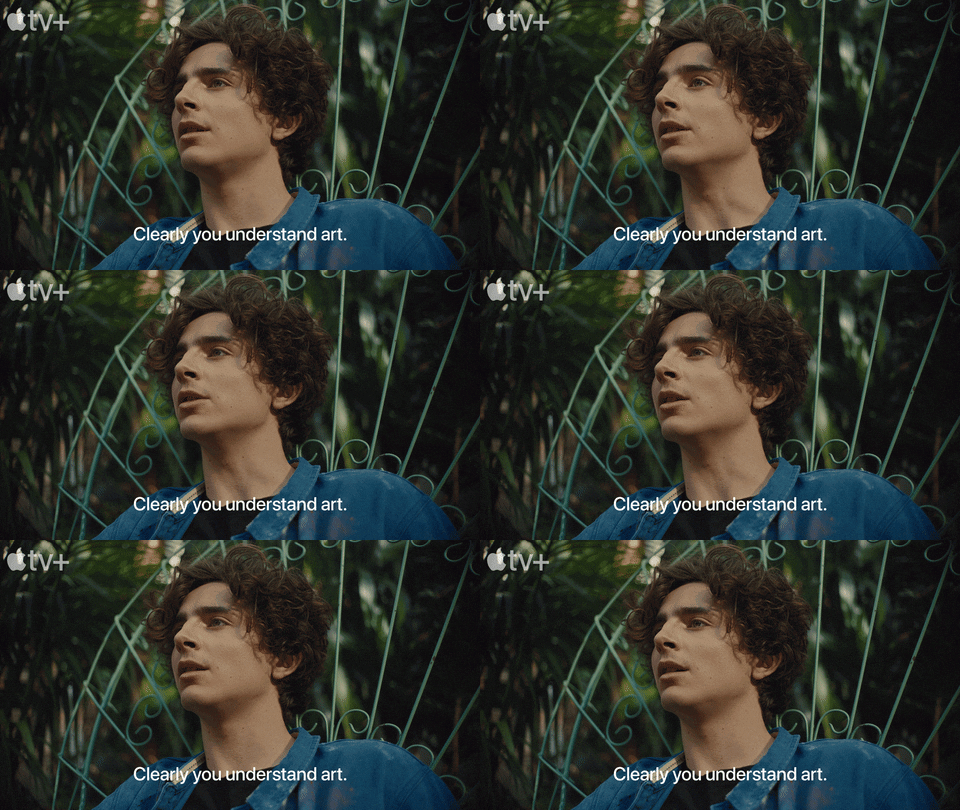
Credit: Apple TV, giphy.com
That was Chalamet’s real mistake. Not the line itself, though it was stupid. Not even the arrogance, though that was certainly there. His mistake was confusing masculine flippancy with untouchable charisma and forgetting that the audience coalition sustaining him is more powerful, more discerning, and frankly more organized than he seems to realize.
Celebrity culture survives by making audiences believe they are seeing a person. What they are usually seeing is a strategy. Sometimes the strategy works.
Sometimes it produces the illusion of intimacy so effectively that people defend it as truth. And sometimes the mask slips just enough for everyone to realize that the soft boy, the art boy, the genius boy, the brat boy, the Dylan boy, whatever boy is currently being sold, is not a revelation of character at all. It is just packaging.
Chalamet did not expose opera and ballet as irrelevant. He exposed the emptiness of a celebrity persona.
Timotheé, go back to your French and quiet persona. Maybe then you will get that Oscar you are salivating over.