





"Thirty years ago, we had a chance to save the planet. The science of climate change was settled. The world was ready to act. Almost nothing stood in our way — except ourselves."
~Losing Earth: The Decade We Almost Stopped Climate Change by Nathaniel Rich
Let us slide into your dms 🥰
Get notified of top trending articles like this one every week! (we won't spam you)Climate Change in the 1980s
Imagine yourself living in the 1980s. Or better yet, ask your parents. There was no such thing as the internet at this time.
People read books or played sports instead of endlessly doomscrolling. This was the age where not having a red tab on your Levi’s jeans was almost considered a social taboo. And instead of listening to music on an iPhone (these only came out as early as 2007), people would instead carry around a type of cassette player called a Walkman.
But this article is not about the unique fashion trends of the 1980s or about what people did without the internet. This article is actually about the much more serious and more relevant topic of climate change.
The attitude towards climate change in the 1980s was significantly different compared to today. By this point, extensive research done by scientists the world over had proven without a shred of doubt that climate change was a very serious issue. According to Nathaniel Rich, author of Losing Earth, nearly everything that is currently understood about climate change today was known to scientists during the 1980s.
The science behind climate change at the time was so clear and the issue so apparent that there was no such thing as “climate denialism.” The fact that climate change was a real threat to the world was common knowledge, well-known and undisputed. Everyone also knew that something had to be done about climate change. Even major fossil fuel companies like Exxon and Shell contributed to the scientific consensus and tried to come up with solutions to combat climate change. In fact, the climate predictions made by these companies were extremely accurate and many of them continue to hold to this day.
In accordance with the increasing amount of alarm and sense of urgency surrounding climate change, in 1979 an international group of scientists from 50 separate nations attended the world’s first World Climate Conference in Geneva and unanimously decided that “it was urgently necessary to act.” Four months after that conference, leaders from some of the world’s wealthiest nations signed an agreement to reduce carbon emissions.
Ten years after that, a meeting held in the Netherlands was attended by more than 60 nations, every member of which decided that action had to be taken. At this point, it had been widely proposed that a global freezing of carbon emissions and a reduction in emissions by 20% by 2005 should be completed as quickly as possible. If this proposal had been met, global warming would have been limited to less than 1.5°C temperature rise. The United States would have lead this initiative.

Image Credit: RCraig09 from Wikimedia Commons

It was at this point that all of the worst impacts of climate change could have been avoided. It was at this point that the world had less than a single step to take. Nothing at all stood in the way of our global success at stopping climate change once and for all. Nothing except ourselves.
What happened next can only be considered the single greatest failure in all of human history.
After this meeting took place, it did not take the oil companies long to figure out that stopping climate change would directly limit their profits from fossil fuel extraction. Stopping climate change, after all, does mean that fossil fuels will have to be phased out. After this realization, various oil and gas companies launched numerous misinformation campaigns designed specifically to raise doubt about whether climate change was actually a serious problem and whether the science surrounding it was perfectly sound.
This resulted in them often denying the extremely accurate research their own scientists had done. These companies even started paying other scientists to write op-eds in magazines and scientific journals to directly increase the uncertainty now growing rapidly around climate change. Millions and millions of dollars were spent on these misinformation campaigns.
This deliberate act by the fossil fuel industry is one of the major reasons why the world missed one of its only chances — its best chance — to stop climate change. This spread of misinformation by the fossil fuel industry is still continuing today to great effect, though they have developed and changed their strategy a bit since the 1980s.
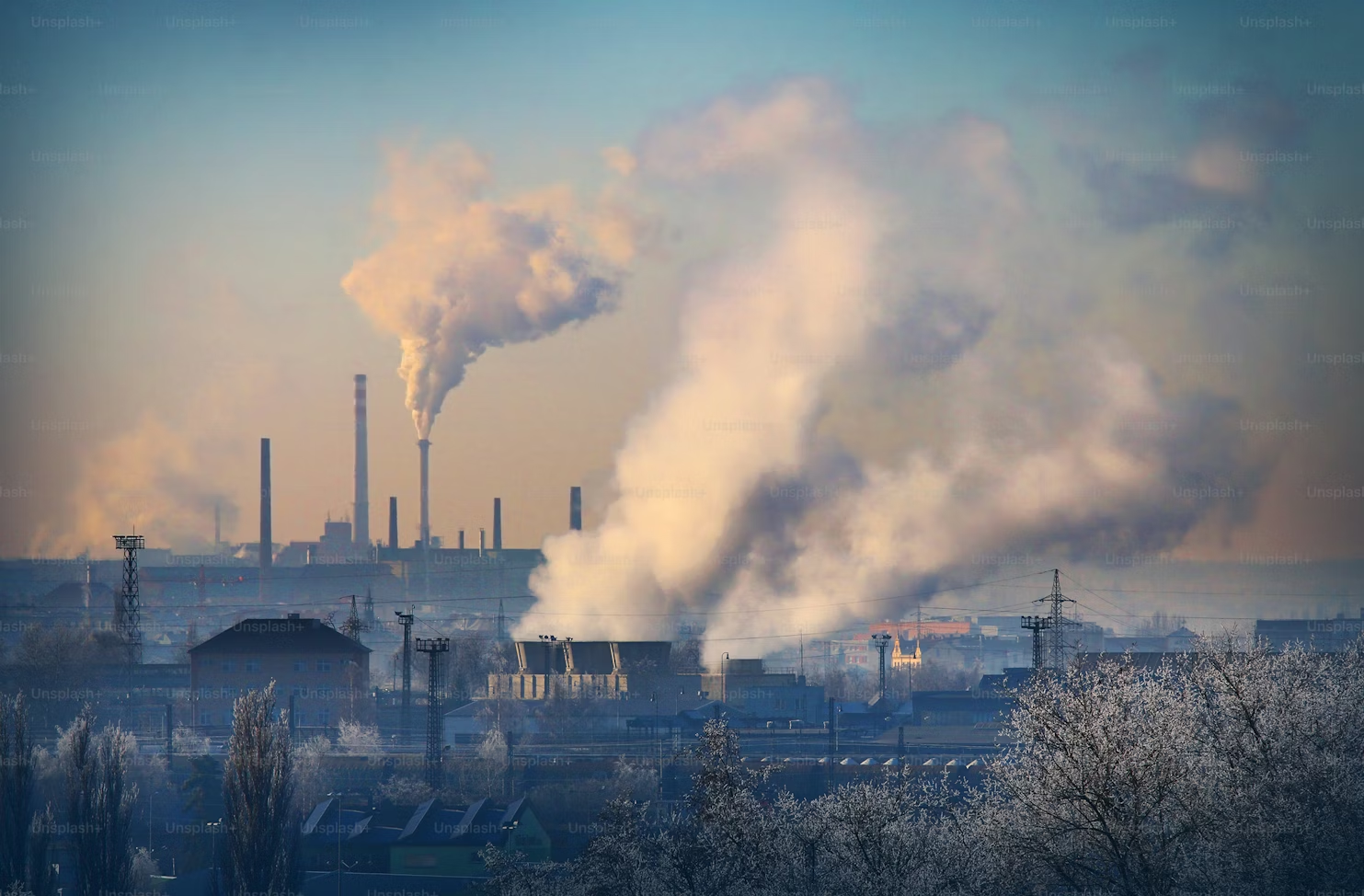
Image Credit: Getty Images from Unsplash


Take the Quiz: Which aespa Member Are You?
Find out which aespa member you resemble!
Present Day
And now we come to the present day.
Today, climate models are predicting a global temperature rise of 2.7°C by 2100. Such a rise in temperature will cause devastating impacts far beyond the scale of 1.5°C temperature rise, the amount of warming that the world could easily have been limited to not even 40 years ago.
But what exactly will happen to the world?
Even at 1.5°C temperature rise, there is significant damage to the global environment. Rising sea levels, under this scenario, will impact land lived in by 510 million people. Nearly a billion people worldwide will be exposed to water stress and desertification. The number, severity, and length of heat waves will increase significantly. Around 350 million more people currently living in urban areas will be exposed to water scarcity from severe droughts. In Mediterranean Europe, the amount of land burned in wildfires will increase by 50%. At 1.5°C temperature rise, 99% of all coral reefs will die out. A quarter of all known oceanic species depend on coral reefs at some point in their lives. As a result, the collapse of this essential ecosystem will cause a ripple throughout the entire ocean biome and impact the billion people that depend on coral reefs for their livelihoods. All totaled, these impacts of climate change will cause global GDP to decline by 4.2%.
However, when compared to 2 or 3°C temperature rise, the 1.5°C scenario begins to look like a utopia. At 2 degrees, the collapse of multiple ice sheets becomes inevitable. The collapse will, of course, take quite a long time, but during that period the world will have many other problems to deal with.
If the effects of climate change are not curbed, 3.5 billion people worldwide are predicted to become climate refuges within the next 50 years. 50 million could be displaced by as early as 2030 due to desertification alone. At a 2.6°C increase (almost the exact amount that the world is predicted to warm), global GDP will fall by nearly 14%. In other words, within the next 50 years alone, climate inaction will cost the global economy $178 trillion dollars. Climate action, on the other hand, could grow the economy by $43 trillion dollars. With 2°C temperature rise, 30% of the world’s land surface will dry out and go through the process of aridification. By 2030, the Arctic could very well experience its first ice free summer.
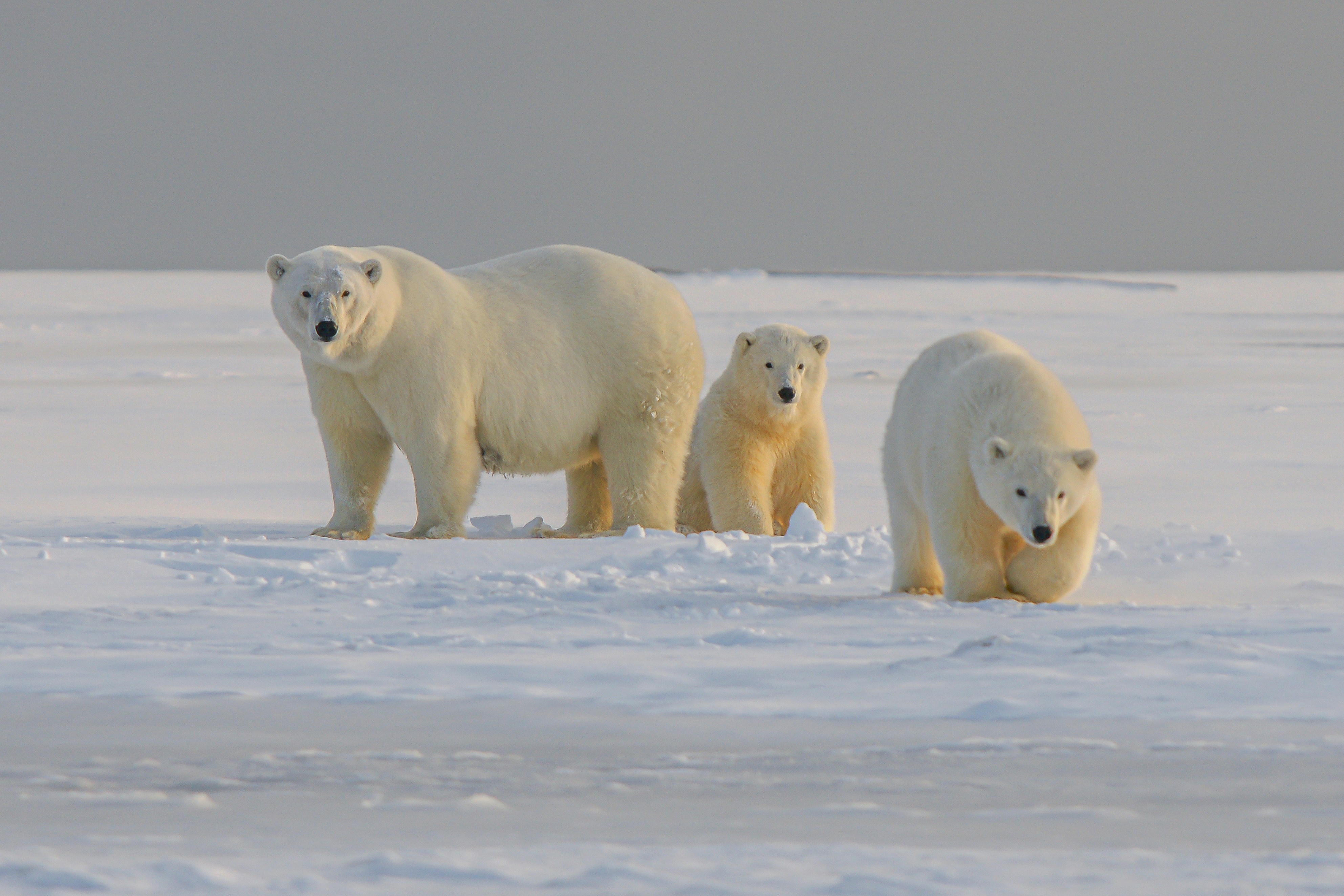
Image Credit: Hans-Jurgen Mager on Unsplash
Already these impacts of climate change have begun. Already half of the world’s coral reefs have died. Already food productivity is 20% lower than it would have been without climate change. Already major climate-related disasters have increased by 83% in the past 20 years since 1980-1999. The frequency of extreme wildfire events globally have more than doubled from 2003 to 2023. 335 billion tonnes of ice are melting each year. All of these numbers will only get higher. 2024 was the hottest recorded year in all of human history. Due to air pollution, 8.1 million people die prematurely each and every year. In fact, pollution is the second leading risk factor for death worldwide after blood pressure and before tobacco. The WHO has stated that 99% of the entire global population breathes air that exceeds WHO air quality limits, threatening our global health, yours included. What will we be breathing by 2100 when carbon dioxide levels are expected to increase substantially? The answer to that question is smoke from the forest fires that will have increased in number by 50% in that time.
What more do you need to know about climate change? Even these examples are just few of the impacts that only give a small glimpse of the catastrophic damage that climate change is capable of.
One Final Chance
The world has just one more chance to mitigate the impacts of climate change and avoid its worst effects. Unfortunately, a 2°C temperature rise is all but inevitable. However, we can avoid any further warming beyond that — we must avoid any further warming — and more easily so than you might think.
For the world to stay at 2°C temperature rise, global emissions must peak by 2025 at the latest and then be reduced by a quarter by 2030. By 2070, we must achieve net zero.
The world has already completed the first step to limiting such warming. Emissions have indeed peaked at their proper time but they have not yet started to decline.
This is, in essence, a repetition of the events leading up to our great failure in the 1980s. Today, we know everything we need to know about climate change. We have all the solutions we need and more to stop climate change in its tracks.
Today, the vast majority of the world population is aware of climate change and in fact are backing policies to do something about it. Worldwide, 72% of the global population supports a quick transition away from fossil fuels to renewable energy sources.
Once again, the only thing in our way is ourselves. To limit the effects of climate change you have to act. Not someone else; not any world governments; not some other environmental organization; you.
There is no other way around it. For something to be done about climate change, global society as a whole must change and that can only happen if individuals like yourself act on your own accord and are willing to initiate much-needed change. Failure to curb the effects of climate change, and I really wish I did not have to say this, will result in the premature deaths of hundreds of millions of people, if not billions, before the end of this very century. There is no greater threat to our world than the one we face today.
There is one more thing you have to understand about climate change though. Fighting against climate change is not about saving some faraway rainforest or making sure that polar bears have ice to live on. It is not about helping people in parts of Africa from the expanding desert, and it is not even about protecting the coral reefs from almost certain extinction. It is about saving your future, for climate change will impact your life just as surely as it will everyone else’s, and it will do so severely.
The world has just one more chance to end the threat of rampant climate change forever. We missed our last chance nearly 40 years ago. We cannot afford to miss again. This is our very last chance and we have to make a stand collectively before it is too late.
“Unless someone like you cares a whole awful lot,
Nothing is going to get better. It’s not.”
~Dr. Seuss, The Lorax
Oh, and one more thing before you finish reading this article and hopefully begin your own climate action to help save the world from a terrible fate. Fossil fuel companies have not just spread misinformation about climate change. They have done the same thing for nuclear power as well, funding anti-nuclear groups, sowing doubt, etc.
So far, these actions have worked out fairly well for them. The number of working nuclear power plants providing electricity worldwide is declining and while renewable energy sources have filled part of that void, the fossil fuel industry has filled in the rest. This is especially bad news because to solve the climate crisis and limit global emissions, the world will need nuclear power.
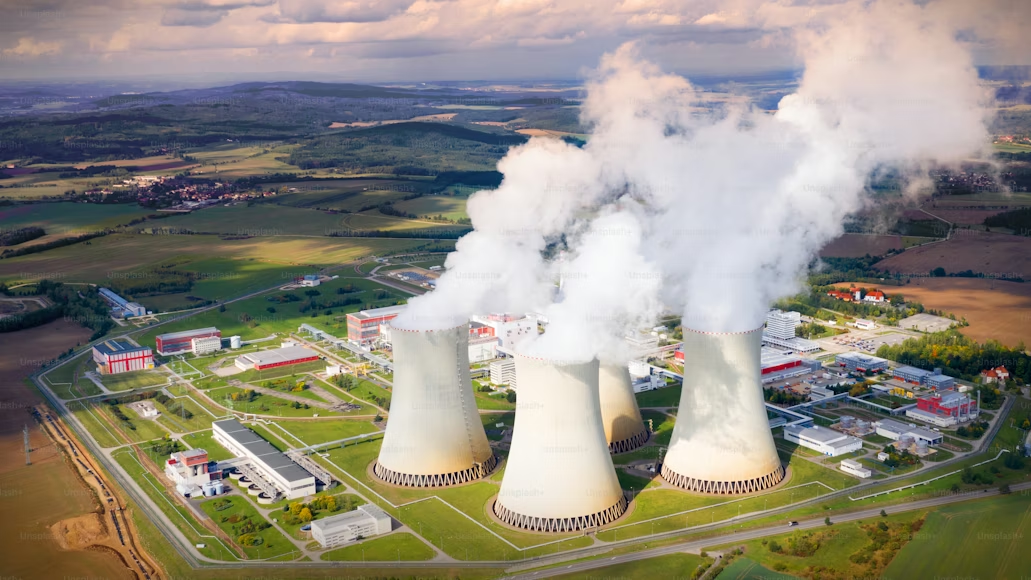
Image Credit: Getty Images from Unsplash
If you are unsure about what you can do to help the environment, put some actual thought and time into thinking about it. You will most certainly come up with some ideas. A good start will always be to reduce your own impact on the environment and to encourage others to take action as well.
If you would like to learn more about the climate change issue, you can look at the sources for this article or do your own research. I also encourage you to watch this video in its entirety. It is 24 minutes long but it has a lot of great information and goes into detail on how the fossil fuel industry is slowing down climate activism today:
Further Information:
This site shows what it will be like to live in cities around the world under high emissions scenarios in 60 years: CityApp
This site shows how many wildfires there were per country in 2025. Imagine what it will be like with 50% more in 2100: Annual number of wildfires, 2025