







Thank you, @tadyontour of X, formerly Twitter, for this legendary quote. Your contributions to the zeitgeist will not be forgotten.
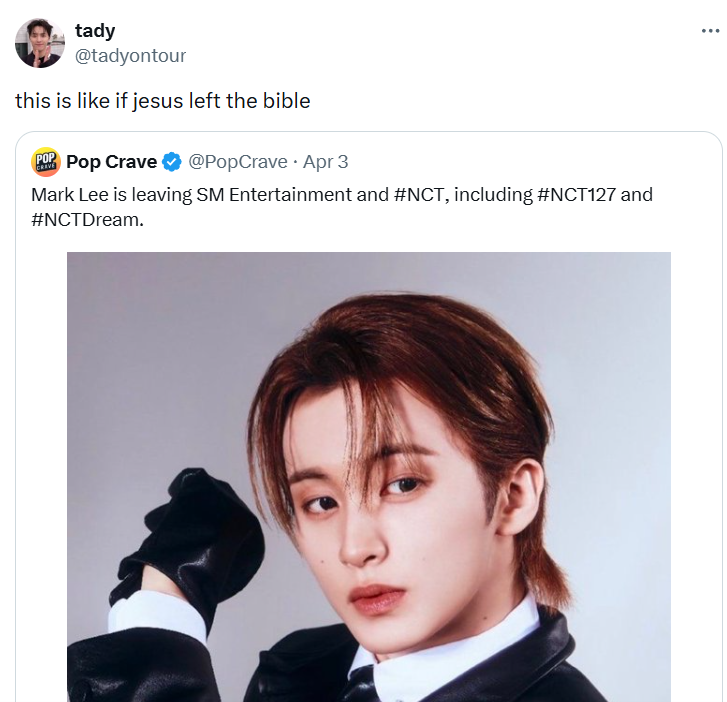
Photo Credit: x.com
Mark 16:15: He said to them, "Go into all the world and preach the gospel to all creation."
Mark Lee leaving NCT feels less like a member departure and more like the sudden discovery that one of the load-bearing walls has developed sentience and walked out. This is not because Mark was merely popular. K-pop has popular members all the time. Mark was infrastructural.
He was a crucial part of the subunits of NCT - NCT U, NCT 127, NCT Dream, later SuperM, and spent a full decade functioning like SM’s most reliable all-purpose solution to literally any musical, performance, or branding problem they had. Need a verse saved? Mark.
Need a stage anchored? Mark. Need a group concept to feel coherent even when the group itself seems to have been assembled by an exhausted Sasaeng? Mark.
Wanna do a KitKat heist? Mark.

Photo Credit: Giphy.com
Fans got used to him being there in the way people get used to gravity. He trained at SM from 2012, debuted in 2016, kept circulating through subunits, and became so omnipresent that his existence started to feel less like a career and more like a law of physics. So when he wrote that this next step is “a quest that I myself am scared about,” the line punctured a fantasy and caused an chain reaction the industry should have expected much sooner.
And what does that mean going forward? For NCT itself, it means both 127 and Dream now have to prove they were groups rather than elaborate delivery systems for Mark Lee’s competence. SM has already said NCT 127 will continue as seven and NCT Dream as six. On paper, that sounds orderly.
In practice, it means two units are losing a member who often served as connective tissue: not always the loudest presence, but very often the one who made the structure make sense. This is the moment where a group either discovers a new artistic center or reveals that it had quietly been leaning on one person to carry far more of the burden than anyone wanted to admit.
If you are not into K-pop, I still think the fairy dust of self-respect Mark Lee has spinkled all over K-pop idols with his departure is worth exploring. And with it, the cultural and economical realities of K-pop as a whole. So, let's do my favorite thing ever: Examining contracts.

Photo Credit: Giphy.com
Mark 10:45: “For even the Son of Man did not come to be served, but to serve, and to give his life as a ransom for many.”
Mark Lee leaving SM Entertainment and NCT as of April 8, 2026landed within days of Ten also exiting SM, though Ten said he would still continue with WayV and NCT “where possible.” Add in the recent reports around Heeseung leaving ENHYPEN, The Boyz trying to terminate contracts over alleged unpaid settlements, and the still-raging NewJeans-ADOR legal war, and what you are looking at is not random chaos. It is an industry argument about power, ownership, and how much of a human being can be contractually converted into content before they break.
One correction before anyone starts writing “K-pop built Korea” in blood-red serif font: no, it did not. South Korea’s prosperity was built first through state-led, export-oriented industrialization, chaebol-led manufacturing, and decades of brutal national discipline under conditions of war, division, and existential insecurity.
In the 1950s, foreign aid was so central that it accounted for about 74% of government revenue and 85% of imports during 1953–61; by 2024, South Korea’s GDP per capita had climbed above $36,000. K-pop came later, not as the foundation of the house, but as the neon sign on top of it: lucrative, globally visible, politically useful, and excellent at turning culture into export strategy.

Photo Credit: Giphy.com
And that matters, because the country did not arrive here through some cute, frictionless glow-up montage. After Japan’s colonial rule ended, the United States and the Soviet Union agreed to divide Korea at the 38th parallel as a temporary military measure. Koreans were not the ones making that decision. Then the temporary became historical trauma.
So when people outside Korea get smug about “toxicity,” they often miss the larger context: South Korea’s modern success story is inseparable from national emergency, militarization, impossible standards, and a society repeatedly told that survival requires discipline bordering on self-erasure. K-pop did not invent that pressure. It commercialized it, choreographed it, and sold it to colonizers.

Photo Credit: Giphy.com
So how do K-pop contracts actually work? The short answer is: they are called “exclusive contracts” for a reason. The modern standard in Korea is that the initial exclusive contract should not exceed seven years, and since a 2024 revision, any extension requires written agreement from all parties.
The revised standard contract also tries to clean up recurring industry disasters by clarifying intellectual-property and publicity rights, tightening settlement and profit-distribution language, and stating that management must consider an artist’s mental and physical condition and cannot force schedules against the artist’s explicit wishes.
Artists may also refuse unjustified demands that go beyond the contract. Those reforms did not fall from the sky out of divine corporate kindness. They came after years of scandal over “slave contracts,” including the infamous TVXQ dispute over a 13-year deal that helped force regulatory change.
This is not the contract Mark Lee signed in 2016. Back then, contracts were binding for ten years and idol protection was minimal.
In practice, though, the K-pop contract is never just a contract. It is a management regime. It governs labor, image, branding, mobility, scheduling, communication, and sometimes the basic conditions of everyday life. The particularly absurd part is that idols are often treated legally less like employees and more like equal contracting parties, which sounds very elegant until someone alleges harassment or mistreatment and then discovers that many labor protections do not apply to them.
That is exactly why Hanni’s case mattered so much: not because it was the first ugly story, but because it exposed, in public, the legal fiction that a teenager or twenty-something whose life is controlled by a giant agency is somehow just a cheerful little entrepreneur of the self.

Photo Credit: Giphy.com
Mark 9:23: "All things are possible to those who believe."
The mental-health toll is not mysterious. South Korea already exists under high-pressure social conditions; OECD data published in 2025 put the country’s suicide rate at 23 per 100,000 people, versus an OECD average of 11, and OECD data for 2022 showed Koreans working about 1,901 hours a year versus an OECD average of 1,752.
Now place an idol inside that broader climate, then add adolescence under surveillance, body regulation, public scrutiny, cyberbullying, and the requirement to perform permanent emotional availability for fans. One academic study on K-pop’s fan platform Bubble argues that these systems commodify artists’ relational labor, and cites platform data suggesting some idols log more than 100 scheduled work events in a single month.
Another scholarly account notes that intense training and contemporary Korean pressures compound without adequate attention to mental health. Or, in normal language: the job is to be talented, beautiful, grateful, available, scandal-free, skinny, funny, multilingual, parasocially intimate, commercially productive, and untraumatized by any of this.

Photo Credit: Giphy.com
So why do people tolerate it? Because “tolerate” is too simple a word for what is actually happening. People love K-pop because it is good.
It is engineered, yes, but engineering is not a synonym for soullessness. The songs hit, the visuals hit, the group dynamics hit, the fandom belonging hits hardest of all. Research on K-pop fans has found associations with increased happiness, self-esteem, and social connectedness.
At the national level, the Korean Wave has also become valuable soft power and a deliberate growth sector, which is why Reuters described South Korea in 2025 as turning to culture as a new engine for growth even though cultural exports remain much smaller than the country’s traditional goods exports.
In other words, people are not blindly worshipping their own exploitation. They are participating in a cultural system that delivers pleasure, community, prestige, jobs, and global recognition while also extracting a very real human cost.
Both things are true. That is what makes the whole machine so durable and so cruel.

Photo credit: Giphy.com
And that is also why idols are pushing back now. Not because Gen Z suddenly invented self-respect, but because the leverage map has changed. The old logic of K-pop was simple: leave the agency and vanish into the void.
The newer logic is messier. Global fandoms are stronger. Individual brands are portable. Public sympathy is higher after repeated contract wars.
The revised contract template gives artists better language around settlements, schedules, and consent. Some idols can now leave the company without necessarily abandoning group identity altogether, as Ten’s case shows. Even when artists lose in court, as NewJeans did in the injunction phase, they still help expose the terms of the fight and educate the public about how these systems operate.
The result is not revolution. It is something more annoying to management and therefore more useful: precedent.

Photo Credit: Giphy.com
Mark 1:15: “The time has come."
The story is not that idols are being “ungrateful,” nor is it that K-pop is uniquely evil while the rest of global entertainment is a feminist worker cooperative. The western pop machine is just as artificial and abusive without having the courage to admit it.
The story is that South Korea built one of the most effective cultural industries on earth, and that effectiveness has always depended on extraordinary discipline, extraordinary sacrifice, and an extraordinary ability to market suffering.
What we are seeing now is not the collapse of K-pop. It is the workers inside its most glamorous factories testing whether they can own more of their labor, their names, their health, and their futures. Frankly, good for them.
The genre will survive. The fantasy that the machine is benevolent may not.
So when Mark wrote that this next step is “a quest that I myself am scared about,” the line hit because it punctured the myth. Suddenly the machine’s most dependable component was reminding everyone that he is, in fact, a human being with fear, agency, and apparently the audacity to leave the cathedral he helped hold up.

Photo Credit: Giphy.com
He is not leaving as a discarded idol or a cautionary tale. He is leaving after a decade, after building a cross-unit legacy, and after already establishing solo work with The Firstfruit in 2025. That makes this feel less like a fall and more like a test case for what post-agency power can look like when an idol leaves at the height of his symbolic value rather than after the industry has wrung him dry.
My read is that his exit will be remembered as one of those moments when fans realized the old K-pop bargain is getting weaker: the company is no longer automatically the sun around which the artist must orbit forever.
Mark’s leaving suggests something radical: the possibility that an idol can walk away from the institution that made him and still remain more culturally important than the institution itself. That is why this feels so apocalyptic to fans. Not because Mark is gone from a lineup card, but because his leaving forces everyone to confront a blasphemous thought at the heart of K-pop: maybe the company was never the miracle.
Maybe the miracle was the human being surviving it.