





,_Art_Gallery_of_New_South_Wales_--_2019_--_3103.jpg)

Underneath towering monkey bars, upon vibrant plastic storage buckets, within the shoveled depths of sand pits, lies a fertile ground for democracy.
Four floors down, nestled within thick concrete walls that once housed WWII ships, an extensive structural art park bursts with wild energy and exuberance.
At the Art Gallery of New South Wales in Australia, Mike Hewson’s The Key’s Under the Mat is the New Zealand-born artist’s latest and most ambitious large-scale project. This immersive exhibition spans approximately 1800 square meters and invites visitors to explore the intersection of art, play, and civic engagement.
I recently visited this exhibition while on vacation with my family and was immediately struck. While we were picking up a museum map, I was caught off guard when a woman at the reception asked if we needed towels. She wasn’t joking.
Access to the exhibition is completely free, allowing visitors to enjoy a multitude of amenities, including a milk-vat steam room, a sauna, obstacle courses, multi-tiered play structures, and self-serve grills. The title of the exhibition is welcoming, reassuring that anyone has the key to access the universal joy of play.
Let us slide into your dms 🥰
Get notified of top trending articles like this one every week! (we won't spam you)Art as a Common Space
Hewson’s installation is one iteration of a “common space,” a concept significantly explored by American political philosopher and Harvard professor Michael Sandel. “Common spaces” or “public spaces,” such as parks and libraries, serve as vital communal areas where individuals from diverse backgrounds can come together to engage in shared activities. Sandel argues that these spaces are essential for the pursuit of the common good, yet the incursion of monetary privatization has rendered many obsolete.
According to Sandel, the common good hinges on the encounters we have with others in public spaces. Through these interactions, “we learn to negotiate and abide by our differences.” Public spaces enable us to participate in a “shared democratic project, by breaking down the barriers that keep us tethered to our isolated cliques.” Hewson’s work unites visitors of all ages and demographics—from toddlers to high schoolers to seniors—in the halcyon joy reminiscent of childhood. “People are really scared by inclusive design,” Hewson noted in a recent interview. Amidst his towering, avant-garde structures, all social hierarchies dissolve.
The only higher ground is literal—at the summit of a slide or rock wall. Amenities typically seen as expensive luxuries, like taking a steam, become freely accessible in this space of leisure recreation.
Common spaces don't just provide recreational physical environments; they play crucial roles in promoting democratic engagement. As Sandel underscores, “if fellow citizens become accustomed to…not bumping up against one another in the course of their everyday life, then eventually they will find themselves unable to deliberate about the common good; they won’t share enough to be able to think of one another as citizens with mutual obligations.” In other words, if we never encounter individuals from differing backgrounds in shared settings—if we don’t “bump up against” them—we cannot expect to engage meaningfully in discussions about widespread socio-political issues. When our reality is limited to the experiences of a small subpopulation, our understanding and perspectives remain narrow.

Take the Quiz: What Candle Scent Matches Your Overall Aesthetic?
Halloween is just around the corner. It's time to light that candle. Take this quiz and find out what candle scent suits you best.
Democracy in Social Practice Art
Although not formally categorized, The Key’s Under the Mat can be classified within the sphere of social practice art, a movement that gained prominence in the late 1900s and is deeply intertwined with collective civic action and political activism. My hometown of San Francisco boasts a rich history in this realm, nurturing such artistic endeavors. A prominent figure in social practice within the city is Bradley McCallum, an American artist and founding director of the TnT Art Lab, a space dedicated to showcasing burgeoning artists in the field. At its core, McCallum defines the lab’s mission as presenting “art as a form of inquiry that draws people in and makes them think more deeply about the society they live in.”
Participatory Transformations
The Key’s Under the Mat cultivates democratic participation by reimagining our relationship with the objects around us and with ourselves. Additionally, it redefines public space. For example, a sauna is creatively constructed inside a 20th-century site shed, positioned alongside shower heads that awkwardly jut out from an old, rusty stone column. Both the space and the objects within it have been thoroughly repurposed or recycled, with sitting areas composed of bricks sourced from industrial manufacturing facilities.
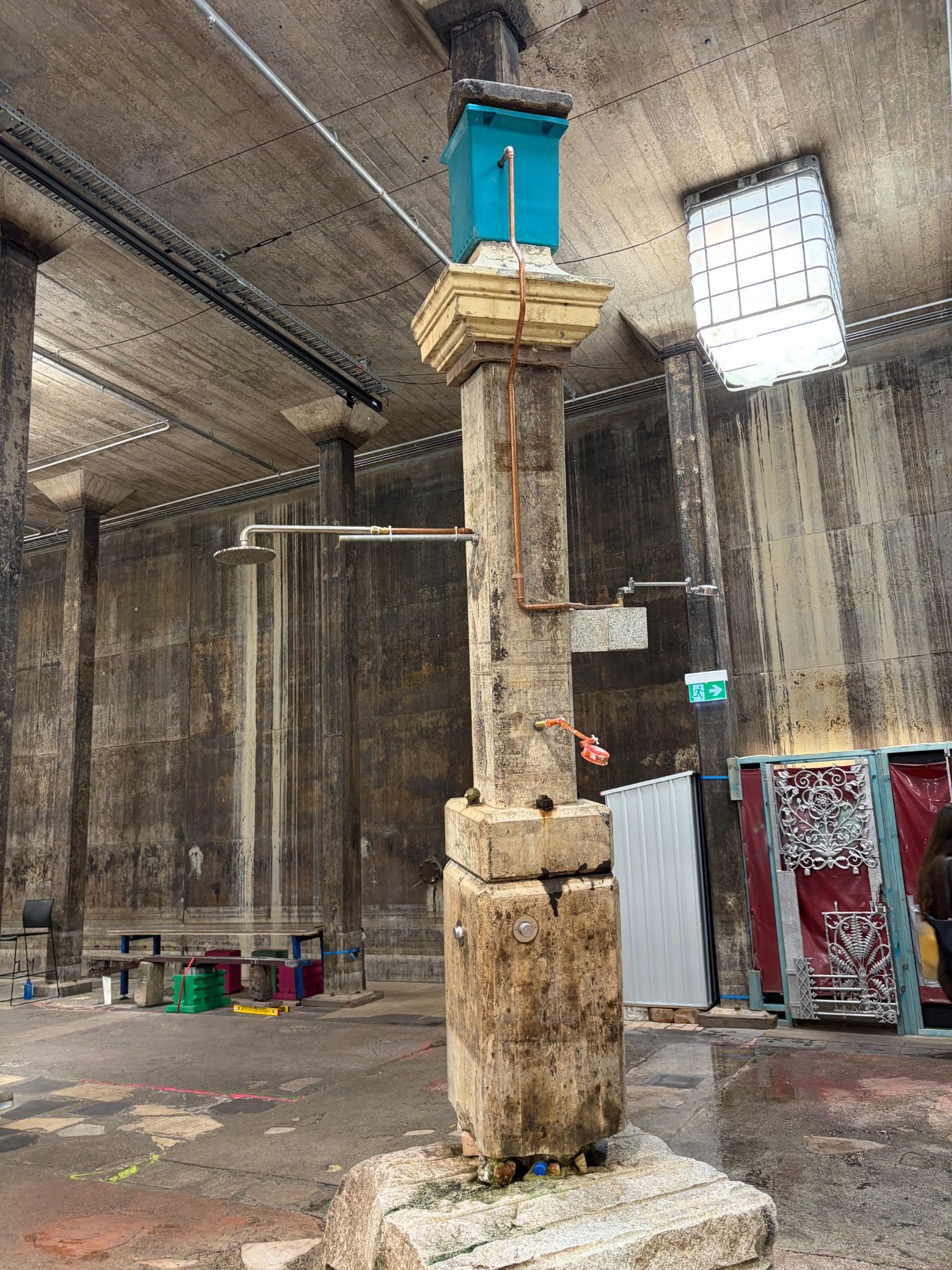
Photo Credit: Jana Kumar
As these materials and structures are transformed, so too are the visitors who enter the space. We shift from passive observers to active participants, shaping the environment through our movements and physical interactions. In response to Hewson’s work, McCallum echoed, “I was struck by how completely engaging and inviting it was.
The work really requires an audience for its potential to be fully realized.” This mirrors the essence of democracy itself: it demands continual engagement and cultivation. At the exhibition, we are not merely witnesses to art; we become members of a nonverbal conversation unfolding between the artist, the objects, and ourselves.
Hewson notes that this space accommodates “so many different uses and it can handle those uses surprisingly all at once and at different times.” It can serve as a playground, a workshop, a sanctuary, or a stage for the mind. Likewise, democracy is not a static construct, but a vibrant, living entity shaped collectively by each of us.
Our engagement with art translates into engagement with democracy, as Hewson champions art as a cathartic force that can inspire civic action. The keys to participating in democracy lie right beneath the swing sets, park benches, and monkey bars.
