



When I initially started reading A Good Girl’s Guide to Murder, I didn’t anticipate seeing so much of myself in the main character, Pippa Fitz-Amobi. Not to the extent that I was investigating a cold case murder in my small town, of course. Rather, I was putting in late hours to cross-match information, growing emotional attachments to the data, and convincing myself that at the very least, this next spreadsheet would remedy everything.
I was not in a fictional crime novel, but rather in a form of crime novel that was real, any difference between the two sometimes felt irrelevant. I was doing my EPQ way before it was supposed to be done (I did it in Year 10, supposed to be done Year 12), and it made everything I did feel even more Pippa-coded, if I'm being honest: mildly untethered, dangerously determined, and operating solely based off of caffeine and OneDrive. Somewhere amidst formatting citations and rereading crime scene documents, I could assess that A Good Girl's Guide to Murder is more than a thriller, but rather an academic horror novel dressed up around a fiction young adult audience.

Let us slide into your dms 🥰
Get notified of top trending articles like this one every week! (we won't spam you)Wait, What Even Is an EPQ?
For those unfamiliar with the British A-Level system, the EPQ - Extended Project Qualification - is an independent research project in which students collate sources, take months researching a topic, and produce either a dissertation, an artefact or some other style of academic output. It is intended to showcase initiative, curiosity, critical thinking - all good things.
In reality? It is a caffeine-fueled refueling of citations, self-doubt on whether you already proof-read that section, and the desperate squeeze of trying to sound as "original" as possible, whilst praying for your conclusion to at least make sense. You become part researcher, part detective, part philosopher, and part extremely tired adolescent, re-evaluating your life choices - not exactly in the realm of murder but equally guilty of ruining your sleep schedule.



Take the Quiz: Which Harry Potter Character Are You?
Find out which character matches your personality!
When Research Becomes Obsession
Reading A Good Girl’s Guide to Murder while doing my EPQ was like watching my own descent into academic madness play out in crime-thriller form. Pippa starts her investigation as a school project, neat and structured, with color-coded notes and a solid plan. Same.
But slowly, the lines between schoolwork and obsession blur. Same again.
At first, it’s curiosity, then it’s urgency. You tell yourself it’s just research, but soon your brain refuses to shut off. You’re reading at dinner.
You’re rewriting sections at 2 a.m. You start justifying bad habits as “commitment.” And by the time you realize you’ve gone too far, you’re already in too deep. The difference between passion and obsession is only clear in hindsight.
The book captures that perfectly. Pippa’s drive to uncover the truth mirrors the way so many students (myself included) throw ourselves into projects that become more than projects. They become proof.
Proof that we’re capable, that we’re good enough, that we matter. It’s not just about the grade; it’s about identity.

The Pressure to Be “Brilliant”
So many of us are academically successful students, and it's simple to confuse exhaustion with excellence. We often romanticize overworking ourselves because it feels like action comes from a place of passion. We might say something like, “I just really care about my topic,” while knowing in the back of our minds that we actually care about control.
Like Pippa, we want to solve it all—to gain a sense of order from chaos and come out on the other end. But, rarely is the cost worthy.
I remember when I finished my EPQ, and at that moment, it didn't feel like achievement; it felt like relief and fatigue. In the pursuit of perfection, I had lost the curiosity that sparked the work to begin with. Maybe that's what feels important about Pippa's story.
Because "success" does not feel victorious it feels empty. The brilliance burns too bright and too fast. Yet, getting the grade in the end does make it seem all worth it.
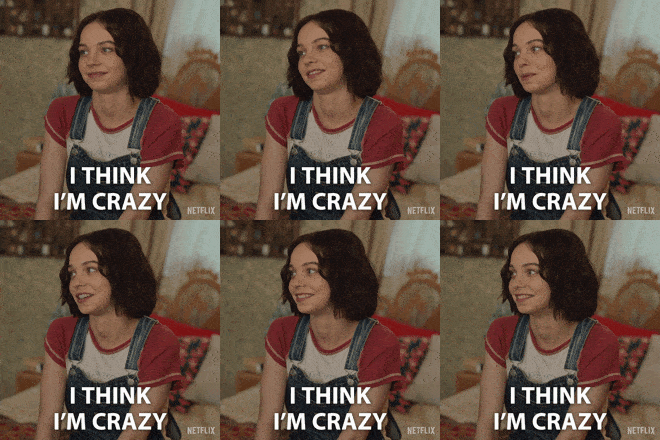
To be fair, Pippa is a little crazy to do an EPQ on a murder. Like, could you imagine telling your supervisor that you will be emailing suspects and visiting crime scenes for 'academic purposes'? This is simply the most bonkers school project topic of all time. She is practically doing the police's job, while the rest of us are relegated to formatting our bibliographies in Harvard writing style. That is essentially why she is such a great reflection of the overachiever mindset: that voice in your head saying, 'Just go a little bit further and I will get it right this time.' Pippa takes that voice in her and says- 'Hold my beer, let me turn that up to eleven.'
Curiosity vs. Control
A subtle distinction exists between curiosity and obsession, between discovering truth and comfort. For Pippa, the distinction is between action and hyperaction. For students, it's the difference between intellectual curiosity and burnout.
It stems from the same seed - concern. Things can go sideways from there when we do not know how to step off the treadmill.
That is why A Good Girl's Guide to Murder feels different after you experience a version of it. The book is not actually about murder, but about control, about how people can become so overwhelmed about making sense of a world they don’t control, they push too hard, dig too deep and mistake fatigue for evidence they are doing "enough." Pippa's adventure is simply the hyperbole of what it is like to be a student in a world that honors perfection but disregards pause.
Maybe We’re All a Little Pippa
At the end of both my EPQ and Pippa’s investigation, I saw something unusual: obsession doesn’t uniformly look dangerous. Sometimes, it looks like commitment. It looks like a color-coded Word document filled with key terms, or a pile of academic books for which you promised yourself, “just one more time,” you would summarize. It looks like focusing care on those so much so that you forget to care about yourself.
This is what resonated with me. For all of my shock at my EPQ being likened to a murder in a small town, I can see some truth to it. We all want answers - we all want things to add up - and as a researcher, the answering, at least in part, becomes about identifying something.
But it's incredibly easy to miss out on what we wanted in the first place. At the end of the day, not every question requires an answer and not everything that is mysterious requires an explanation. Perhaps the issue isn't the question or the answer, it's determining when to let go.
So yes, Pippa is a little crazy for what she did. But we are too, perhaps, in our own caffeinated, bigger-than-we-should rationality. And that is okay. There might actually be something a little bit magical about caring as much as we do - as long as we do not let it burn us out.