



"Noodles? You were really dreaming about noodles?"
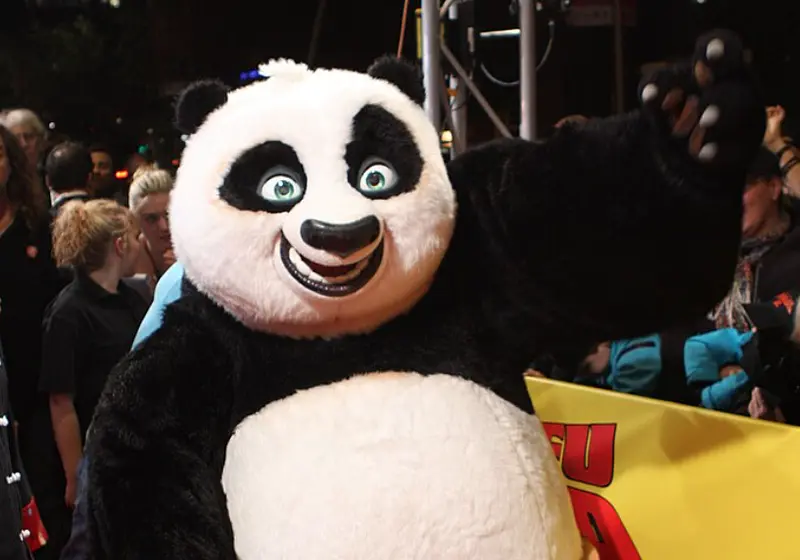
Po wasn't dreaming about noodles, he wasn't anywhere near that. He was dreaming of being the greatest Kung Fu warrior in all of China. Until his father very promptly plummeted him back down to earth.
He is noodle folk, that's where he belongs. He won't be destined for anything more, other than taking over from his father's noodle shop, who he inherited from his father, who inherited it from his friend in a game of Mahjong. Po is where he should be. Or, is he?
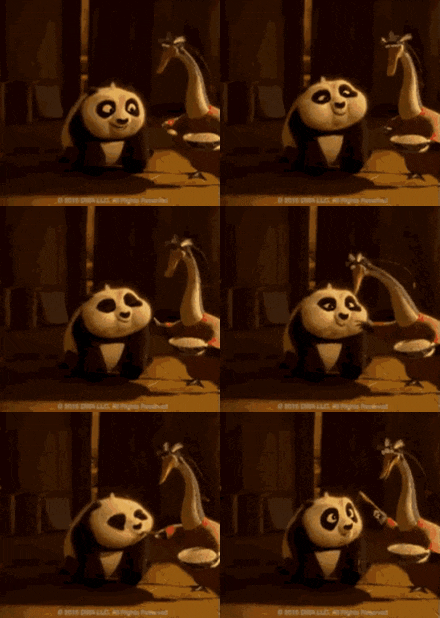
There is something extremely comforting about returning to Kung Fu Panda as a teenager. Maybe out of sentimentality. Or maybe it is from the food-loving panda doing midair splits.
Or perhaps, deep down, the movies really remind us of something we tend to forget: greatness is not an inherited trait for humans, but a developed one. In today's world of instant success, that feels especially poignant.
What really propels the Kung Fu Panda trilogy into something much more than an anthology of animated comedy is its heart. Somehow, some way, DreamWorks took what was essentially meant to be a comedic story about a clumsy panda learning kung fu and turned it into an ongoing philosophic examination of identity, fate, and self-acceptance. It is a movie that talks to children, but connects with teenagers and adults, who are still trying to figure themselves out.
The moments when Po gazes into a reflective surface, and contemplates if he is really worthy to stand among the legends, you can nearly feel the resonance of your own self-doubt. There is something oddly intimate about watching a kid's movie embrace feelings that most adults can't even name.
The Art of Being Overlooked
One of the things that makes Kung Fu Panda so wonderful is how underrated it is. Perhaps this can be attributed to it being “a kids’ movie”, stuck between sillier franchises featuring talking animals and wild humor. To simply designate Kung Fu Panda “a kids’ movie” is like calling Up “a movie about balloons.” There is much more going on beneath the dumpling jokes and Jade Palace carnage: it is a meditation on finding peace in who you are, even when the rest of the world doesn’t believe in you.
Po’s journey isn’t about destiny becoming “the Dragon Warrior” or something; it is about realizing that identity isn’t discovered, it is constructed. He doesn’t need a prophecy to confirm he is special, he merely needs to believe that who he already is matter. Each film claws back another layer of that thought: feeling unworthy in the first, facing his past in the second, then simply learning to find inner peace in the third, Po is made special, a mirror for anyone who has ever felt out of place and seeking belonging. That isn’t just storytelling; it’s therapy cloaked as kung fu.
And that's part of the beauty of it: every supporting character (from Shifu to Tigress to even Tai Lung) represents a different facet of searching for identity. Shifu carries the burden of control, Tigress bears the weight of expectation, and Tai Lung represents the danger of entitlement. Po’s story weaves through them all to illustrate that peace is not something someone else gives you, but something you choose to embrace. That’s seriously mature for a franchise that also includes an extended dumpling eating contest.

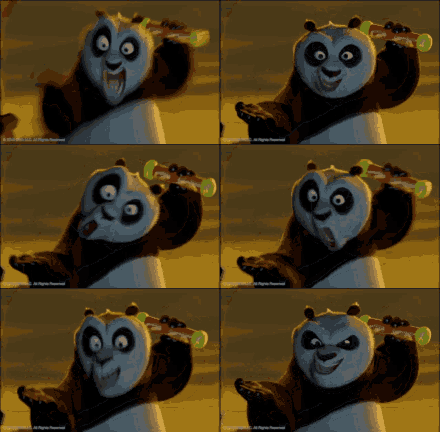
Po's outburst at realizing that Shifu is putting him up against Tai Lung his human. He is terrified. I mean, hey, I would be too if I had to fight someone who's spent 20 years in jail and is on a quest for vengeance.
He's been told constantly that he is not enough, and that he will never be enough. Yet he stayed. He "stayed because every time you [Shifu] threw a brick at my [his] head or said I [he] smelled, it hurt. But it could never hurt more than it did every day of my life just being me." And I think that's beautiful. Po never felt like he truly belonged, and the second his life turns upside down (literally with the blasted-from-the-sky thing), he begins to live his dream. But being told over and over again that he is not worthy compounded that belief that he will never be enough.
Po embodies many of us in this way. We all have had dreams; dreams to be the greatest in the world at whatever interests us. Yet, many of us have been striked down.
Maybe you've been held back in a lifestyle that you are not happy with and you're being forced to endure. Maybe you've been told repeatedly that your dream is ridiculous and that 'it's a dream for a reason'. Being the best, the smartest, or being the strongest, Po shows that perfect is great, but persistence and heart carry us further in the journey. There is a sense that the experience shows us that as long as we believe in ourselves, it doesn't matter if nobody else does.
A Symphony of Humor and Heart
And then, of course, there’s the tone. The films are laugh out loud funny, while never losing sincerity. Jack Black’s voice talent captures something special: he plays Po as both ridiculous and beautifully profound, reminding you that confidence can be present with vulnerability.
The comedy makes sense because the humor is truly coming from honesty. You are laughing with Po, not laughing at Po, and in that laughter, you see a little piece of yourself.
Visually, it's stunning The animation is influenced by traditional Chinese art; intricate landscapes; tactile brushstrokes; imagery that seems to have been choreographed instead of animated. Each action has weight and rhythm to it; every scene has warmth and life. The filmmakers don’t simply incorporate elements of Chinese culture, they honor it, with a respect and vibrance that is almost unheard of for western animation.
Viewing those moments is almost meditative. You can feel every frame was a deliberate choice.
And the music, from Hans Zimmer, and John Powell, enhances the visual stimuli. The sweeping strings, the performance of traditional instruments at a grande scale, returns a cinematic quality, dressing up the quietest of scenes with tense significance. The music is a pulse to the emotional narrative; not simply background noise.
The Real Secret Ingredient
One of the reasons Kung Fu Panda is timeless is because it never tells you what to be; it simply shows you that you are enough. In a time when every other story is screaming, “be rebellious” or “re-invent the genre”, Po’s story says: you do not have to become someone else to matter; you simply have to see value in who you are. A reminder that self-acceptance is not passive, but takes bravery.
So yes, I will proudly say I think it is among the greatest animated franchises—and one of the greatest franchises for a film, period. It straddles wisdom and whimsy, action and honesty, philosophy and fun, as few films attempt to do. It is a rare series that grows with you; it teaches children how to dream, teenagers how to endure, and adults how to let go.
When Po’s father first tells him that “There is no secret ingredient,” you believe him. Perhaps this was the lesson all along, that we don’t need to become something bigger than ourselves in order to be special, we just need to be ourselves, cookie crumbs and all.
Because perhaps the secret ingredient was never about kung fu. It is about us.