







Research papers have been incorrectly defined. At some point, they became standardized documents containing boring introductions, predictable formats, and writing meant solely for grading and disposal. It may have been five paragraphs in length.
They would have a neutral tone regarding content, without saying anything about which there would be any controversy. The only thing they were "really" getting accomplished was to impress an instructor with intellect while working very little in return.
That is an inaccurate representation of writing research.
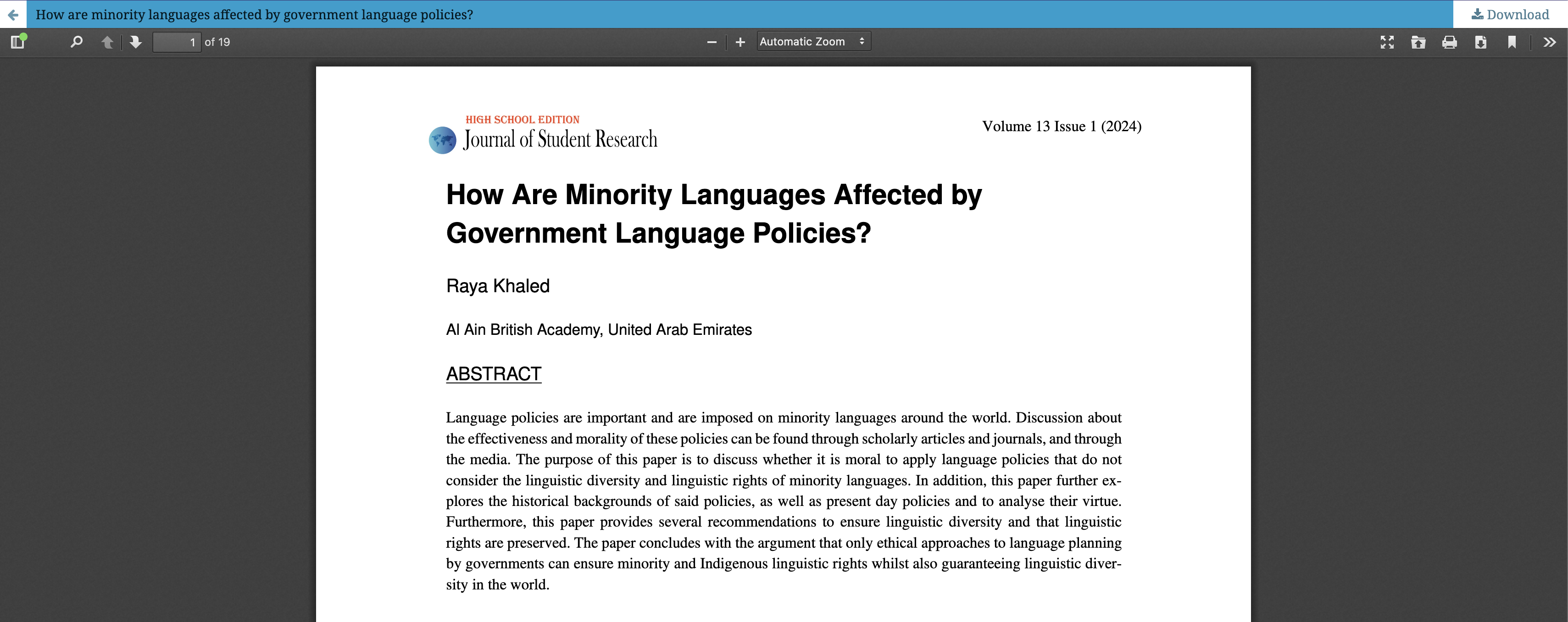
My initial understanding of this fact began during Year 10, where I completed the A-Level Extended Project Qualification research project on Language Policies & Planning (which has now been published seen below). I was younger than most people who take on an EPQ, and I had no interest in producing something that sounded like a stretched-out exam. Instead, I wanted to explore how government utilized language as "power". I wanted to explore how the political landscape of a country has changed because of the political policies of government.
At first, that opened my eyes to the fact that true research does not have a "school" feeling to it; it has an investigative feel to it, it is an argumentative feel to it, it gradually opens up to illustrate to you how incredibly complex our world is compared to what we were originally led to believe.
These are the kinds of research papers that will actually stand out.
Let us slide into your dms 🥰
Get notified of top trending articles like this one every week! (we won't spam you)Start With a Question That Refuses to Leave You Alone
Before students even put pen to paper, bad research papers often fail. Not because of lack of writing ability, but rather that the question itself lacks depth or substance.
Many students select research topics because they sound "academic," rather than out of any sense of urgency for an answer. There is an almost immediate difference between writing that comes from a place of urgency and writing that is more polished but lacks attachment, the former being engaged via emotional connection, while the latter simply just careful, well-structured arguments.
When I first decided on my research project topic of Language Policies and Planning, it was due to my curiosity of the relationship between language and power. For example, the way in which some languages are maintained and other languages simply disappear. Why in some communities they support and endorse bilingualism while in other communities multilingualism is discouraged. Or, rather, look at ongoing discussions regarding "Official Languages." Many of these conversations are about status, and being part of a group or culture, whereas in other instances, the discussions revolve around grammatical correctness.
When I began researching my topic, I had no idea what the answers would be. To me that is the difference between a true researcher and a person determined to prove their opinion.
The topic of a well-stated, relevant and significant research question will generally be a source of mild discomfort, and as a result, force one to wrestle with the unknowns.

Image Credit: Scott Graham from Unsplash
Take the Quiz: What Type of Notes Should I Take?
Discover the best note-taking method for your learning style!
Think in Sections, Not in Paragraph Quotas
School teaches structure like filling in a stock answer. In actuality, the research process treats the topic as a series of logical steps.
When I wrote my Extended Project Qualifying (EPQ) paper, I didn't think about how many paragraphs I needed; instead, I concentrated on how to get my reader to follow my thoughts (meaning "Arrange the content so it makes sense"). For instance, in my EPQ I organized my research using the following information: context, history, policy, consequence, and contradiction.
Rather than forcing my work into an artificial five-paragraph shape, I arranged it around themes that I wanted to communicate.
- The emergence of the language policy
- Beneficiaries of the language policy
- The marginalized
- The method of developing control through the language policy
- The sources of resistance to the language policy
Each of these groups represented a different section, and all of them were written for the ultimate purpose of serving the thesis statement, rather than conforming to an arbitrary template.
The organization of your research paper in this manner makes it feel intellectually sophisticated. It provides a framework by which to guide the reader's understanding of your thought process rather than simply checking off boxes for the teacher.
Treat Sources Like Conversations, Not Decorations
The way that sources are used is one of the most obvious indicators of poor research writing: quote, cite, move on.
In my EPQ, the sources I read were not intended to demonstrate how much I had read but rather to provide me with opportunities to critique the arguments of others. I consulted works by linguists, government documents and case studies that argued against each other. These conflicting arguments formed the backbone of my paper.
Instead of presenting the sources as factual statements, I represented them as individuals arguing against each other. Some one person suggested that language standardization is needed for promoting national unity, while another person argued that it would eliminate minority identities. My position was to examine where they both disagreed, not to remain unbiased.
This approach allows you to create substantial research writing. In this case, you were not hiding behind authority, you were participating in it.

Image Credit: Windows from Unsplash
Write Like You Think First, Then Edit Like You Mean It
The first thing that students often overlook is that at least their very first draft does not need to be written in an academic tone.
When creating my EPQ draft, I simply wrote a whole lot of long sentences, included embedded questions, used some confusion and established some very tentative connections to what I was writing about. I tried to sound like a human being writing out his/her ideas in a rough form.
Afterwards I accurately refined my language, made my claims tighter and improved on how to define my terms.
Preparing your first draft to sound "academic" will only make you sound like you are trying to imitate someone else rather than creating your own thoughts. Neither universities nor employers are interested in imitation; they want to see your thought process clearly demonstrated.
Clarity will be found AFTER you've been honest, with yourself and with others.
Analysis Is Where You Prove You Understand Power
In regards to language policy it can be relatively straightforward to outline the existence of Language Policy - including official languages, education systems and legal policies.
However, understanding language policy requires that you understand what these forms of language exist to do.
In my EPQ I had an example of this to consider for every policy so that I could answer:
Who benefits from having this policy? Who does not see themselves or their voice represented by this policy? What do we say about our cultural identities through this policy? What do we lose?
If your paper is only telling the reader "What" that means you are writing descriptively, if you tell the reader "Why" it matters, that means you are writing analytically.
This is where you must express your thoughts independently.

Image Credit: Daria Nepriakhina from Unsplash
Let Research Change Your Mind
Completing my EPQ early provided me with the ability to make mistakes.
Through my research, my views on those aspects of language planning that I originally had assumed to be purely repressive became clear that many of them had protective elements, and that those that were labeled as neutral were in fact very political. By allowing the argument to develop, I could see that it had become increasingly nuanced.
An excellent paper reflects growth by providing a paper trail that shows thinking has progressed.
If you come away from your research paper with the same viewpoint you had when you began, then you probably didn't listen to your own research.
Your Conclusion Should Leave a Mark, Not Just Close a Loop
The least effective conclusions are those that repeat the introductory statements and provide no perspectives.
My EPQ was an opportunity to connect all the research in one place. I noted the limitations to my research and acknowledged the ambiguity of my findings. As I wrote my final draft, I thought about why policies concerning language have an impact outside of academic settings.
A strong conclusion outlines what the researcher has determined but goes further and provides insight into the real-world implications.
Why This Kind of Writing Matters
Writing a research paper opened my eyes to the way I look at every type of writing that I have completed or will complete in the future. Writing essays shifted from being an obligation to becoming an argument for a point. Writing projects shifted from being a burden to being an ongoing exploratory investigation.
Universities appreciate this type of writing because it represents a certain level of independence and maturity in an individual's intellectual development. It implies that the individual is capable of going beyond what they are told to do and thinking outside the box.
Research papers do not have to be boring.They do not have to follow a standardized pattern to be accepted.They can sound like a person thinking critically, thoughtfully and honestly about what they have written down.
And once you learn how to do this, (especially if you develop the ability to write in this fashion early in your academic career), you will not return to the way you wrote before.
