



There's a specific kind of electric tension as a Formula 1 season nears its concluding races. The suspense, the props, the scrolling through post-race debates about tire strategies and pace comparisons late at night. But 2025 feels oddly flat.
Not because F1 is losing its luster as it has in perhaps past transition years, but because it appears the narrative of championship drama was written long ago. With three races remaining, the math says we are watching a title contention. The nuance indicates we are watching inevitability play out slowly.
And yet millions of us come to watching every weekend to have even a remote chance of seeing something that resembles magic.

Image Credit: Formula One on Wikimedia Commons
Let us slide into your dms 🥰
Get notified of top trending articles like this one every week! (we won't spam you)The Championship That Was Over Before It Began
McLaren not only established themselves this season, but they totally rewrote the narrative. They claimed the Constructors' Championship very early, finishing with over 300 points on second place in the championship. The year 2025 became a lesson in control. Their car, developed through years of supposed small changes, lots of bold upgrades during the season, and their design approach hitting the apex at just the right time, became the standard setter from Bahrain to Brazil.
The Drivers' Championship shows, quite starkly, their control over the competition. On paper, the remaining competitors are Lando Norris, Oscar Piastri, and if you squint hard enough, you could argue Max Verstappen. But at this point, "competitor" would be overstating Verstappen's position. Mathematically he is involved, but that is simply the distance between possibility and probability.
Which now leaves us with the battle that has defined 2025: Norris versus Piastri, teammate with teammate, orange versus... same orange. A rivalry within a rivalry, starring two teammates fighting each other; a rivalry that will occur under one roof.
And therein lies the question: is this a championship battle or merely a contained internal workaround rivalry, within the potentially, entirely new most dominant team F1 has seen since Red Bull?
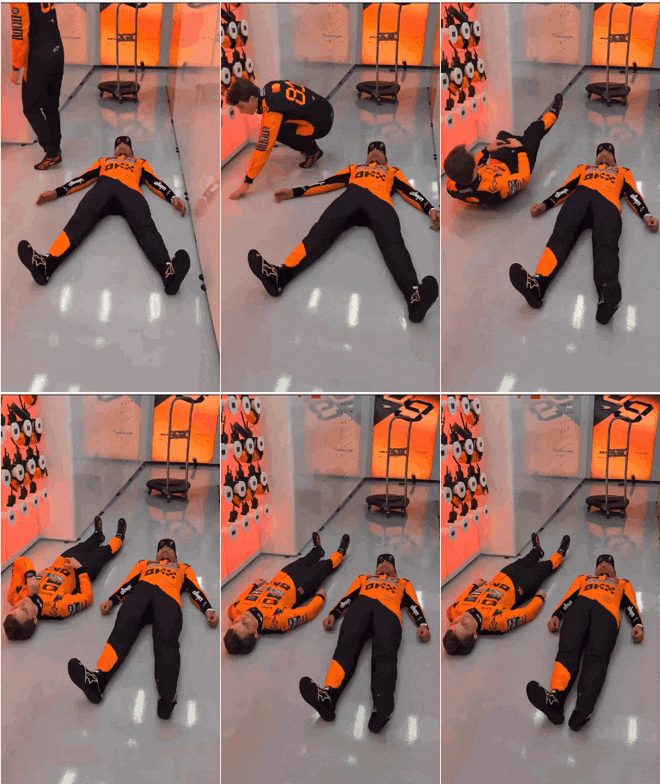
via Tenor


Take the Quiz: Which Blade Angel best represents you?
Are you more like Alysa, Amber, or Isabeau?
Dominance and the Illusion of Competition
Dominance is an oddity. It instills reverence, but it generates predictability as well—and that's not what we want if we're hosting suspense. McLaren's 2025 campaign has been a near-robotic embodiment of perfect; so much so that it extinguishes drama from the storyline, simply by being too good.
Let's be clear; Norris and Piastri are giving it their all. Their lap times, their qualifying contests, their radio exchanges filled with just the right amount of tension are all working to create the title fight we all want. However, it still feels a little bit muted when the conflict is all confined to the same aerodynamic package, the same upgrade schedule, and the same paramount reliability.
This is not Red Bull versus Mercedes. Nor is it Senna versus Prost; two worldviews. No, this is conflict controlled.
Captive. Curated.
And perhaps that's how some fans feel like they've seen this all before; the narrative beats are the same, albeit with new chassis.

Image Credit: 2025 Japan GP - McLaren on Wikimedia Commons
The Joy of the Unexpected
And still, amid a season defined by foregone conclusions, Formula 1 has a history of reminding us that it still has a pulse of unpredictability. Every four to five races, something breaks through the impeccable exterior of McLaren's domination and sends the fandom into some sort of collective euphoria. It is the unexpected podiums that do it, the moments that serve as the plot twist in a tale everybody thought they had already read.
Carlos Sainz with a podium position no one had him in. Isack Hadjar developing a weekend that should have been anonymous into the result that would define his young career. Nico Hülkenberg, after years of bad luck returning to the rostrum with that quiet satisfaction of someone who waited too long for what almost got away from him.
There were even weekends where Haas, a team that often is written off when the year starts, scored double points and reminded anyone who was still watching what resiliency truly looked like. Those results were not only statistical anomalies. They were emotional detonations. They moved something in the ether of the sport.
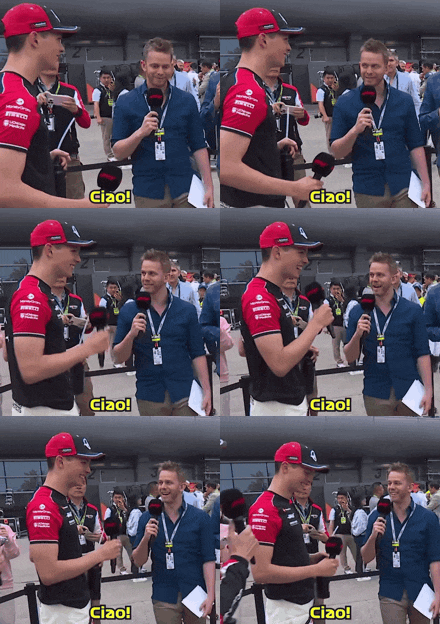
You could sense the reaction on social media within minutes. The rejoicing was boisterous, almost collective. Supporters, who usually bicker about constructors’ disparities and driver mistakes, found common purpose in sheer joy.
Memes plummeted online, feeds were engulfed by incredulity, and the word ‘finally’ was uttered everywhere. Moments like these brought the fandoms' pulse back to a boiling simmer.
Because for all of the F1 engineering certainty, the magic has always been in the mistakes in the algorithm. The midfielders and back markers falling into daylight. The drivers who weren't supposed to influence the championship making their mark on the season regardless.
These moments of chaos revive something invaluable. They show us there is always potential for shock and joy, by even a year based on overwhelming dominance. They can bring belief, back to the sport, which advertisers endless unpredictability, but often struggles to deliver.
In that way, the shocks of 2025 do not affect the championship, but they affect watching and enjoying the championship. They have enabled fans to hold on to the belief that anything is still possible, even when you feel everything is settled.
When Regulations Create Winners… and Spectators
The unfortunate truth is that the current regulations are working, just not for everyone. They're working spectacularly for McLaren, intermittently for Mercedes, and piecemeal for Red Bull. But as a Ferrari fan—I won't say anything for my own sanity—the situation is a much less attractive one for anyone outside of the top three teams.
And the evidence is right there painfully: race gaps.

Image Credit: Sara Ruffoni on Unsplash (I had to add Ferrari okay)
We have gotten to the point of having more than a minute and a half difference from P1 to P20. That is more than just drivers performing differently. That's a different race at the same time. The sport has become less about competition and about stratification at that point—the hierarchy is so predictable that we sort of have knowledge of the top teams, the midfielders, and those sewn into being the backmarkers.
Formula 1 used to be many things, political, slightly unpredictable, sometimes chaotic, but mostly it was close. Margins meant things. A tenth was a universe. A second was an insutlt.
Now? A minute and a half is a galaxy.
And while dominance is impressive, it isn’t necessarily enjoyable. Not for viewers. Not for neutral fans. And honestly, not for the sport’s soul.

via Tenor
2025 as a Season in Limbo
The impending changes to regulations in 2026 is looming over the grid. Teams are reorganizing their resources towards the new era trapped in an implied understanding, they even term it fair to say the current season is not worth the battle against many other efforts.
2025 stands at two junctures. One, everything is easy; a car that dominates, a Constructors' Championship running in the same manner, and a Drivers' title seemingly residing in one team's hands. The other horizon might pose disruption, in the form of power-unit formulas flips, aerodynamic resets and technological improvements based on 3D modelling!
This in between phase creates an atmosphere that affects the racing. It affects the stakes. It even affects the willingness to take risks. And potentially enough not meaning to but definitely enough creates the sense that the championship is not a real fight and is some type of holding pattern

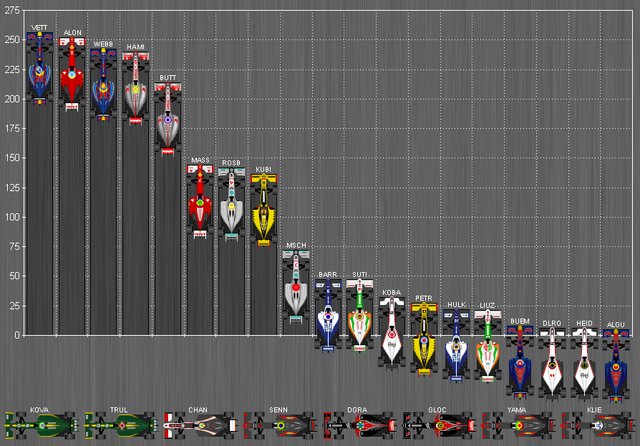
Image Credit: 2010 F1 Season Championship Standings on Wikimedia Commons

Image Credit: 2020 F1 Season Championship Standings on Wikimedia Commons
Why Do We Keep Watching When We Know the Ending?
This is the question that follows the sport like exhaust smoke. If a conclusion is always written then why do we so eagerly show up for every chapter?
Because Formula 1 is never solely about who is the victor.
Fans watch for the human nuances: the tension in the debrief with the team, the micro-expressions between two drivers who both believe they are the deserving champion; the radio message that escapes when the mask slips. We watch because winning may seem predictable, but people will always remain unpredictable.
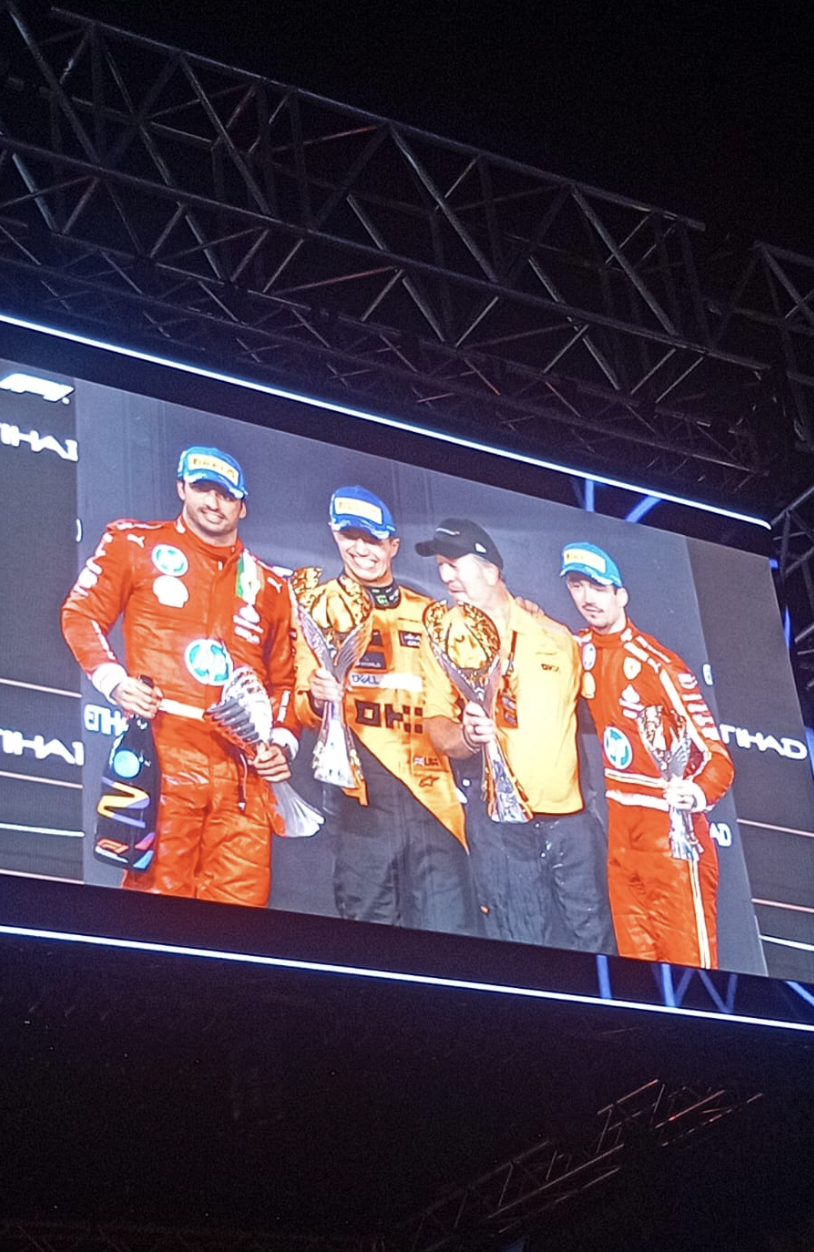
Image Credit: Raya Khaled (2024 Abu Dhabi GP)
And perhaps we also watch because hope, in sport, is irrational by design. We watch for the freak safety car, the rain shower that was not in the forecast, the error in the pit stop, the moment where a season of certainty shatters can occur in six laps of chaos. We watch because F1 is a sport built on the improbable posing as impossible.
Even if we know how the story ends, we show up for the way it’s told.
What the 2025 Title Battle Really Says About Formula 1
The issue at hand this year is less about the standings and more about F1’s identity. The sport is grappling with its evolution: the fact that what is deemed perfect and satisfying tame is in opposition to the expectation of the audience to have some form of chaos or unpredictability. The rise of data-driven performance, we poets might say, faces the nostalgia for chaos. Hyper-optimized engineering, the future of F1, is in conflict with racing’s prior messy, emotional core that always made it matter.
Norris and Piastri are remarkable talents. McLaren deserve every headline they have earned. But the deeper, quieter story of 2025 is less about dominance as it is about what this dominance tells us. Not simply about teams dominating in a race series, but about us.
Because in a season where the outcome feels predetermined it is in the gap between what seems/believe is inevitable that we are really watching the importance of hope. Can we still hope that unexpected things can happen, even if logic or objectivity tells us otherwise? Can we still hope to watch a sport that feels alive to us, and not simply driven by algorithm.
via Tenor
So, is the 2025 championship really a fight?
On the surface, no. It’s a controlled battle within the walls of McLaren’s garage, a rivalry held firmly in the hands of the season’s most dominant team.
But beneath the surface, in the hearts of fans, in the quiet calculations of rival engineers, in the eyes of two drivers who both believe they’re destined for that trophy, the fight is more human than statistical.
And maybe that’s the part worth watching.