




.jpg)
I have always admired ballerinas. I love watching as they leap across the stage with unparalleled elegance, spin in perfect uniformity, and seamlessly transition between movements. Through their precise technique, ballet allows dancers to tell a story that captivates the audience with their strength, beauty, and power.
Growing up, I took ballet classes for seven years. However, even years after I finished dance lessons, I still find myself watching performances through social media, completely entranced by the gracefulness of the dancers.
If you're considering signing up for your first class or just curious about the sport, here's the perfect beginner's guide to everything you need to know about ballet:
Let us slide into your dms 🥰
Get notified of top trending articles like this one every week! (we won't spam you)History of Ballet
Ballet was first performed in the 1400s during the Italian Renaissance. During luxurious events like weddings, noblemen and noblewomen would learn ballet as part of the festivities. The art form spread to France in the 1500s when Catherine de Medici married the King of France, bringing with her the ballet tradition.
Later, King Louis XIV would make ballet mainstream by creating the Paris Opera Ballet (then called Académie Royale de Danse). Through this company, the nobility would no longer be the performers; instead, trained professional dancers would master a standardized curriculum to showcase their talents to a larger audience.
Today, across the globe, people admire the years of dedication, talent, and mesmerizing grace of ballerinas. Consequently, the art form has become more popular as The Nutcracker viewings have become a family tradition for many and principal dancers like Misty Copeland have become household names.


Take the Quiz: Are You a Good Cook?
Think you're a good cook? Well, take this quiz and find out...
Ballet Positions
Probably the first thing that your ballet teachers will instruct you on is the five positions. Normally, other movements will end up or begin with one of the five positions; so, mastering the basics first is important to learning routines later on.
For first position, create a circle with your arms just below your shoulders while your feet form a "V" with your heels connected. Make sure that your fingertips barely touch each other.
Second position has a similar arm placement, but the circle is now elongated so that it closely resembles an oval. Your feet should move apart, separated by 12 inches, but still have toes pointed outward.
Fourth position is when your feet are turned outwards, with one in front of the other, while one arm is raised in the air and the other resembles the arm placement of second position. For your arm in the air, imagine that it is half of the first position circle.
Finally, fifth position is when your feet are outward-facing and connected. The back foot's toes should make contact with the front foot's heel while both arms are raised in an elongated circle.
As for third position, it is not commonly used anymore because of the similarities with fifth position.
Basic Movements
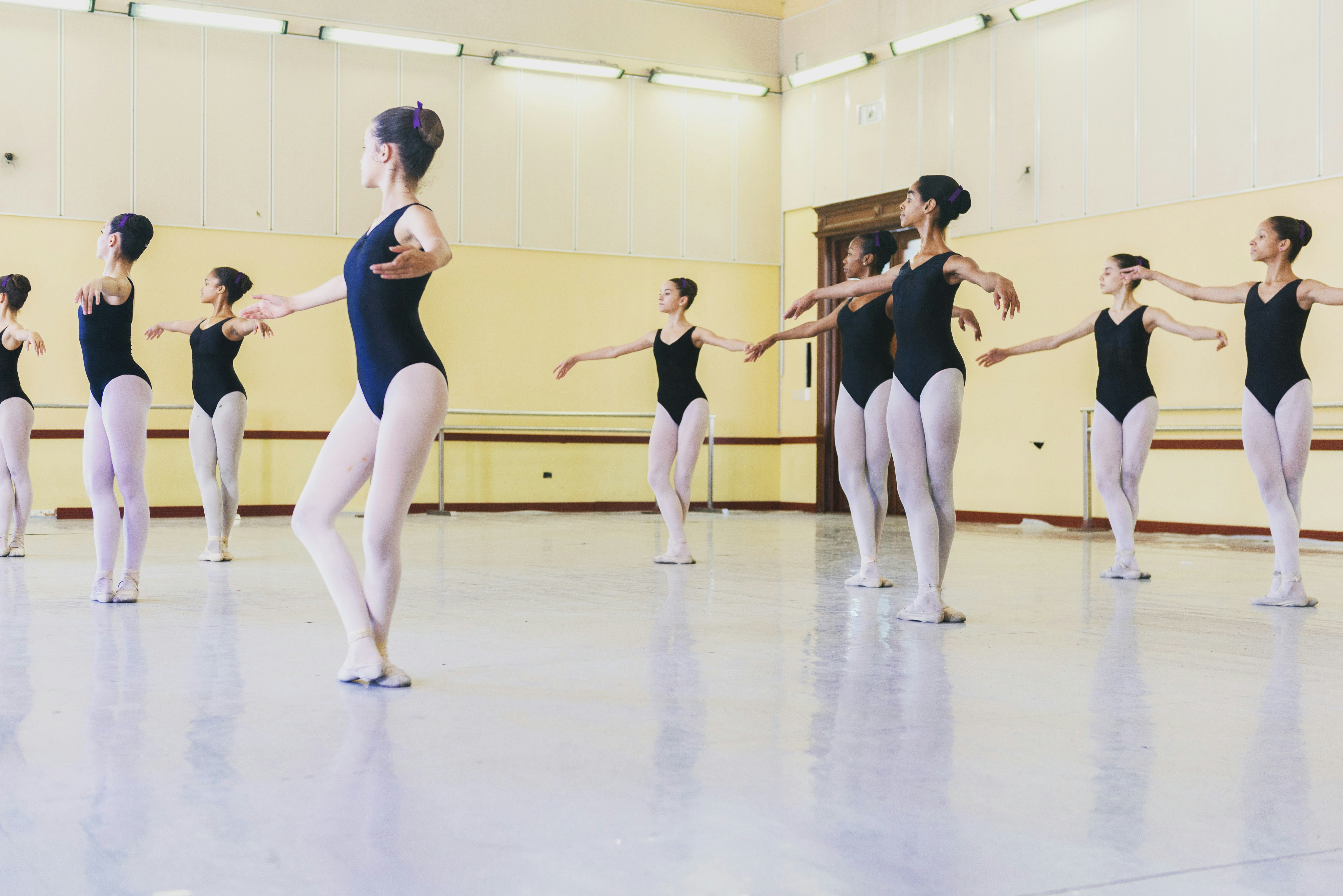
Image Credit: Ken S from Unsplash
After learning the five ballet positions, you will likely be taught relevé (French for lifted or raised) and plié (French for bent), which are two fundamental ballet moves. Relevé is when you lift yourself onto your tippy-toes, often after a plié, where you bend your knees halfway, keeping your toes pointed outward.
To move across the stage, ballerinas can use a chassé (one foot glides forward and the other quickly flows) or a jeté (a leap where you leave the ground on one foot and land on another with horizontally extended legs mid-air), among many other beginner techniques.
Other basic movements include a tendu, where you commence in first position and extend your pointed toes away from first position, creating a straight line before returning to the original position. For jumps, the sauté begins in one of the five positions where dancers will bend their knees to launch themselves directly upwards.
All of the moves above also require balance, precision, and good posture. Consequently, ballet is a difficult art form to master because of the detail-oriented nature of the sport as well as the physical demands.
Pointe Technique
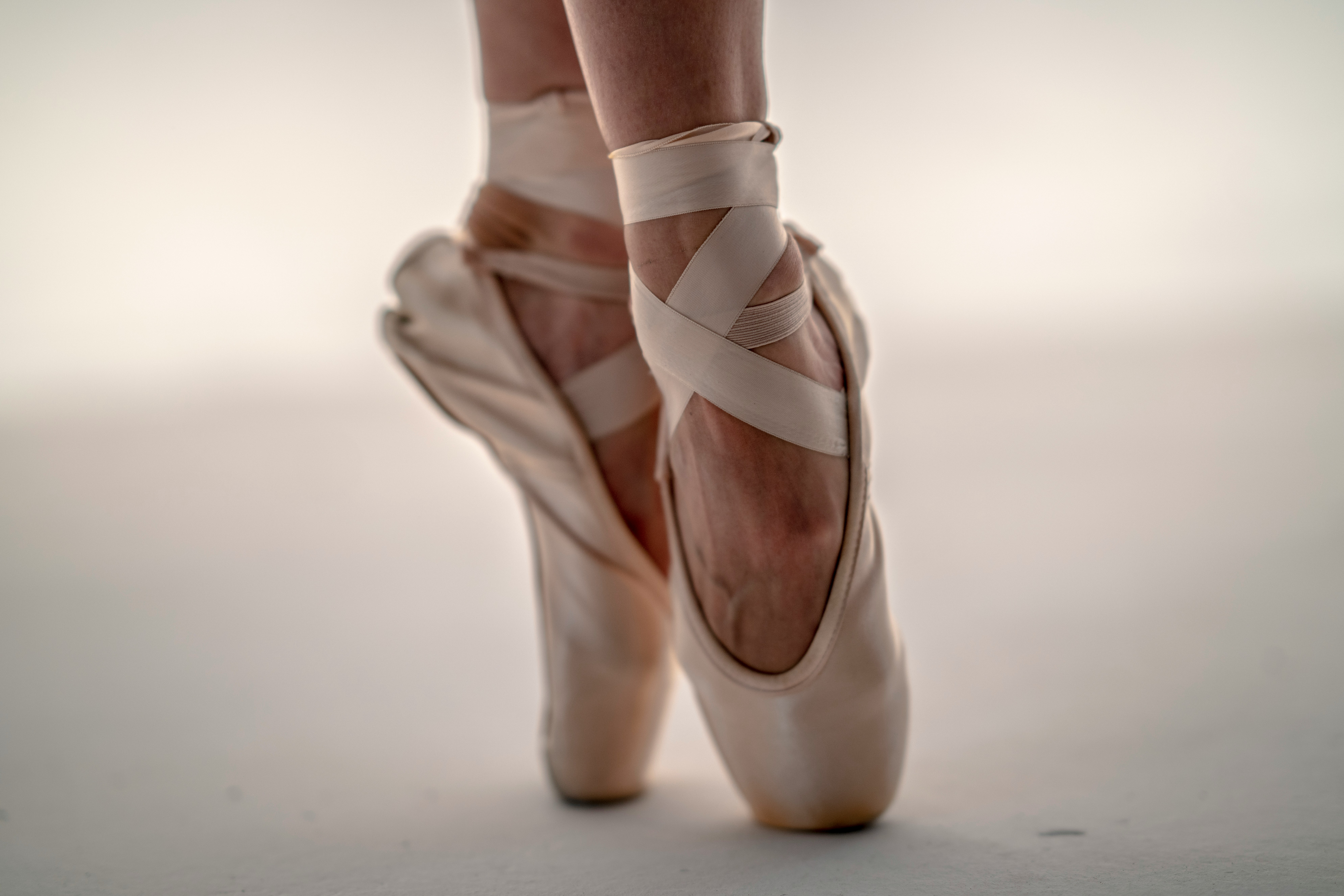
Image Credit: Nihal Demirci from Unsplash
After years of training, ballerinas can eventually learn the pointe technique. If you've ever seen a professional ballet company show, you have watched dancers performing en pointe.
To do this, they first had to build strong ankles, legs, feet, calves, and core that could support their entire body on the tips of their toes. Furthermore, proper balance, control, dedication, and years of serious ballet training are required.
Next, dancers must find the proper pointe shoes that work for them. When dancing en pointe, it is important that the ballerina feels as if their shoes are a continuous part of their feet. This often requires dancers to customize their shoes by reshaping, cutting, shortening, and sewing different aspects.
The shoes themselves are made with cardboard, paper, and fabric (held together by paste) to support the foot and allow the dancers to hold their movements without fear of their shoes bending. On the outside, satin ribbons ensure the shoes stay in place, a leather sole prevents slipping on smooth surfaces, and a cotton interior provides sweat absorption.
Closure
I hope that you have learned a little bit more about ballet from its history to some of the fundamental skills. If you're looking to sign up for your first class, there's no better time than the present! Ballet can be difficult to learn due to the precision and strength required; however, don't let anything stop you from achieving your dreams. Also, if you ever get the chance to see a company's show, I would highly recommend it, especially now that you know a little bit more about this beautiful art form.
.jpg)


.jpg)