




Have you ever been in a fandom that just couldn't take ANY sort of criticism? As in, regardless of how nicely your critique is presented, like in a compliment sandwich or a haystack full of flattery (with just a small needle to improve), you'll still have fans foaming at the mouth as if you compared their beloved artwork or artists to rat-infested sewer water?
Unfortunately, there are many, many cases of fan(atic)s that are all too quick to conflate any and all types of criticism as hate! While most critiques usually don't come with malicious intent, these harbingers of toxicity will swear that your takes are purely due to a lack of media literacy, a consequence of an alleged lack of taste, or simply being too dumb to understand the true intent behind what a creator was saying.
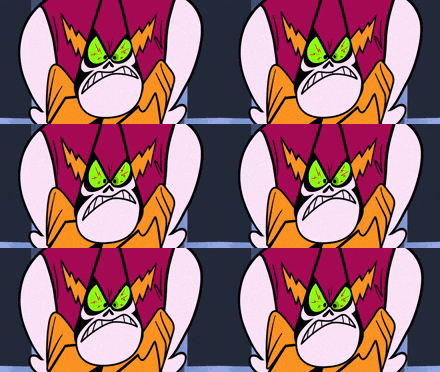
And inevitably, you'll have to deal with the online equivalent of this:
This is something I've noticed in EVERY fandom, across various genres. Animation, music, politics, books, etc. all have very... invested individuals that just so happen to be more prone to starting an uproar. Of course, this isn't exactly a new discovery or anything; toxic fans have been alive since the dawn of fandoms.
It just so happens that the internet exacerbates this toxicity with the addition of anonymity. Which makes it much, much easier to be more vicious, given it's harder to enforce consequences (not to mention, with echo chambers, there's always going to be some people who support this terrible behavior....).
Let us slide into your dms 🥰
Get notified of top trending articles like this one every week! (we won't spam you)The Psychology Behind The Outrage
"Okay, but it's just a piece of media, right? Who cares?"
I'm sure this is a thought we've ALL had whenever we encountered some of the more passionate fans of media we enjoy. Sure, I'm not going to act as if I've never gotten a little sad whenever someone expressed dislike or disinterest in my favorite shows or characters, but I've never really taken it as a personal attack. After all, I'm not the one who created the media, and more importantly, the criticism isn't aimed at me as a person, so I'm good! But why exactly are some fans unable to make this distinction when most can?
Well, according to Psychology Today, there are a lot of "evangelists" within modern fandom who interact with other fans in the most pompous and rage-baiting ways possible. The term was coined by Twitter user @Atrieded, who analyzed the changes in fandom over the past decade and factors that have contributed to its current toxicity. If you've ever met a fan who just seemed so desperate to prove you wrong on a certain topic or flex their "superior" knowledge of your favorite story, then you've met one of these fandom evangelists.
In essence, this toxic mentality has led to fans being less united in celebrating the work they love and instead divided into factions to uphold and spread their beliefs on a piece of work. We all know those sectors of our favorite fandoms.
From the "my ship is best" clique to the "certified [character] lover/hater" fans, they all have very strong opinions and usually don't like hearing otherwise. Staying with the religious comparison, imagine that the fans within these factions were essentially trying to spread their interpretation of a piece of media to make it the most popular and agreed upon as the "correct" take.

Image Credit: cottonbro studio from Pexels
This essentially creates in-groups and out-groups. And if you're unfamiliar with either term, it's a psychological concept that describes our evolutionary tendency to categorize people as "us" vs. "them." Our ancestors used this to enhance group cohesion and chances of survival, but in the modern age, this leads to a lot of biases and hostility towards those outside of our in-groups. Perhaps that's why you got such a scathing response when you mentioned that you ship characters A and C to someone who adores A and B together.....


Take the Quiz: If you were a Never Have I Ever character, which one would you be?
Are you Crazy Devi, robotics queen Fabiola Torres, or maybe popular jock Paxton?
Reasoning from fandom perspective
A common justification I've heard for this reaction is that there are many bad actors posing as qualified analyzers of media in order to bash on works they dislike. This way, whenever these haters are called out for any poorly given "criticism", they can insist that any opposing opinions are due to fandom sensitivity and an unwillingness to accept the "truth"...which just so happens to perfectly align with their exact thoughts.
Now, as someone fully aware of the extent of bad-faith critique, I can understand how frustrating this is. It's not just a matter of someone bashing on something you love, but also disguising their non-stop (and unasked for) tirade as "critique" despite offering no sort of feedback or creative solutions. However, this is one of those cases where the reasoning does not justify the means!
Contrary to what it seems, bad faith critics are the minority of media commenters, not the majority! I've seen many great critique videos that show loads of love and support for creators while also offering thoughtful commentary and creative suggestions for potential revisions. Personally, I love these kinds of videos because I get to see new perspectives of my favorite works and learn how to better execute some ideas in my own stories.
Learning about underutilized concepts, plot holes, and a lack of character(s) development isn't entirely negative! It allows fans to dream up their own potential storylines and recognize certain pitfalls creators can fall into (as well as making room for your next favorite piece of fanfic).
That's the power of REAL critique! When done correctly, fans are allowed to rave about the things they love about media and use their imaginations to dream up bigger possibilities! However, despite this enthusiasm, you can still be stripped of your title as a "real fan" in some circles.
Image Credit: westphotoandvideo from Pixabay
I feel as though I should mention that the above justification for disliking critique does mean that generalization and confirmation bias are at play. When you generalize, you assume that every person and thing in a given category will be a certain way (whether good or bad), which is what this rationale does to all criticism. It paints bad critique as the standard and, therefore, automatically categorizes well-meaning critique as bad without checking otherwise.
As for confirmation bias, this happens when we hold a certain notion, and whenever we see instances of our (bad) theories at play, it reinforces our beliefs and tends to make us unaware of the MANY other cases where they were proven otherwise. For example, I recently watched a video that discussed media illiteracy in response to critiques of a show I like. However, I noticed this video had nothing to do with the show's major critiques, but instead, harped over minor misinterpretations people had and how cases like these proved that the fandom "hate" wasn't to be listened to.
It was admittedly pretty shallow and very, very focused on a specific and small minority of viewers, but it did a good job at validating other fans existing beliefs, hence why the creator was deemed a "real fan" (not questioning or challenging their fan status by the way. I just wanted to point out how concerning it is that the requirement to be deemed a fan means you endlessly praise someone or something).
Critique Isn't An Evil Monster, But a Friend To Creators!
As a writer, I'd be lying if I said that I've never felt a little stung after a bit of critique I've received. It's like showing off your shiny new car only for your friends to point out there's a scratch on the side. Does it suck?
Absolutely! But is knowing there's a problem better than not knowing? 100%! It'll come as a shock in the moment, but critique is ultimately designed to help you make a piece better. If implemented correctly, critiques won't just help you fix the scratch on the side of your car, but also add some highlights that'll make it look 10x cooler than before.
Which reminds me, I think now is a good time to define what critique is, especially since I've pointed out just how misinterpreted the word can be. As I stated, critique, or constructive criticism, aims to highlight any flaws in your work that keep it from being at its best and offer suggestions to help you improve. In fact, I'd go so far as to argue that it's fairly simple to differentiate thoughtful and genuine criticism from a bad-faith bash fest.
But if you want some tell-tale signs to look out for, as well as tips on how to better your own critique, I'll give you a walkthrough! I have about 2-3 years of experience being an editor for literary magazines and journalism (including this publication!), so I swear you won't be led astray. Ready?

- DO NOT be all-negative!
Remember, art has the power to resonate with us in ways that most other sectors in our society can't, so let's not be that one jerk online who makes it a point to say, "This thing sucks!" and then refuses to elaborate. Yes, I highly understand that there are pieces of media that are just poorly executed (Velma, Mr.Birchum, etc.), but this response isn't productive. We're not going to get better stories, new perspectives, or inspire the next generation of writers by going on a tirade.
Negativity is for X, Reddit, and Instagram! We don't waste 20+ minutes of people's lives just to rant; we add substance and encouragement. Also, please don't give engagement to "critics" who just whine. We don't want to make way for more poor media analysis or spread more needless negativity.
- DO NOT center your critique on whether a work is objectively good or bad without proper, in-depth reasoning. That's not critique, but either being relentlessly mean or sugarcoating with no substance!
A huge issue with modern critique is that people only focus on one side of a spectrum and ignore everything else that doesn't align with what they already believe. Think about those "critics" whose entire point is that a piece of media is "woke" because of POC and female leads. It's clear the sentiment is negative, but it offers zero ways build these characters or make better stories with these types of leads.
Or maybe you've seen fans who spend 30+ minutes worshipping a piece of media without once touching on how the story lore doesn't add up with previous information. And if it is somehow brought to their attention, they'll make up some crazy theory on the spot or swear that the creator just needs more time for their marvelous reveal that'll bring everything together?
Put simply, neither of these are reviews; they're reactions! And while it's fine to like or dislike a piece of media, simply offering something vague like, "This was GOATED!" or "Omg, this was a dumpster fire," honestly does nothing for a piece in the long run. If your intent is to give genuine criticism, you need to be more in-depth!
In the case of reviewing longer forms of media such as, shows or movies, I'd highly recommend a format similar to the 5-paragraph essay structure. If you didn't have to write these in elementary school (or just haven't done them for a while), it consists of one beginning paragraph, three body paragraphs with each of your key points, and a conclusion paragraph to bring your thesis home.
It may be a bit of work, but honestly, I think we do need to start normalizing not simplifying our thoughts! Taking the time to reason allows us to convey more complex ideas and avoid what I like to call the "abstraction trap." This is what happens when certain words or phrases are repeatedly used as a placeholder for big ideas that the user won't touch on in favor of focusing solely on the point they want to make.
Unfortunately, the words caught in the abstraction trap wear down and tend to lose their original, more thoughtful meanings as they become sucked into the void of internet lingo. (Woke, communist, snow bunny, alpha, and many, many more fall into this list) That said, if you notice certain media commenters repeatedly abusing a word or phrase and having no explanation for its use other than to get their point across, then you'll know you're dealing with a phony.

Image Credit: IqbalStock from Pixabay
- DO offer suggestions that can be built on!
I'm not saying to come up with a completely rewritten version of the work you're reviewing, but to give the creator a starting point on how to implement your critique. Personally, I've found that the best critique usually comes with some sort of example on how a certain flaw can be fixed. Don't worry, I promise this isn't to make you do any of the work for a creator, but to shine a light where they didn't originally see one.
As creatives, we're VERY attached to our work and while it does give us the drive to finish our magnum opuses...it also means we're blindfolded to their flaws. So if you see a writer fall into a gaping plot hole or something of the like, a point of reference would be really great to help them write their way out.
Side note: Also, this may be a personal preference, but I, for one, LOVE in-depth feedback! Now I'm not saying you have to write multiple paragraphs of critique, but I find being detailed can help a lot. Of course, if this isn't your style or something you find unhelpful, then I would suggest being direct!
Remember, this does not mean be rudely blunt and point out every bad thing about a piece of work! It means highlight what works, how it can be made better, and offer an idea or two. That's that!
- DO take a creative writing class!
A huge reason I picked up on a lot of this is because of writing classes. It's often expected that you read your peers' work and offer them feedback to help their stories flourish, so you'll be guaranteed to have good guidance for this process!
Now here's a case where anger IS warranted
Sorry, team, great work taking in everything I've said so far, but unfortunately, this isn't going to be enough to fix toxic fan culture. While I genuinely hope everything I've said so far has made you all reflect on how you approach criticism as a fan, peer reviewer, and creator, there's another topic that needs to be addressed before our master plan to heal modern fandoms will succeed! And that means, we have to face a foe that's much more fearsome than any villainous plot a toxic fan could dare to enact...because this foe has fanned the flames for many of the most deplorable fan comments you've inevitably found on social media. And that foe is HATRED.
No, I don't mean "hatred" as in discussing extreme contempt for a creation I enjoy. Because a) art is subjective, b) as long as this contempt isn't rooted in bigotry, then it's just an opinion, and c) that topic shouldn't be as significant as it is on the internet when so much ACTUAL hatred is hurled at fans (and creators, artists, writers, actors) of certain backgrounds.
Yet for some reason, there are tens of thousands of videos defending certain shows and celebrities with millions of views and very little regarding how much fandoms aim to exclude fellow fans and the lengths they'll go to do it.
For example, did you hear the story about Ashley Gail Paxton (@squidkid1111 on Instagram)? They were a 19-year-old black cosplayer who absolutely loved dressing up and showing love for their favorite anime. And you would think that fans would be overjoyed or at least supportive that their favorite media was being shown love and had reached people across multiple backgrounds, right?
Well, no! Unfortunately, Ashley faced SO MUCH online harassment from racist fanatics because they alleged that Ashley "ruined" certain characters by even daring to dress like them with their skin color! (Interesting how white fans can cosplay as Japanese characters and somehow have an "accurate" portrayal though....).
You'd think, given how young Ashley was and how terrible it was for grown adults to bully a minor (they've been cosplaying for years) enough for them to not want to be here, there'd be some sort of change or wake-up call, right? Well, no....because other fans can still enjoy the shows Ashley used to love, but there won't be a proper tribute or any sort of justice delivered.
No, the more "important" topics that flood our feeds are always the fan theories, release dates, condemnation for certain ships, etc. Life gets to go on peacefully for a fandom that made life miserable for someone else, and it seems the anime community as a whole isn't striving to improve despite this.
Image Credit: Anna Tarazevich from Pexels
Unfortunately, racism is rampant (and often unchecked) in anime fandoms. Often, I've noticed in cases regarding discrimination, the go-to response is, "Not all of us are like that", "What racism?", or "You just care too much!" Never, "We will try to be more mindful of noticing and condemning exclusionary and other hateful behavior." I'm not saying every anime fan is a racist jerk...but these responses are all too similar to the common "We investigated ourselves and found no wrongdoing" refrain. Hence, why the anime community will continue to be notorious for racism (among other things) until there's collective acknowledgement that there needs to be higher standards instead of being dumbfounded every time someone gets angry or worse, seriously hurt because of the lack thereof!
And this need for higher standards applies to EVERY fandom. Remember how I mentioned earlier that it's much easier to be vicious online because people can't be identified and charged?
Well...this is why bigotry can be as rampant as it is in certain spaces (including, but not limited to: anime, K-pop, MAGA, heavy metal, and many online multiplayer game spaces). In cases of fandom bigotry, it's never enough to just say, "Aw, that's so sad!", you have to be the change we need to see because continued silence allows for bigots to feel as comfortable as they are being volatile towards black/POC, female, and queer fans who simply want to appreciate art that brings so many people joy.
If you take away nothing else from this, then at the very least, try and make the spaces you love more hospitable to EVERYONE who wants to enjoy them. Look out for your black and dark-skinned friends when cosplaying! Report bigots online!
Stop deliberately ignoring people and news speaking of bigotry in your fandom and LISTEN so there can be a better path forward! People shouldn't need permission to exist, and quite frankly, it's tiring to see their struggles swept under the rug so other fans can enjoy their favorite media guilt-free (all while others have to pray to not be called slurs just for wanting to participate).

Image Credit: Alexas_Fotos from Pixabay
In Conclusion
I say all of this not just to ensure Ashley's legacy is remembered (RIP, Ashley!), but also to point out just how little some fans can look outside their bubbles and realize they don't have it as bad as they swear they do. Usually, I'm not a fan of sentiments like, "There are people going through worse things than you, so just be grateful." Yes, they are intended to help you see that the world isn't so dark, but they (unintentionally) also state that your problems are insignificant and don't matter in the grand scheme of things.
However, given just how much of a victim mentality I've noticed certain fans have, I can confidently say this statement absolutely applies. You're not oppressed because people had an unfavorable opinion about the media you like! (And if you are of this opinion, I BEG you to go pick up a history book or read any news articles that have sparked outcry and protest. You'll learn what hate truly is.)
I cannot tell you the amount of times I've seen fans so worked up because they swear their fandom is "hated on" despite the media they love having great success and praise. These fandom evangelists swear up and down that any critique is some sort of blasphemy that must be punished but yet, are typically radio silent whenever vicious forces within their fandoms mistreat others. It's quite frustrating because, honestly, it's so, so childish and entitled the more I think about it.
There's so much hostility towards fans providing great critique but yet, that devotion and anger just never seem to be put toward anything useful. Again, I'm not saying you can't love something, but when this admiration devolves into frequent petty fights online, shattered feelings or anger over different interpretations, spamming comment sections, and spending all of your free time consuming a piece of media...that's no longer love, it's obsession. And contrary to what every romantasy/romance novel says, obsession really isn't hot or a lovable trait. It demands counseling and reevaluating your priorities!
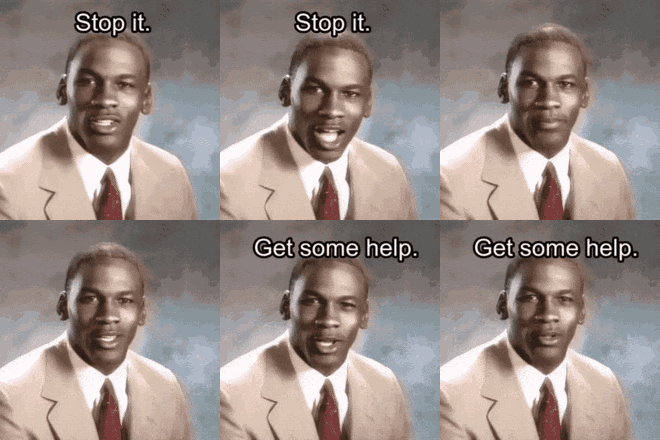
Critique is a necessity for works to improve. Differing opinions are a natural consequence of art being subjective. And being a real fan IS NOT dependent on being silent or ignorant of the flaws in a work, but simply enjoying the work and participating in the fandom regardless.
So enjoy the art you love and critique with good intent! And should you ever find a piece of media taking up a large amount of space in your daily life (say, multiple hours daily), be sure to take a step back and find things you love beyond fandom! After all, it may end up being a skill you could incorporate into your own artwork one day.
