








Lately, I have been thinking about how often teens turn to AI when they feel overwhelmed. At first, it might just be for homework help or brainstorming. But sometimes it becomes more than that.
When school stress piles up or emotions feel messy, it can be tempting to open a chatbot and start typing. That is exactly why this University of Washington project caught my attention.
Teen mental health support matters, but getting help is not always easy. Some teens worry about stigma. Others face long waitlists, high costs, or simply do not know where to start.
Because of that, researchers have started asking a serious question: could AI tools help support teens in healthy ways, especially when they are feeling stressed or emotionally stuck? At the same time, there is another side to that question. If these tools are designed poorly, they could also confuse, overwhelm, or even harm the people using them.
That is what makes this UW research interesting. The project grew out of research on how generative AI and creative tools might support youth emotion regulation. In project materials shared with me, the team explains that clinicians saw some promising potential here.
AI could help teens put feelings into words, reflect more clearly, and practice coping skills in a more personal and creative way. But the clinicians also raised serious concerns, including whether certain AI responses or generated content could become emotionally triggering or reinforce unhealthy thinking.
Now, the researchers are building a creative AI tool for teens’ emotional well-being with input from high school students and clinicians. They are currently looking for teens ages 11 to 18 in the U.S. to participate in a 60-minute Zoom session. Participants will try the creative AI tool and compare it with a trusted self-guided CBT module for emotion regulation.
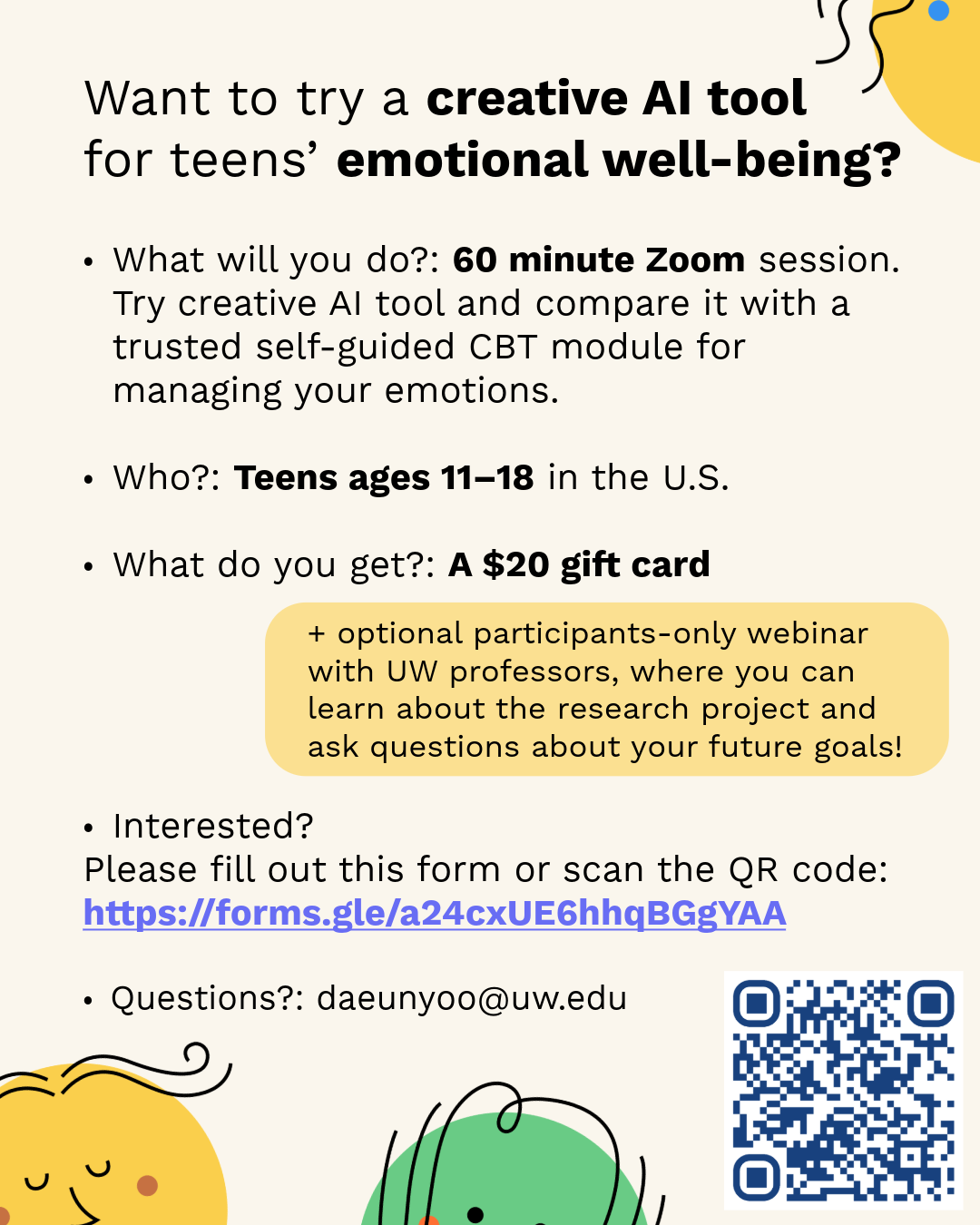
Image Credit: Image courtesy of Daeun Yoo and the University of Washington research team
What I like about this project is that it is not treating teens like passive users who just have to accept whatever technology adults build for them. It is asking for teen input before these tools become more common. That matters. If AI is going to become part of how young people deal with stress, emotions, and mental well-being, then teens should have a voice in shaping what that future looks like.
So if you are between 11 and 18, live in the U.S., and are curious about how AI could be used more thoughtfully for teen emotional well-being, this study is worth checking out. It is a chance to share your perspective, test a new tool, and help researchers think more carefully about what teens actually need.
Along with a $20 gift card, participants will have a chance to learn fun emotion management skills and join an optional participants-only webinar with UW professors where they can learn more about the research project, ask questions about college, majors, and research, and even bring their parents if they want!
The session is just 60 minutes over Zoom. For questions, the contact listed on the recruitment materials is daeunyoo@uw.edu.
- Ready to share your voice? Apply here: [https://forms.gle/a24cxUE6hhqBGgYAA]
- Curious about the science? Read the full CHI paper here: [https://camps.aptaracorp.com/ACM_PMS/PMS/ACM/CHI26/638/566d9a7f-f66d-11f0-957d-16ffd757ba29/OUT/chi26-638.html]
- Learn more about Professors Katie Davis and Jason Yip here: [https://katiedavisresearch.com/] [https://ischool.uw.edu/people/faculty/profile/jcyip]
